a Division of Biological Chemistry and Biologicals , National Institute of Health Sciences , Kanagawa , Japan.
b The Noguchi Institute , Tokyo , Japan.
MAbs. 2019 Jul;11(5):826-836. doi: 10.1080/19420862.2019.1608143. Epub 2019 May 8.
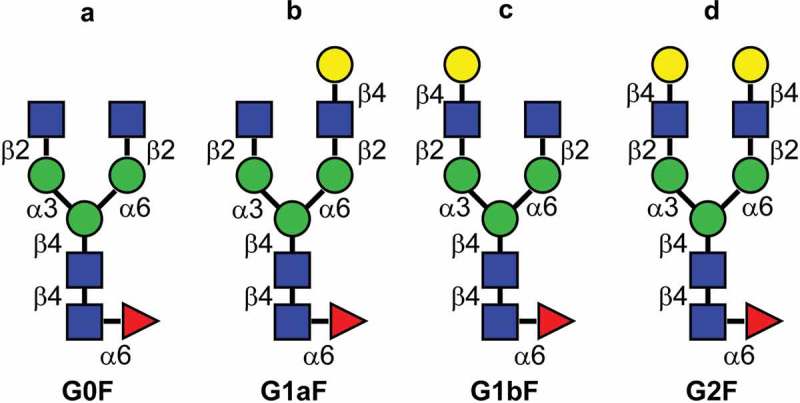
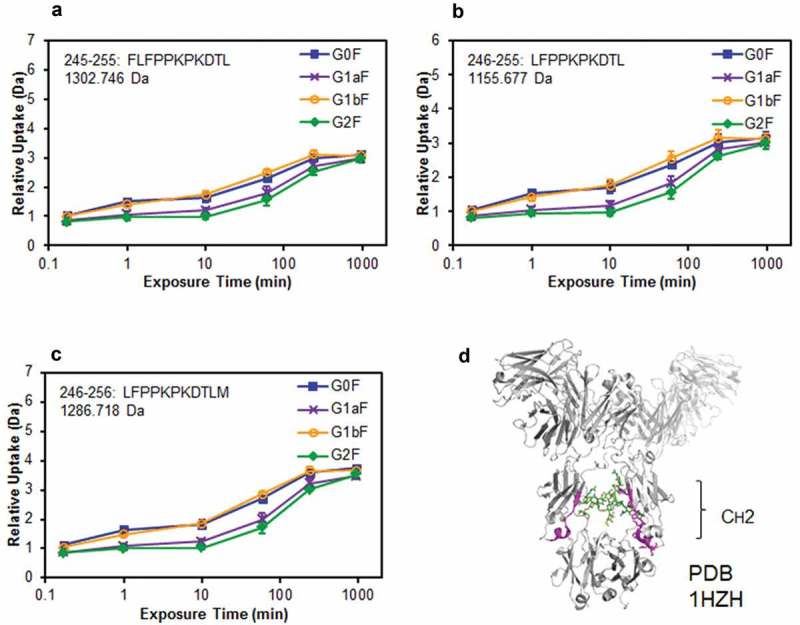
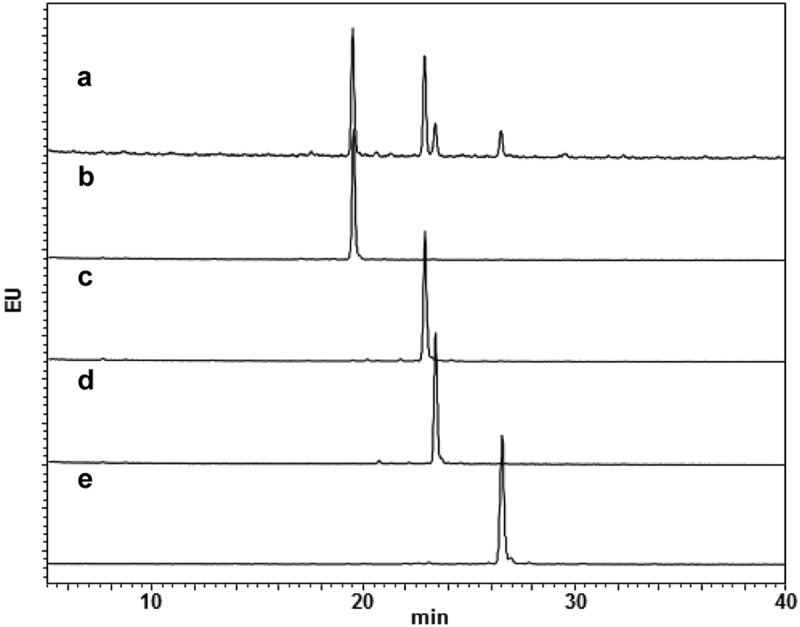
Typical crystallizable fragment (Fc) glycans attached to the CH2 domain in therapeutic monoclonal antibodies (mAbs) are core-fucosylated and asialo-biantennary complex-type glycans, e.g., G2F (full galactosylation), G1aF (terminal galactosylation on the Man α1-6 arm), G1bF (terminal galactosylation on the Man α1-3 arm), and G0F (non-galactosylation). Terminal galactose (Gal) residues of Fc-glycans are known to influence effector functions such as antibody-dependent cell-mediated cytotoxicity and complement-dependent cytotoxicity (CDC), but the impact of the G1F isomers (G1aF and G1bF) on the effector functions has not been reported. Here, we prepared four types of glycoengineered anti-CD20 mAbs bearing homogeneous G2F, G1aF, G1bF, or G0F (G2F mAb, G1aF mAb, G1bF mAb, or G0F mAb, respectively), and evaluated their biological activities. Interestingly, G1aF mAb showed higher C1q- and FcγR-binding activities, CDC activity, and FcγR-activation property than G1bF mAb. The activities of G1aF mAb and G1bF mAb were at the same level as G2F mAb and G0F mAb, respectively. Hydrogen-deuterium exchange/mass spectrometry analysis of dynamic structures of mAbs revealed the greater involvement of the terminal Gal residue on the Man α1-6 arm in the structural stability of the CH2 domain. Considering that mAbs interact with FcγR and C1q via their hinge proximal region in the CH2 domain, the structural stabilization of the CH2 domain by the terminal Gal residue on the Man α1-6 arm of Fc-glycans may be important for the effector functions of mAbs. To our knowledge, this is the first report showing the impact of G1F isomers on the effector functions and dynamic structure of mAbs. ABC, ammonium bicarbonate solution; ACN, acetonitrile; ADCC, antibody-dependent cell-mediated cytotoxicity; C1q, complement component 1q; CDC, complement-dependent cytotoxicity; CQA, critical quality attribute; Endo, endo-β--acetylglucosaminidase; FA, formic acid; Fc, crystallizable fragment; FcγR, Fcγ receptors; Fuc, fucose; Gal, galactose; GlcNAc, -acetylglucosamine; GST, glutathione S-transferase; HER2, human epidermal growth factor receptor 2; HDX, hydrogen-deuterium exchange; HILIC, hydrophilic interaction liquid chromatography; HLB-SPE, hydrophilic-lipophilic balance-solid-phase extraction; HPLC, high-performance liquid chromatography; mAb, monoclonal antibody; Man, mannose; MS, mass spectrometry; PBS, phosphate-buffered saline; SGP, hen egg yolk sialylglycopeptides.
典型的可结晶片段(Fc)糖基化产物附着在治疗性单克隆抗体(mAb)的 CH2 结构域上,是核心岩藻糖基化的和非唾液酸化的双天线复合型糖,例如 G2F(完全半乳糖基化)、G1aF(甘露糖α1-6 臂末端半乳糖基化)、G1bF(甘露糖α1-3 臂末端半乳糖基化)和 G0F(非半乳糖基化)。Fc 糖基化的末端半乳糖(Gal)残基已知会影响效应功能,如抗体依赖的细胞介导的细胞毒性和补体依赖的细胞毒性(CDC),但 G1F 异构体(G1aF 和 G1bF)对效应功能的影响尚未报道。在这里,我们制备了四种类型的糖工程化抗 CD20 mAb,分别带有同质的 G2F、G1aF、G1bF 或 G0F(分别为 G2F mAb、G1aF mAb、G1bF mAb 或 G0F mAb),并评估了它们的生物学活性。有趣的是,G1aF mAb 表现出比 G1bF mAb 更高的 C1q 和 FcγR 结合活性、CDC 活性和 FcγR 激活特性。G1aF mAb 和 G1bF mAb 的活性分别与 G2F mAb 和 G0F mAb 处于同一水平。mAb 动态结构的氘氢交换/质谱分析表明,Fc 糖基化的甘露糖α1-6 臂上的末端 Gal 残基更能参与 CH2 结构域的结构稳定性。考虑到 mAb 通过其 CH2 结构域中的铰链近侧区域与 FcγR 和 C1q 相互作用,Fc 糖基化的甘露糖α1-6 臂上的末端 Gal 残基对 CH2 结构域的结构稳定可能对 mAb 的效应功能很重要。据我们所知,这是第一个报告显示 G1F 异构体对 mAb 的效应功能和动态结构的影响。