Heuberger Roschelle
Department of Human Environmental Studies, Central Michigan University, Mt. Pleasant, MI, USA.
Curr Gerontol Geriatr Res. 2017;2017:9417350. doi: 10.1155/2017/9417350. Epub 2017 May 29.
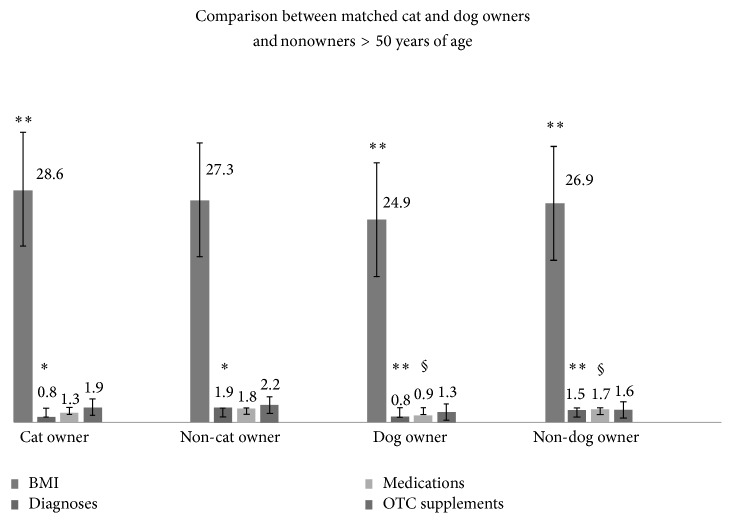
Pet ownership has been shown to improve quality of life for older adults. The objective of this cross-sectional study was to compare older pet owners and older non-pet owners and assess differences between groups. This study was conducted on adults over 50 years of age, who owned either one cat or one dog versus nonowners based on age, race, gender, and education. Matched older pet owners (OPO) versus non-pet owners (NPO) pairs ( = 84), older cat owners (OCO) versus non-cat owners (NCO) ( = 29), and older dog owners (ODO) versus non-dog owners (NDO) pairs ( = 55) were analyzed. No differences were found between OPO and NPO for dietary, activity, or lifestyle, except OPO had fewer health conditions [ < 0.03]. Total OCO had greater body mass indices [BMI] ( = 29.6 ± 8.2) than ODO ( = 23.2 ± 5.2) [ < 0.02], less activity [ < 0.02], and shorter duration of activity [ < 0.05] and took fewer supplements [ < 0.003]. OCO and NCO differed on health conditions ( = 0.8 ± 0.9 versus = 1.9 ± 1.3, [ < 0.008]) and ODO versus NDO differed on BMI ( = 25 ± 4 versus = 27 ± 6, [ < 0.04]). Although there are limitations to this study, data may be useful for targeting marketing and health messages to older persons.
研究表明,养宠物有助于提高老年人的生活质量。本横断面研究的目的是比较老年宠物主人和非宠物主人,并评估两组之间的差异。本研究针对50岁以上的成年人,根据年龄、种族、性别和教育程度,将拥有一只猫或一只狗的人与非宠物主人进行对比。对配对的老年宠物主人(OPO)与非宠物主人(NPO)(n = 84)、老年猫主人(OCO)与非猫主人(NCO)(n = 29)以及老年狗主人(ODO)与非狗主人(NDO)配对(n = 55)进行了分析。在饮食、活动或生活方式方面,OPO和NPO之间未发现差异,但OPO的健康问题较少[P < 0.03]。总体而言,OCO的体重指数[BMI](29.6 ± 8.2)高于ODO(23.2 ± 5.2)[P < 0.02],活动量较少[P < 0.02],活动持续时间较短[P < 0.05],服用的补充剂较少[P < 0.003]。OCO和NCO在健康状况方面存在差异(0.8 ± 0.9对1.9 ± 1.3,[P < 0.008]),ODO和NDO在BMI方面存在差异(25 ± 4对27 ± 6,[P < 0.04])。尽管本研究存在局限性,但这些数据可能有助于针对老年人开展营销和健康宣传。