Maugeri Andrea, Medina-Inojosa Jose R, Kunzova Sarka, Barchitta Martina, Agodi Antonella, Vinciguerra Manlio, Lopez-Jimenez Francisco
International Clinical Research Center, St Anne's University Hospital, Brno, Czech Republic.
Department of Medical and Surgical Sciences and Advanced Technologies "GF Ingrassia," University of Catania, Catania, Italy.
Mayo Clin Proc Innov Qual Outcomes. 2019 Aug 23;3(3):268-275. doi: 10.1016/j.mayocpiqo.2019.07.007. eCollection 2019 Sep.
To investigate the association of pet ownership, and specifically dog ownership, with cardiovascular diseases (CVD) risk factors and cardiovascular health (CVH) in the Kardiovize Brno 2030 study, a randomly selected prospective cohort in Central Europe.
We included 1769 subjects (aged from 25 to 64 years; 44.3% males) with no history of CVD who were recruited from January 1, 2013, to December 19, 2014. We compared sociodemographic characteristics, CVD risk factors, CVH metrics (ie, body mass index, healthy diet, physical activity level, smoking status, blood pressure, fasting glucose, and total cholesterol), and score between pet owners and non-pet owners or dog owners and several other subgroups.
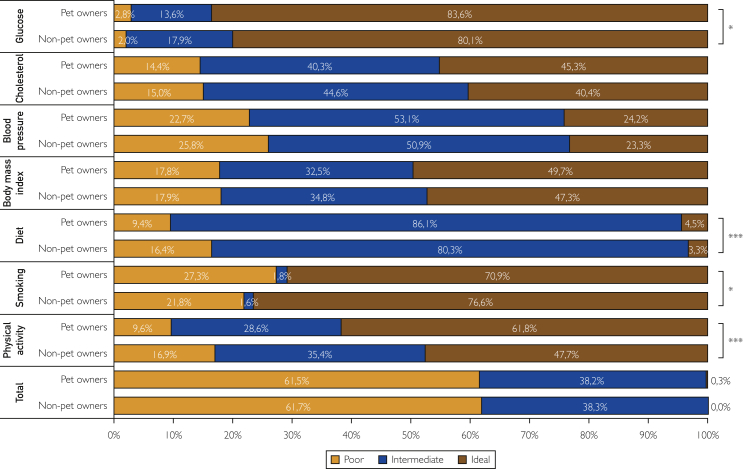
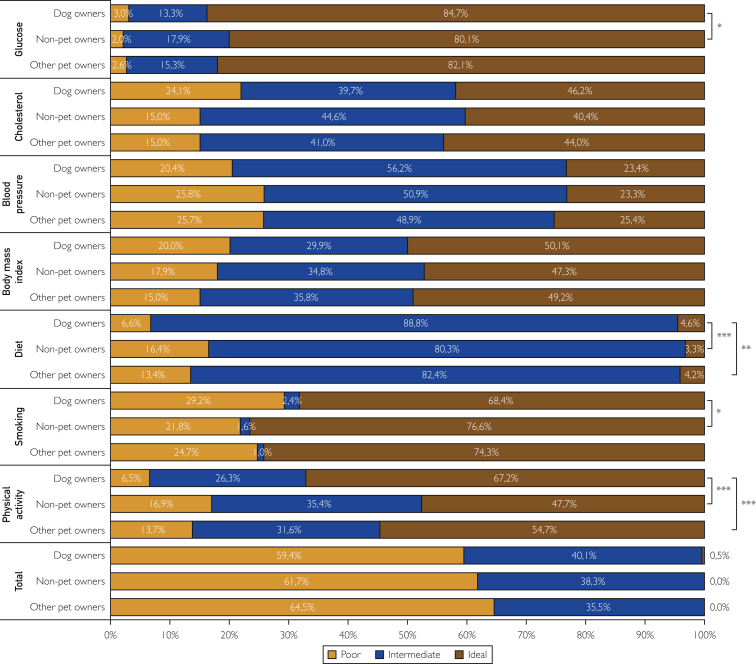
Approximately 42% of subjects owned any type of pet: 24.3% owned a dog and 17.9% owned another animal. Pet owners, and specifically dog owners, were more likely to report physical activity, diet, and blood glucose at ideal level, and smoking at poor level, which resulted in higher CVH score than non-pet owners (median, 10; interquartile range = 3 vs median, 9; interquartile range = 3; =0.006). Compared with owners of other pets, dog owners were more likely to report physical activity and diet at ideal level. The comparison of dog owners with non-dog owners yielded similar results. After adjustment for covariates, dog owners exhibited higher CVH scores than non-pet owners (β=0.342; SE=0.122; =0.005), other pet-owners (β=0.309; SE=0.151; =0.041), and non-dog owners (β=0.341; SE=0.117; =0.004).
Except for smoking, dog owners were more likely to achieve recommended level of behavioral CVH metrics (physical activity and diet) than non-dog owners, which translated into better CVH.
在中欧一项随机选取的前瞻性队列研究——布尔诺心血管研究2030中,调查养宠物尤其是养狗与心血管疾病(CVD)风险因素及心血管健康(CVH)之间的关联。
我们纳入了1769名无心血管疾病病史的受试者(年龄在25至64岁之间;男性占44.3%),这些受试者于2013年1月1日至2014年12月19日被招募。我们比较了宠物主人与非宠物主人或狗主人与其他几个亚组之间的社会人口学特征、心血管疾病风险因素、心血管健康指标(即体重指数、健康饮食、身体活动水平、吸烟状况、血压、空腹血糖和总胆固醇)以及得分情况。
约42%的受试者拥有某种宠物:24.3%的人养狗,17.9%的人养其他动物。宠物主人,尤其是狗主人,更有可能报告身体活动、饮食和血糖处于理想水平,吸烟处于较差水平,这使得他们的心血管健康得分高于非宠物主人(中位数为10;四分位间距 = 3,而非中位数为9;四分位间距 = 3;P = 0.006)。与其他宠物主人相比,狗主人更有可能报告身体活动和饮食处于理想水平。狗主人与非狗主人的比较产生了类似结果。在对协变量进行调整后,狗主人的心血管健康得分高于非宠物主人(β = 0.342;标准误 = 0.122;P = 0.005)、其他宠物主人(β = 0.309;标准误 = 0.151;P = 0.041)和非狗主人(β = 0.341;标准误 = 0.117;P = 0.004)。
除吸烟外,狗主人比非狗主人更有可能达到行为心血管健康指标(身体活动和饮食)的推荐水平,这意味着更好的心血管健康状况。