Fraga-Lamas Paula, Fernández-Caramés Tiago M, Castedo Luis
Department of Computer Engineering, Faculty of Computer Science, Universidade da Coruña,15071 A Coruña, Spain.
Sensors (Basel). 2017 Jun 21;17(6):1457. doi: 10.3390/s17061457.
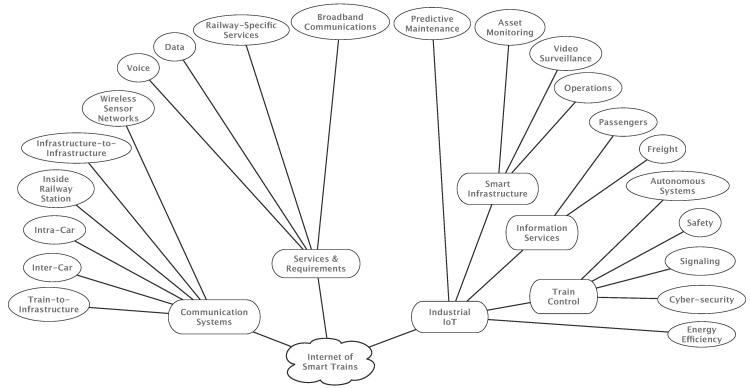
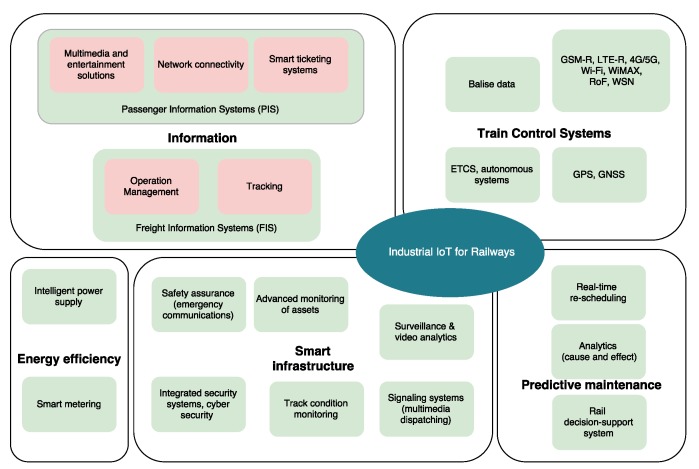
Nowadays, the railway industry is in a position where it is able to exploit the opportunities created by the IIoT (Industrial Internet of Things) and enabling communication technologies under the paradigm of Internet of Trains. This review details the evolution of communication technologies since the deployment of GSM-R, describing the main alternatives and how railway requirements, specifications and recommendations have evolved over time. The advantages of the latest generation of broadband communication systems (e.g., LTE, 5G, IEEE 802.11ad) and the emergence of Wireless Sensor Networks (WSNs) for the railway environment are also explained together with the strategic roadmap to ensure a smooth migration from GSM-R. Furthermore, this survey focuses on providing a holistic approach, identifying scenarios and architectures where railways could leverage better commercial IIoT capabilities. After reviewing the main industrial developments, short and medium-term IIoT-enabled services for smart railways are evaluated. Then, it is analyzed the latest research on predictive maintenance, smart infrastructure, advanced monitoring of assets, video surveillance systems, railway operations, Passenger and Freight Information Systems (PIS/FIS), train control systems, safety assurance, signaling systems, cyber security and energy efficiency. Overall, it can be stated that the aim of this article is to provide a detailed examination of the state-of-the-art of different technologies and services that will revolutionize the railway industry and will allow for confronting today challenges.
如今,铁路行业正处于能够利用工业物联网(IIoT)创造的机遇以及在列车物联网范式下实现通信技术的阶段。本综述详细介绍了自GSM-R部署以来通信技术的发展历程,描述了主要的替代方案以及铁路需求、规范和建议是如何随时间演变的。还解释了最新一代宽带通信系统(如LTE、5G、IEEE 802.11ad)的优势以及铁路环境中无线传感器网络(WSN)的出现,并阐述了确保从GSM-R顺利迁移的战略路线图。此外,本次调查侧重于提供一种整体方法,确定铁路可以利用更好的商业物联网功能的场景和架构。在回顾了主要的行业发展情况后,对智能铁路的短期和中期物联网支持服务进行了评估。然后,分析了预测性维护、智能基础设施、资产的高级监测、视频监控系统、铁路运营、客运和货运信息系统(PIS/FIS)、列车控制系统、安全保障、信号系统、网络安全和能源效率方面的最新研究。总体而言,可以说本文的目的是对不同技术和服务的最新状态进行详细审视,这些技术和服务将彻底改变铁路行业,并有助于应对当今的挑战。