Okely Anthony D, Lubans David R, Morgan Philip J, Cotton Wayne, Peralta Louisa, Miller Judith, Batterham Marijka, Janssen Xanne
Early Start Research Institute and School of Education, University of Wollongong, Wollongong, NSW, 2522, Australia.
llawarra Health and Medical Research Institute, Wollongong, NSW, 2522, Australia.
Int J Behav Nutr Phys Act. 2017 Jun 21;14(1):81. doi: 10.1186/s12966-017-0535-6.
Slowing the decline in participation in physical activity among adolescent girls is a public health priority. This study reports the outcomes from a multi-component school-based intervention (Girls in Sport), focused on promoting physical activity among adolescent girls.
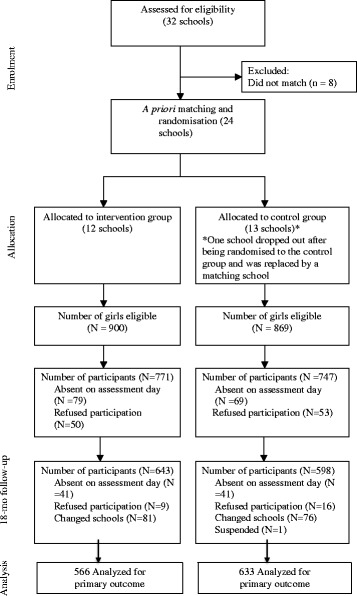
Group randomized controlled trial in 24 secondary schools (12 intervention and 12 control). Assessments were conducted at baseline (2009) and at 18 months post-baseline (2010). The setting was secondary schools in urban, regional and rural areas of New South Wales, Australia. All girls in Grade 8 in 2009 who attended these schools were invited to participate in the study (N = 1769). Using a Health Promoting Schools and Action Learning Frameworks, each school formed a committee and developed an action plan for promoting physical activity among Grade 8 girls. The action plan incorporated strategies in three main areas - i) the formal curriculum, ii) school environment, and iii) home/school/community links - based on the results of formative data from target girls and staff and on individual needs of the school. A member of the research team supported each school throughout the intervention. The main outcome measure was accelerometer-derived total physical activity (TPA) spent in physical activity. Data were analyzed from December 2011 to March 2012.
1518 girls (mean age 13.6y ±0.02) were assessed at baseline. There was a significant decline in TPA from baseline to 18-month follow-up with no differences between girls in the intervention and control schools. Only one-third of schools (4/12) implemented the intervention as per their action plan. Per-protocol analyses on these schools revealed a smaller decline in percentage of time spent in MVPA among girls in the intervention group (adjusted difference 0.5%, 95% CI = -0.01, 0.99, P = 0.05).
The Girls in Sport intervention was not effective in reducing the decline in physical activity among adolescent girls. Lack of implementation by most intervention schools was the main reason for a null effect. Identifying strategies to enhance implementation levels is critical to determining the true potential of this intervention approach.
This study was retrospectively registered with the Australian New Zealand Clinical Trials Registry ACTRN12610001077055 . Date of registration: 7 December 2010.
减缓青春期女孩体育活动参与度的下降是一项公共卫生重点工作。本研究报告了一项多成分的校本干预措施(“运动女孩”项目)的结果,该措施旨在促进青春期女孩的体育活动。
在24所中学(12所干预学校和12所对照学校)开展群组随机对照试验。在基线期(2009年)和基线期后18个月(2010年)进行评估。研究地点为澳大利亚新南威尔士州城市、地区和农村的中学。邀请了2009年在这些学校就读的所有八年级女生参与研究(N = 1769)。利用健康促进学校和行动学习框架,每所学校成立了一个委员会,并制定了一项促进八年级女生体育活动的行动计划。该行动计划根据目标女生和教职员工的形成性数据结果以及学校的个体需求,纳入了三个主要领域的策略——i)正规课程,ii)学校环境,以及iii)家庭/学校/社区联系。在整个干预过程中,研究团队的一名成员为每所学校提供支持。主要结局指标是通过加速度计得出的体育活动总运动量(TPA)。数据于2011年12月至2012年3月进行分析。
1518名女生(平均年龄13.6岁±0.02)在基线期接受了评估。从基线期到18个月随访期,TPA显著下降,干预学校和对照学校的女生之间没有差异。只有三分之一的学校(4/12)按照其行动计划实施了干预。对这些学校进行的符合方案分析显示,干预组女生中度至剧烈体育活动(MVPA)时间百分比的下降幅度较小(调整差异0.5%,95%CI = -0.01,0.99,P = 0.05)。
“运动女孩”干预措施在减少青春期女孩体育活动下降方面无效。大多数干预学校缺乏实施是产生无效结果的主要原因。确定提高实施水平的策略对于确定这种干预方法的真正潜力至关重要。
本研究已在澳大利亚新西兰临床试验注册中心进行回顾性注册,注册号为ACTRN12610001077055。注册日期:2010年12月7日。