McCormick Natalie, Reimer Kathryn, Famouri Ali, Marra Carlo A, Aviña-Zubieta J Antonio
Faculty of Pharmaceutical Sciences, The University of British Columbia, Vancouver, Canada.
Arthritis Research Canada, Richmond, Canada.
BMJ Open. 2017 Jun 21;7(6):e013977. doi: 10.1136/bmjopen-2016-013977.
Systemic autoimmune rheumatic diseases (SARDs) are a group of debilitating autoimmune diseases, including systemic lupus erythematosus and related disorders. Assessing the healthcare and economic burden of SARDs has been challenging: while administrative databases can be used to determine healthcare utilisation and costs with minimal selection and recall bias, other health, sociodemographic and economic data have typically been sourced from highly selected, clinic-based cohorts. To address these gaps, we are collecting self-reported survey data from a general population-based cohort of individuals with and without SARDs and linking it to their longitudinal administrative health data.
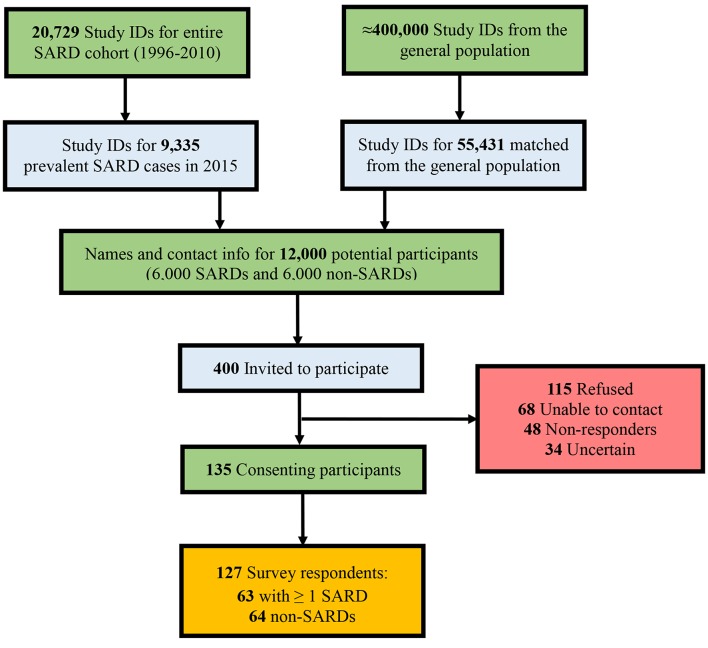
Using administrative data from the province of British Columbia (BC), Canada, we established a population-based cohort of all BC adults receiving care for SARDs during 1996-2010 (n=20 729) and non-SARD individuals randomly selected from the general population. BC Ministry of Health granted us contact information for 12 000 SARD and non-SARD individuals, who were recruited to complete the surveys by mail or online.
Four hundred individuals were initially invited to participate, with 135 (34%) consenting and 127 (94%) submitting the first survey (72% completed online). Sixty-three (49.6%) reported ≥1 SARD diagnosis. The non-SARDs group (n=64) was 92% female with mean age 57.0±11.6 years. The SARDs group (n=63) was 94% female with mean age 56.5±13.1 years. Forty-eight per cent of those with SARDs were current-or-former smokers (mean 10.6±16.2 pack-years), and 33% were overweight or obese (mean body mass index of 24.4±5.3).
Health and productivity data collected from the surveys will be linked to participants' administrative health data from the years 1990-2013, allowing us to determine the healthcare and lost productivity costs of SARDs, and assess the impact of patient-reported variables on utilisation, costs, disability and clinical outcomes. Findings will be disseminated through scientific conferences and peer-reviewed journals.
系统性自身免疫性风湿病(SARDs)是一组使人衰弱的自身免疫性疾病,包括系统性红斑狼疮及相关病症。评估SARDs的医疗保健和经济负担一直具有挑战性:虽然行政数据库可用于确定医疗保健利用率和成本,且选择和回忆偏倚最小,但其他健康、社会人口统计学和经济数据通常来自高度选择的基于诊所的队列。为填补这些空白,我们正在从一个基于普通人群的队列中收集自我报告的调查数据,该队列中有或没有SARDs的个体,并将其与他们的纵向行政健康数据相链接。
利用加拿大不列颠哥伦比亚省(BC)的行政数据,我们建立了一个基于人群的队列,其中包括1996 - 2010年期间接受SARDs治疗的所有BC省成年人(n = 20729)以及从普通人群中随机选取的非SARD个体。BC省卫生部向我们提供了12000名SARD和非SARD个体的联系信息,这些个体通过邮件或在线方式被招募来完成调查。
最初邀请了400人参与,其中135人(34%)同意参与,127人(94%)提交了第一次调查(72%通过在线完成)。63人(49.6%)报告有≥1次SARD诊断。非SARDs组(n = 64)中女性占92%,平均年龄57.0±11.6岁。SARDs组(n = 63)中女性占94%,平均年龄56.5±13.1岁。患有SARDs的人中有48%是当前或曾经的吸烟者(平均10.6±16.2包年),33%超重或肥胖(平均体重指数为24.4±5.3)。
从调查中收集的健康和生产力数据将与参与者1990 - 2013年的行政健康数据相链接,使我们能够确定SARDs的医疗保健和生产力损失成本,并评估患者报告变量对利用率、成本、残疾和临床结果的影响。研究结果将通过科学会议和同行评审期刊进行传播。