Papoutsi Chrysanthi, Hargreaves Dougal, Colligan Grainne, Hagell Ann, Patel Anita, Campbell-Richards Desirée, Viner Russell M, Vijayaraghavan Shanti, Marshall Martin, Greenhalgh Trisha, Finer Sarah
Nuffield Department of Primary Care Health Sciences, University of Oxford, Oxford, UK.
UCL Great Ormond St. Institute of Child Health, University College London, London, UK.
BMJ Open. 2017 Jun 21;7(6):e017363. doi: 10.1136/bmjopen-2017-017363.
Young adults with diabetes often report dissatisfaction with care and have poor diabetes-related health outcomes. As diabetes prevalence continues to rise, group-based care could provide a sustainable alternative to traditional one-to-one consultations, by engaging young people through life stage-, context- and culturally-sensitive approaches. In this study, we will co-design and evaluate a group-based care model for young adults with diabetes and complex health and social needs in socioeconomically deprived areas.
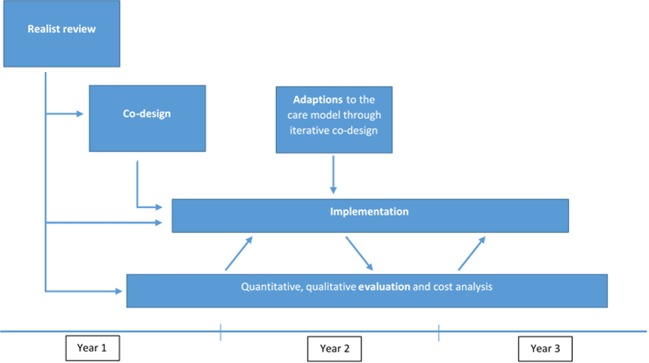
This participatory study will include three phases. In phase 1, we will carry out a realist review to synthesise the literature on group-based care for young adults with diabetes. This theory-driven understanding will provide the basis for phase 2, where we will draw on experience-based co-design methodologies to develop a new, group-based care model for young adults (aged <25 years, under the care of adult diabetes services). In phase 3, we will use a researcher-in-residence approach to implement and evaluate the co-designed group clinic model and compare with traditional care. We will employ qualitative (observations in clinics, patient and staff interviews and document analysis) and quantitative methods (eg, biological markers, patient enablement instrument and diabetes distress scale), including a cost analysis.
National Health Service ethics approval has been granted (reference 17/NI/0019). The project will directly inform service redesign to better meet the needs of young adults with diabetes in socioeconomically deprived areas and may guide a possible cluster-randomised trial, powered to clinical and cost-effectiveness outcomes. Findings from this study may be transferable to other long-term conditions and/or age groups. Project outputs will include briefing statements, summaries and academic papers, tailored for different audiences, including people living with diabetes, clinicians, policy makers and strategic decision makers.
PROSPERO (CRD42017058726).
患有糖尿病的年轻人经常表示对护理不满意,且糖尿病相关的健康状况较差。随着糖尿病患病率持续上升,基于群体的护理可以通过针对生活阶段、背景和文化敏感的方法吸引年轻人,为传统的一对一咨询提供可持续的替代方案。在本研究中,我们将共同设计并评估一种针对社会经济贫困地区患有糖尿病且有复杂健康和社会需求的年轻人的基于群体的护理模式。
这项参与性研究将包括三个阶段。在第一阶段,我们将进行一项现实主义综述,以综合关于为患有糖尿病的年轻人提供基于群体护理的文献。这种理论驱动的理解将为第二阶段提供基础,在该阶段我们将利用基于经验的共同设计方法,为年轻人(年龄<25岁,在成人糖尿病服务机构的护理下)开发一种新的基于群体的护理模式。在第三阶段,我们将采用驻院研究员方法来实施和评估共同设计的群体诊所模式,并与传统护理进行比较。我们将采用定性方法(诊所观察、患者和工作人员访谈以及文件分析)和定量方法(例如生物标志物、患者赋能工具和糖尿病困扰量表),包括成本分析。
已获得英国国民医疗服务体系(NHS)的伦理批准(参考号17/NI/0019)。该项目将直接为服务重新设计提供信息,以更好地满足社会经济贫困地区患有糖尿病的年轻人的需求,并可能指导一项可能的整群随机试验,该试验以临床和成本效益结果为动力。本研究的结果可能适用于其他长期病症和/或年龄组。项目产出将包括为不同受众量身定制的简报声明、摘要和学术论文,这些受众包括糖尿病患者、临床医生、政策制定者和战略决策者。
PROSPERO(CRD42017058726)。