Peña-Altamira Emiliano, Petralla Sabrina, Massenzio Francesca, Virgili Marco, Bolognesi Maria L, Monti Barbara
Department of Pharmacy and Biotechnology, University of BolognaBologna, Italy.
Front Aging Neurosci. 2017 Jun 7;9:175. doi: 10.3389/fnagi.2017.00175. eCollection 2017.
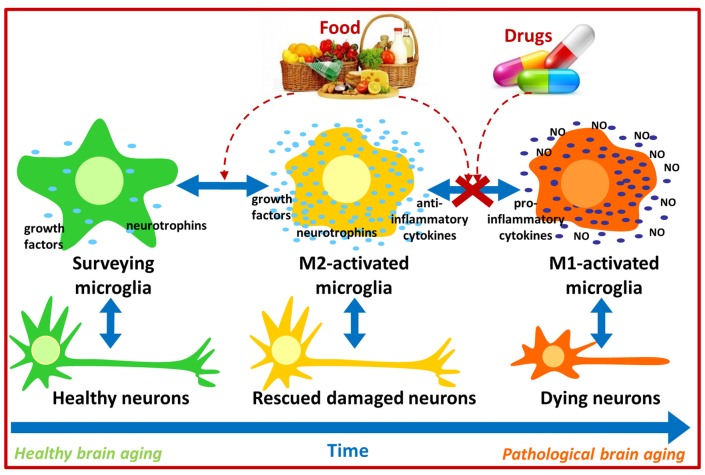
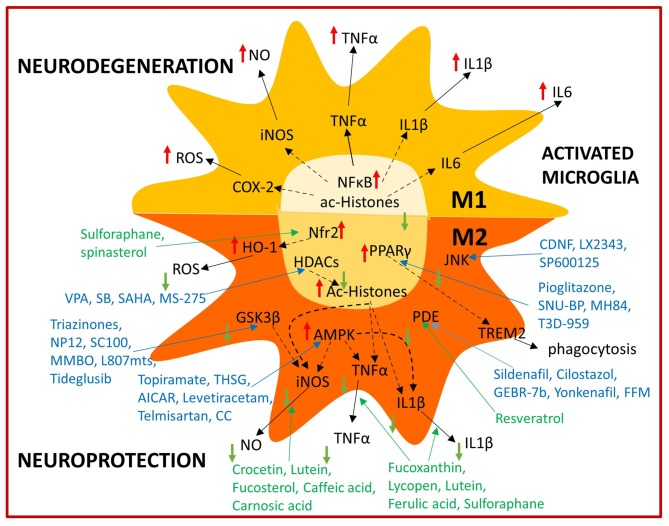
The study of microglia, the immune cells of the brain, has experienced a renaissance after the discovery of microglia polarization. In fact, the concept that activated microglia can shift into the M1 pro-inflammatory or M2 neuroprotective phenotypes, depending on brain microenvironment, has completely changed the understanding of microglia in brain aging and neurodegenerative diseases. Microglia polarization is particularly important in aging since an increased inflammatory status of body compartments, including the brain, has been reported in elderly people. In addition, inflammatory markers, mainly derived from activated microglia, are widely present in neurodegenerative diseases. Microglial inflammatory dysfunction, also linked to microglial senescence, has been extensively demonstrated and associated with cognitive impairment in neuropathological conditions related to aging. In fact, microglia polarization is known to influence cognitive function and has therefore become a main player in neurodegenerative diseases leading to dementia. As the life span of human beings increases, so does the prevalence of cognitive dysfunction. Thus, therapeutic strategies aimed to modify microglia polarization are currently being developed. Pharmacological approaches able to shift microglia from M1 pro-inflammatory to M2 neuroprotective phenotype are actually being studied, by acting on many different molecular targets, such as glycogen synthase kinase-3 (GSK3) β, AMP-activated protein kinase (AMPK), histone deacetylases (HDACs), etc. Furthermore, nutritional approaches can also modify microglia polarization and, consequently, impact cognitive function. Several bioactive compounds normally present in foods, such as polyphenols, can have anti-inflammatory effects on microglia. Both pharmacological and nutritional approaches seem to be promising, but still need further development. Here we review recent data on these approaches and propose that their combination could have a synergistic effect to counteract cognitive aging impairment and Alzheimer's disease (AD) through immunomodulation of microglia polarization, i.e., by driving the shift of activated microglia from the pro-inflammatory M1 to the neuroprotective M2 phenotype.
在小胶质细胞极化被发现后,对作为大脑免疫细胞的小胶质细胞的研究迎来了复兴。事实上,激活的小胶质细胞可根据脑微环境转变为M1促炎表型或M2神经保护表型这一概念,彻底改变了人们对小胶质细胞在脑衰老和神经退行性疾病中的理解。小胶质细胞极化在衰老过程中尤为重要,因为据报道老年人身体各部位(包括大脑)的炎症状态会增加。此外,主要源自激活的小胶质细胞的炎症标志物广泛存在于神经退行性疾病中。小胶质细胞炎症功能障碍也与小胶质细胞衰老有关,已被广泛证实,并与衰老相关神经病理状况下的认知障碍有关。事实上,已知小胶质细胞极化会影响认知功能,因此已成为导致痴呆的神经退行性疾病的主要因素。随着人类寿命延长,认知功能障碍的患病率也在增加。因此目前正在开发旨在改变小胶质细胞极化的治疗策略。实际上正在研究通过作用于许多不同分子靶点(如糖原合酶激酶-3 (GSK3)β、AMP活化蛋白激酶(AMPK)、组蛋白脱乙酰酶(HDACs)等),使小胶质细胞从M1促炎表型转变为M2神经保护表型的药理学方法。此外,营养方法也可改变小胶质细胞极化,从而影响认知功能。食物中通常存在的几种生物活性化合物,如多酚,可对小胶质细胞产生抗炎作用。药理学和营养方法似乎都很有前景,但仍需要进一步发展。在此,我们综述了有关这些方法的最新数据,并提出它们的联合应用可能具有协同效应,通过对小胶质细胞极化进行免疫调节来对抗认知衰老障碍和阿尔茨海默病(AD),即促使激活的小胶质细胞从促炎M1表型转变为神经保护M2表型。