Norman Jonna, Fu Michael, Ekman Inger, Björck Lena, Falk Kristin
1 Institute of Health and Care Sciences, Sahlgrenska Academy, University of Gothenburg, Gothenburg, Sweden.
2 The Gothenburg University Centre for Person-Centred Care (GPCC), Sahlgrenska Academy, Gothenburg, Sweden.
Eur J Cardiovasc Nurs. 2018 Jan;17(1):54-65. doi: 10.1177/1474515117715843. Epub 2017 Jun 22.
Despite treatment recommended by guidelines, many patients with chronic heart failure remain symptomatic. Evidence is accumulating that mindfulness-based interventions (MBIs) have beneficial psychological and physiological effects. The aim of this study was to explore the feasibility of MBI on symptoms and signs in patients with chronic heart failure in outpatient clinical settings.
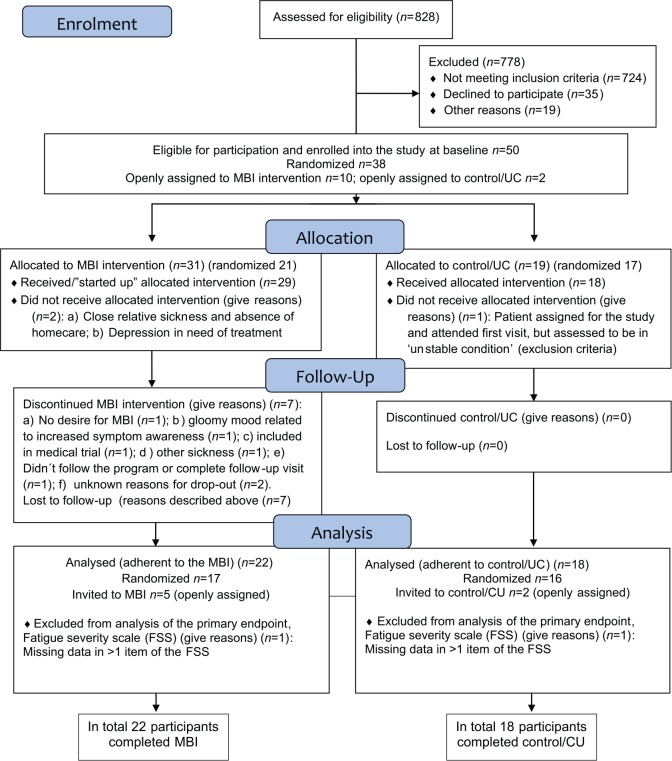
A prospective feasibility study. Fifty stable but symptomatic patients with chronic heart failure, despite optimized guideline-recommended treatment, were enrolled at baseline. In total, 40 participants (median age 76 years; New York Heart Association (NYHA) classification II-III) adhered to the study. Most patients ( n=17) were randomized into MBI, a structured eight-week mindfulness-based educational and training programme, or controls with usual care ( n=16). Primary outcome was self-reported fatigue on the Fatigue severity scale. Secondary outcomes were self-reported sleep quality, unsteadiness/dizziness, NYHA functional classification, walking distance in the six-minute walk test, and heart and respiratory rates. The Mann-Whitney U test was used to analyse median sum changes from baseline to follow-up (week 10±1).
Compared with usual care (zero change), MBI significantly reduced the self-reported impact of fatigue (effect size -8.0; p=0.0165), symptoms of unsteadiness/dizziness ( p=0.0390) and breathlessness/tiredness related to physical functioning (NYHA class) ( p=0.0087). No adverse effects were found.
In stable but symptomatic outpatients with chronic heart failure, MBI alleviated self-reported symptoms in addition to conventional treatment. The sample size is small and further studies are needed, but findings support the role of MBI as a feasible complementary option, both clinically and as home-based treatment, which might contribute to reduction of the symptom burden in patients diagnosed with chronic heart failure.
尽管有指南推荐的治疗方法,但许多慢性心力衰竭患者仍有症状。越来越多的证据表明,基于正念的干预措施(MBIs)具有有益的心理和生理作用。本研究的目的是探讨在门诊临床环境中,MBI对慢性心力衰竭患者症状和体征的可行性。
一项前瞻性可行性研究。50名稳定但有症状的慢性心力衰竭患者,尽管接受了优化的指南推荐治疗,在基线时被纳入研究。共有40名参与者(中位年龄76岁;纽约心脏协会(NYHA)分级为II-III级)坚持完成了研究。大多数患者(n = 17)被随机分为MBI组,即一个为期八周的基于正念的结构化教育和培训项目,或常规护理对照组(n = 16)。主要结局是疲劳严重程度量表上的自我报告疲劳。次要结局包括自我报告的睡眠质量、不稳/头晕、NYHA功能分级、六分钟步行试验中的步行距离以及心率和呼吸率。采用曼-惠特尼U检验分析从基线到随访(第10±1周)的中位数总和变化。
与常规护理(无变化)相比,MBI显著降低了自我报告的疲劳影响(效应量-8.0;p = 0.0165)、不稳/头晕症状(p = 0.0390)以及与身体功能相关的呼吸急促/疲劳(NYHA分级)(p = 0.0087)。未发现不良反应。
在稳定但有症状的慢性心力衰竭门诊患者中,MBI除了传统治疗外还减轻了自我报告的症状。样本量较小,需要进一步研究,但研究结果支持MBI作为一种可行的补充选择,无论是在临床还是作为居家治疗,这可能有助于减轻慢性心力衰竭患者的症状负担。