Jia Dongya, Jolly Mohit Kumar, Kulkarni Prakash, Levine Herbert
Center for Theoretical Biological Physics, Rice University, Houston, TX 77005, USA.
Graduate Program in Systems, Synthetic and Physical Biology, Rice University, Houston, TX 77005, USA.
Cancers (Basel). 2017 Jun 22;9(7):70. doi: 10.3390/cancers9070070.
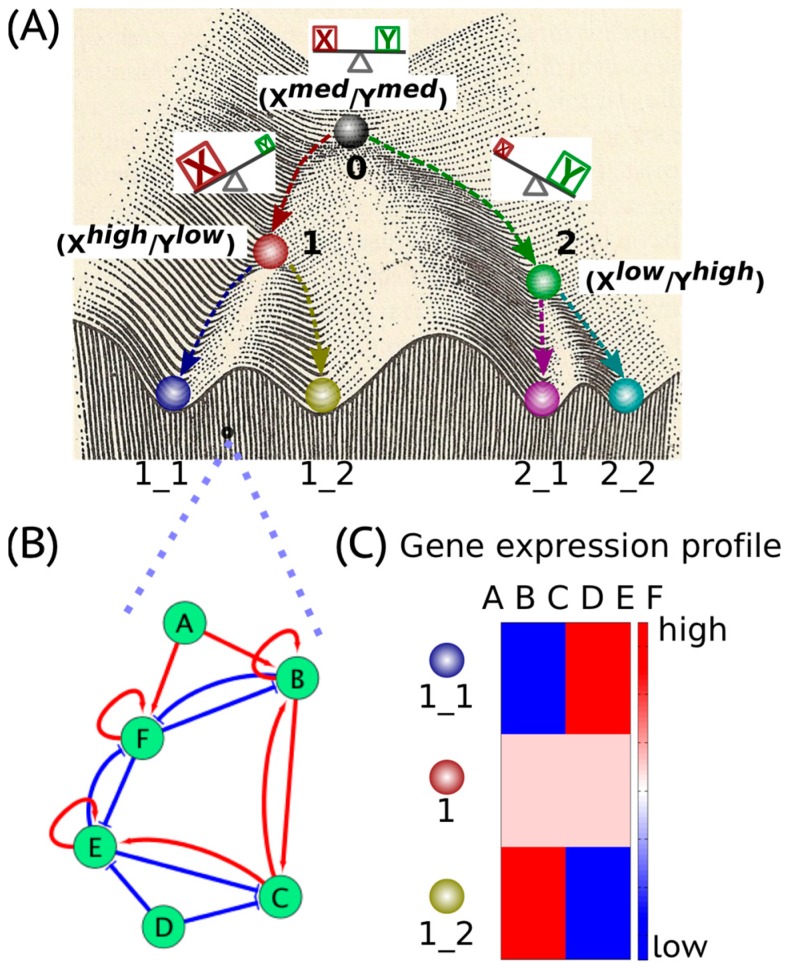
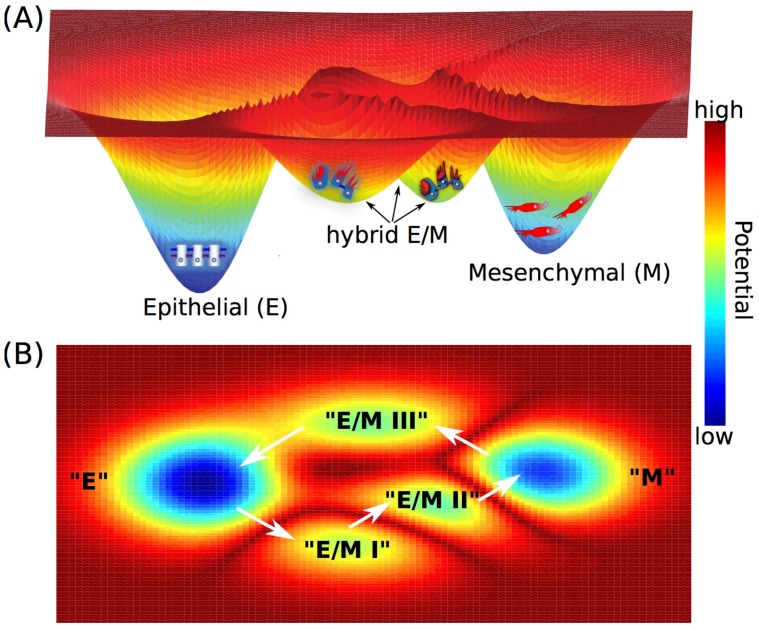
Waddington's epigenetic landscape, a famous metaphor in developmental biology, depicts how a stem cell progresses from an undifferentiated phenotype to a differentiated one. The concept of "landscape" in the context of dynamical systems theory represents a high-dimensional space, in which each cell phenotype is considered as an "attractor" that is determined by interactions between multiple molecular players, and is buffered against environmental fluctuations. In addition, biological noise is thought to play an important role during these cell-fate decisions and in fact controls transitions between different phenotypes. Here, we discuss the phenotypic transitions in cancer from a dynamical systems perspective and invoke the concept of "cancer attractors"-hidden stable states of the underlying regulatory network that are not occupied by normal cells. Phenotypic transitions in cancer occur at varying levels depending on the context. Using epithelial-to-mesenchymal transition (EMT), cancer stem-like properties, metabolic reprogramming and the emergence of therapy resistance as examples, we illustrate how phenotypic plasticity in cancer cells enables them to acquire hybrid phenotypes (such as hybrid epithelial/mesenchymal and hybrid metabolic phenotypes) that tend to be more aggressive and notoriously resilient to therapies such as chemotherapy and androgen-deprivation therapy. Furthermore, we highlight multiple factors that may give rise to phenotypic plasticity in cancer cells, such as (a) multi-stability or oscillatory behaviors governed by underlying regulatory networks involved in cell-fate decisions in cancer cells, and (b) network rewiring due to conformational dynamics of intrinsically disordered proteins (IDPs) that are highly enriched in cancer cells. We conclude by discussing why a therapeutic approach that promotes "recanalization", i.e., the exit from "cancer attractors" and re-entry into "normal attractors", is more likely to succeed rather than a conventional approach that targets individual molecules/pathways.
沃丁顿的表观遗传景观是发育生物学中一个著名的隐喻,它描绘了干细胞如何从未分化表型发展为分化表型。在动力系统理论背景下,“景观”概念代表一个高维空间,其中每个细胞表型被视为一个“吸引子”,由多个分子参与者之间的相互作用决定,并能抵御环境波动。此外,生物噪声被认为在这些细胞命运决定过程中起重要作用,实际上控制着不同表型之间的转变。在这里,我们从动力系统角度讨论癌症中的表型转变,并引入“癌症吸引子”的概念——即潜在调控网络的隐藏稳定状态,正常细胞不会占据这些状态。癌症中的表型转变根据具体情况发生在不同水平。以上皮-间质转化(EMT)、癌症干细胞样特性、代谢重编程和治疗抗性的出现为例,我们说明了癌细胞中的表型可塑性如何使它们获得混合表型(如上皮/间质混合表型和代谢混合表型),这些表型往往更具侵袭性,并且对化疗和雄激素剥夺疗法等治疗具有 notoriously 的抗性。此外,我们强调了可能导致癌细胞表型可塑性的多个因素,例如(a)由癌细胞命运决定中涉及的潜在调控网络控制的多稳定性或振荡行为,以及(b)由于癌细胞中高度富集的内在无序蛋白(IDP)的构象动力学导致的网络重连。我们通过讨论为什么促进“再通”的治疗方法,即从“癌症吸引子”退出并重新进入“正常吸引子”,比针对单个分子/途径的传统方法更有可能成功来结束本文。