Kim Dae-Soo, Ryu Jea-Woon, Son Mi-Young, Oh Jung-Hwa, Chung Kyung-Sook, Lee Sugi, Lee Jeong-Ju, Ahn Jun-Ho, Min Ju-Sik, Ahn Jiwon, Kang Hyun Mi, Kim Janghwan, Jung Cho-Rok, Kim Nam-Soon, Cho Hyun-Soo
Genome Research Center, Korea Research Institute of Bioscience and Biotechnology, Daejeon, Republic of Korea.
Department of Functional Genomics, Korea University of Science and Technology, Daejeon, Republic of Korea.
Hepatology. 2017 Nov;66(5):1662-1674. doi: 10.1002/hep.29324. Epub 2017 Oct 3.
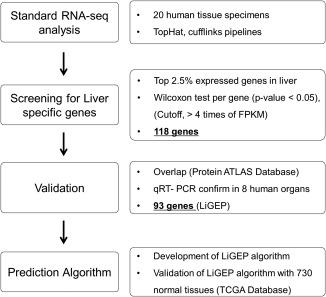
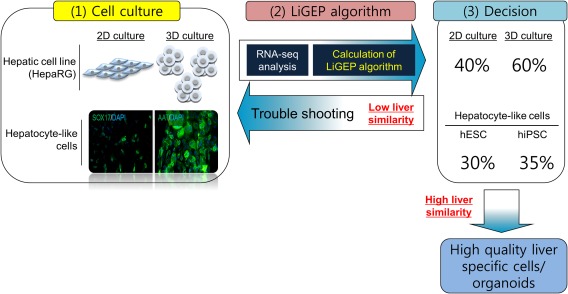
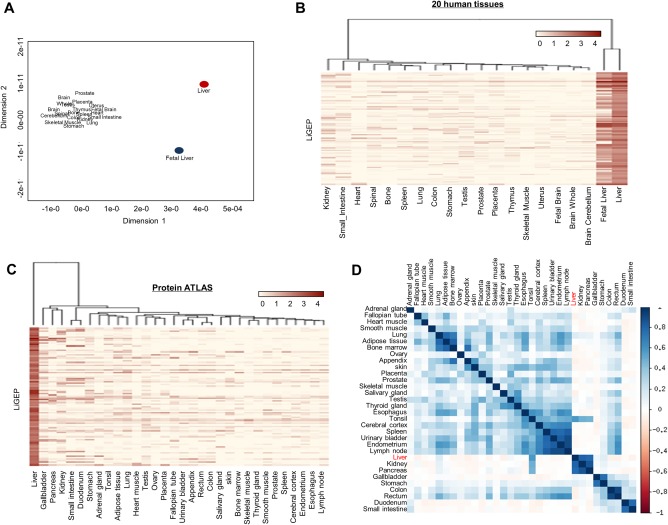
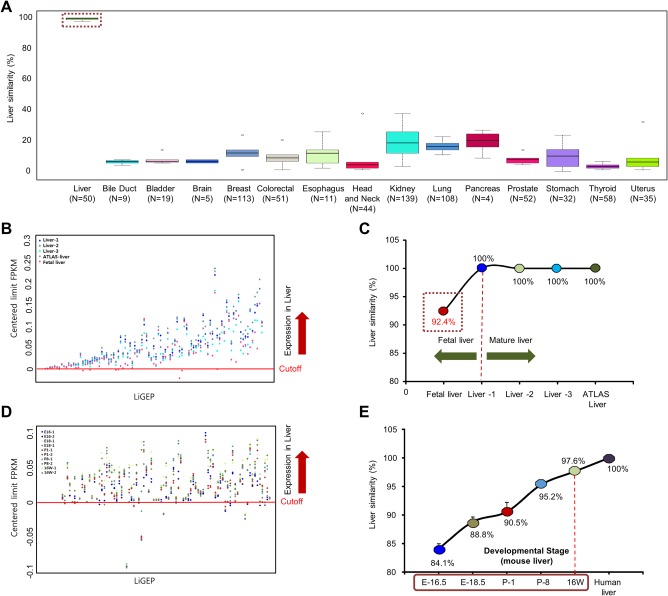
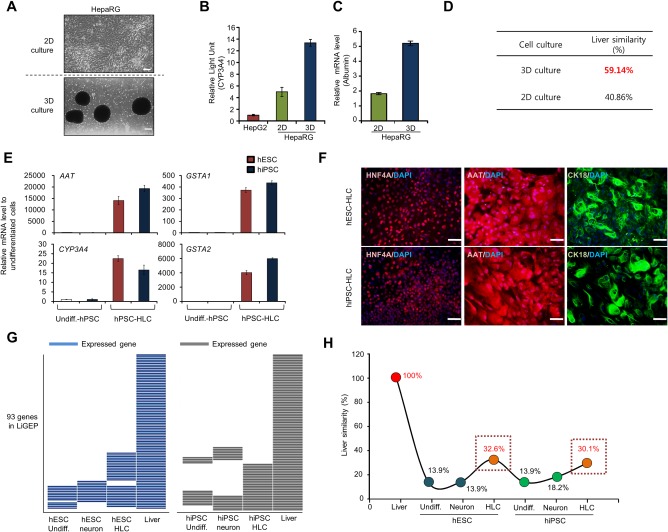
Alternative cell sources, such as three-dimensional organoids and induced pluripotent stem cell-derived cells, might provide a potentially effective approach for both drug development applications and clinical transplantation. For example, the development of cell sources for liver cell-based therapy has been increasingly needed, and liver transplantation is performed for the treatment for patients with severe end-stage liver disease. Differentiated liver cells and three-dimensional organoids are expected to provide new cell sources for tissue models and revolutionary clinical therapies. However, conventional experimental methods confirming the expression levels of liver-specific lineage markers cannot provide complete information regarding the differentiation status or degree of similarity between liver and differentiated cell sources. Therefore, in this study, to overcome several issues associated with the assessment of differentiated liver cells and organoids, we developed a liver-specific gene expression panel (LiGEP) algorithm that presents the degree of liver similarity as a "percentage." We demonstrated that the percentage calculated using the LiGEP algorithm was correlated with the developmental stages of in vivo liver tissues in mice, suggesting that LiGEP can correctly predict developmental stages. Moreover, three-dimensional cultured HepaRG cells and human pluripotent stem cell-derived hepatocyte-like cells showed liver similarity scores of 59.14% and 32%, respectively, although general liver-specific markers were detected.
Our study describes a quantitative and predictive model for differentiated samples, particularly liver-specific cells or organoids; and this model can be further expanded to various tissue-specific organoids; our LiGEP can provide useful information and insights regarding the differentiation status of in vitro liver models. (Hepatology 2017;66:1662-1674).
替代细胞来源,如三维类器官和诱导多能干细胞衍生细胞,可能为药物开发应用和临床移植提供一种潜在有效的方法。例如,基于肝细胞的治疗的细胞来源开发需求日益增加,肝移植用于治疗严重终末期肝病患者。分化的肝细胞和三维类器官有望为组织模型和革命性的临床治疗提供新的细胞来源。然而,传统的确认肝脏特异性谱系标志物表达水平的实验方法无法提供关于分化状态或肝脏与分化细胞来源之间相似程度的完整信息。因此,在本研究中,为了克服与分化肝细胞和类器官评估相关的几个问题,我们开发了一种肝脏特异性基因表达面板(LiGEP)算法,该算法将肝脏相似程度呈现为一个“百分比”。我们证明,使用LiGEP算法计算出的百分比与小鼠体内肝脏组织的发育阶段相关,这表明LiGEP可以正确预测发育阶段。此外,尽管检测到了一般的肝脏特异性标志物,但三维培养的HepaRG细胞和人多能干细胞衍生的肝细胞样细胞的肝脏相似性评分分别为59.14%和32%。
我们的研究描述了一种针对分化样本,特别是肝脏特异性细胞或类器官的定量和预测模型;并且该模型可以进一步扩展到各种组织特异性类器官;我们的LiGEP可以提供关于体外肝脏模型分化状态的有用信息和见解。(《肝脏病学》2017年;66:1662 - 1674)