Guangdong Provincial Key Laboratory of Stomatology, Guanghua School of Stomatology, Hospital of Stomatology, Institute of Stomatological Research, Sun Yat-sen University, Guangzhou, Guangdong, China.
The Stowers Institute for Medical Research, Kansas City, Missouri, United States of America.
PLoS Genet. 2017 Jun 22;13(6):e1006771. doi: 10.1371/journal.pgen.1006771. eCollection 2017 Jun.
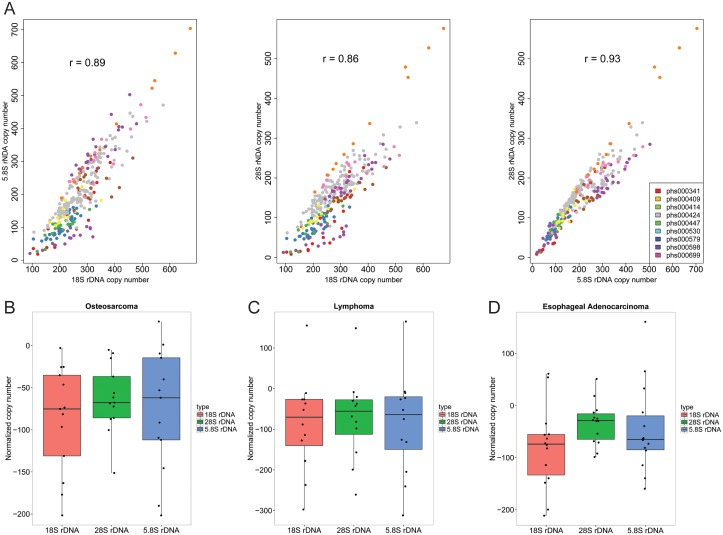
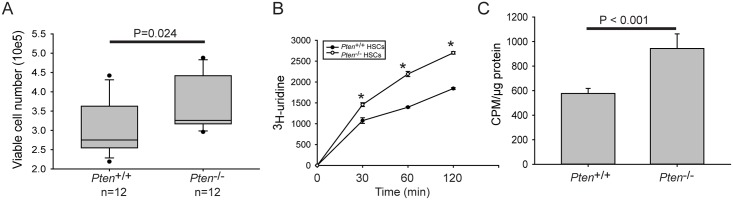
Ribosomal DNA is one of the most variable regions in the human genome with respect to copy number. Despite the importance of rDNA for cellular function, we know virtually nothing about what governs its copy number, stability, and sequence in the mammalian genome due to challenges associated with mapping and analysis. We applied computational and droplet digital PCR approaches to measure rDNA copy number in normal and cancer states in human and mouse genomes. We find that copy number and sequence can change in cancer genomes. Counterintuitively, human cancer genomes show a loss of copies, accompanied by global copy number co-variation. The sequence can also be more variable in the cancer genome. Cancer genomes with lower copies have mutational evidence of mTOR hyperactivity. The PTEN phosphatase is a tumor suppressor that is critical for genome stability and a negative regulator of the mTOR kinase pathway. Surprisingly, but consistent with the human cancer genomes, hematopoietic cancer stem cells from a Pten-/- mouse model for leukemia have lower rDNA copy number than normal tissue, despite increased proliferation, rRNA production, and protein synthesis. Loss of copies occurs early and is associated with hypersensitivity to DNA damage. Therefore, copy loss is a recurrent feature in cancers associated with mTOR activation. Ribosomal DNA copy number may be a simple and useful indicator of whether a cancer will be sensitive to DNA damaging treatments.
核糖体 DNA 是人类基因组中与拷贝数最相关的高度可变区域之一。尽管 rDNA 对于细胞功能很重要,但由于与绘图和分析相关的挑战,我们实际上对其在哺乳动物基因组中的拷贝数、稳定性和序列的调控机制知之甚少。我们应用计算和液滴数字 PCR 方法来测量人类和小鼠基因组中正常和癌症状态下的 rDNA 拷贝数。我们发现拷贝数和序列在癌症基因组中可以发生变化。与直觉相反的是,人类癌症基因组显示出拷贝数的减少,同时伴随着全局拷贝数的共同变化。在癌症基因组中,序列也可能更加多变。拷贝数较低的癌症基因组具有 mTOR 过度活跃的突变证据。PTEN 磷酸酶是一种肿瘤抑制因子,对于基因组稳定性和 mTOR 激酶途径的负调节至关重要。令人惊讶的是,但与人类癌症基因组一致的是,来自 Pten-/- 小鼠白血病模型的造血癌症干细胞的 rDNA 拷贝数低于正常组织,尽管增殖、rRNA 产生和蛋白质合成增加。拷贝数的丢失发生得很早,并与对 DNA 损伤的敏感性增加有关。因此,拷贝数丢失是与 mTOR 激活相关的癌症的一个常见特征。核糖体 DNA 拷贝数可能是癌症对 DNA 损伤治疗敏感的一个简单而有用的指标。