Wong Vincent Kam Wai, Zeng Wu, Chen Juan, Yao Xiao Jun, Leung Elaine Lai Han, Wang Qian Qian, Chiu Pauline, Ko Ben C B, Law Betty Yuen Kwan
State Key Laboratory of Quality Research in Chinese Medicine, Macau University of Science and TechnologyMacau, China.
Key Laboratory of Molecular Biology on Infectious Diseases, Ministry of Education, The Second Affiliated Hospital of Chongqing Medical University, Chongqing Medical UniversityChongqing, China.
Front Pharmacol. 2017 Jun 8;8:351. doi: 10.3389/fphar.2017.00351. eCollection 2017.
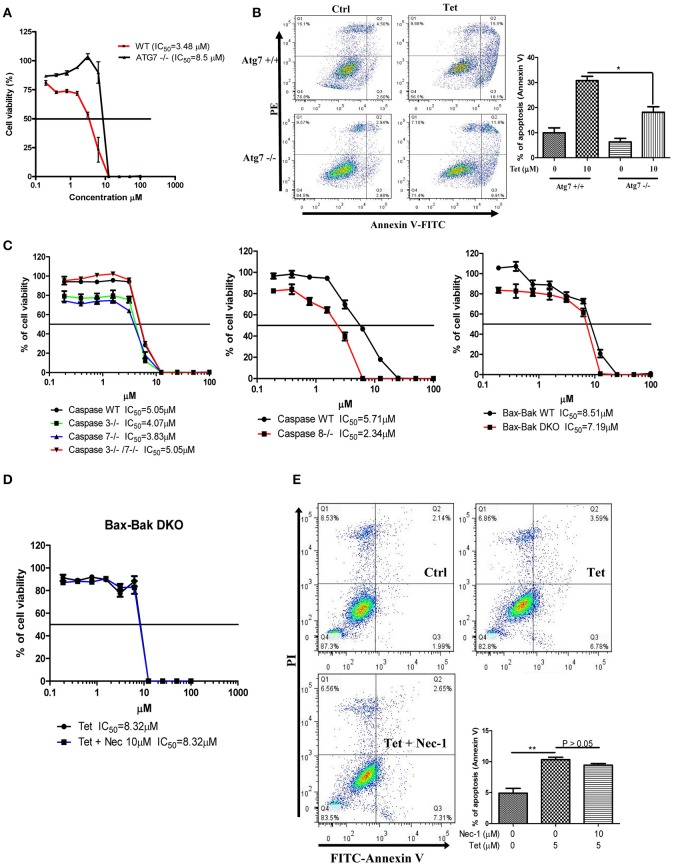
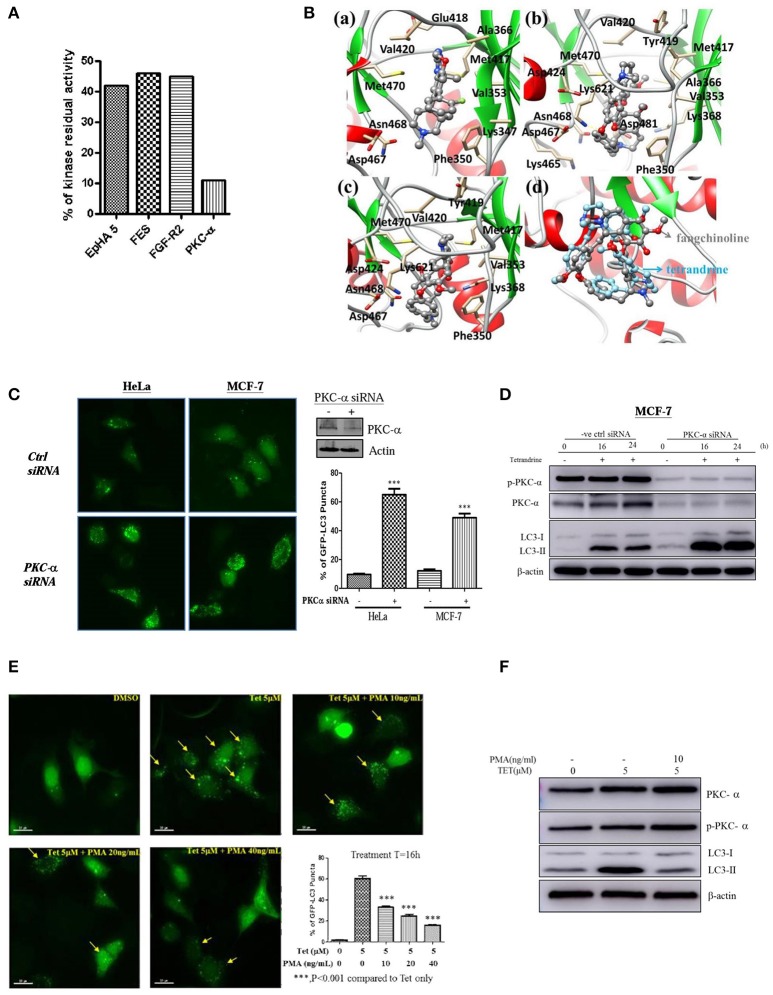
Emerging evidence suggests the therapeutic role of autophagic modulators in cancer therapy. This study aims to identify novel traditional Chinese medicinal herbs as potential anti-tumor agents through autophagic induction, which finally lead to autophagy mediated-cell death in apoptosis-resistant cancer cells. Using bioactivity-guided purification, we identified tetrandrine (Tet) from herbal plant, , as an inducer of autophagy. Across a number of cancer cell lines, we found that breast cancer cells treated with tetrandrine show an increase autophagic flux and formation of autophagosomes. In addition, tetrandrine induces cell death in a panel of apoptosis-resistant cell lines that are deficient for caspase 3, caspase 7, caspase 3 and 7, or Bax-Bak respectively. We also showed that tetrandrine-induced cell death is independent of necrotic cell death. Mechanistically, tetrandrine induces autophagy that depends on mTOR inactivation. Furthermore, tetrandrine induces autophagy in a calcium/calmodulin-dependent protein kinase kinase-β (CaMKK-β), 5' AMP-activated protein kinase (AMPK) independent manner. Finally, by kinase profiling against 300 WT kinases and computational molecular docking analysis, we showed that tetrandrine is a novel PKC-α inhibitor, which lead to autophagic induction through PKC-α inactivation. This study provides detailed insights into the novel cytotoxic mechanism of an anti-tumor compound originated from the herbal plant, which may be useful in promoting autophagy mediated- cell death in cancer cell that is resistant to apoptosis.
新出现的证据表明自噬调节剂在癌症治疗中的治疗作用。本研究旨在通过自噬诱导来鉴定新型传统中草药作为潜在的抗肿瘤药物,最终导致抗凋亡癌细胞中自噬介导的细胞死亡。通过生物活性导向纯化,我们从草药植物中鉴定出粉防己碱(Tet)作为自噬诱导剂。在多种癌细胞系中,我们发现用粉防己碱处理的乳腺癌细胞自噬通量增加且自噬体形成增加。此外,粉防己碱在一组分别缺乏半胱天冬酶3、半胱天冬酶7、半胱天冬酶3和7或Bax-Bak的抗凋亡细胞系中诱导细胞死亡。我们还表明粉防己碱诱导的细胞死亡与坏死性细胞死亡无关。机制上,粉防己碱诱导的自噬依赖于mTOR失活。此外,粉防己碱以钙/钙调蛋白依赖性蛋白激酶激酶-β(CaMKK-β)、5'单磷酸腺苷激活蛋白激酶(AMPK)非依赖的方式诱导自噬。最后,通过针对300种野生型激酶的激酶谱分析和计算分子对接分析,我们表明粉防己碱是一种新型蛋白激酶C-α(PKC-α)抑制剂,其通过PKC-α失活导致自噬诱导。本研究详细深入地了解了一种源自草药植物的抗肿瘤化合物的新型细胞毒性机制,这可能有助于促进对凋亡有抗性的癌细胞中自噬介导的细胞死亡。