Wang Min, Sun Gui-Bo, Du Yu-Yang, Tian Yu, Liao Ping, Liu Xue-Song, Ye Jing-Xue, Sun Xiao-Bo
Beijing Key Laboratory of Innovative Drug Discovery of Traditional Chinese Medicine (Natural Medicine) and Translational Medicine, Institute of Medicinal Plant Development, Chinese Academy of Medical Sciences-Peking Union Medical CollegeBeijing, China.
College of Pharmacy, Guilin Medical UniversityGuilin, China.
Front Pharmacol. 2017 Jun 8;8:353. doi: 10.3389/fphar.2017.00353. eCollection 2017.
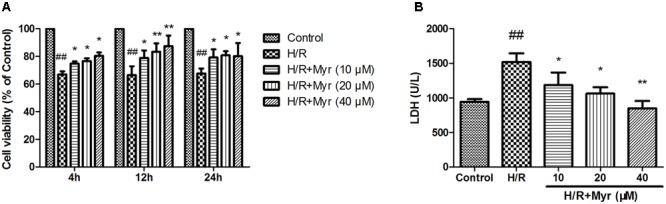
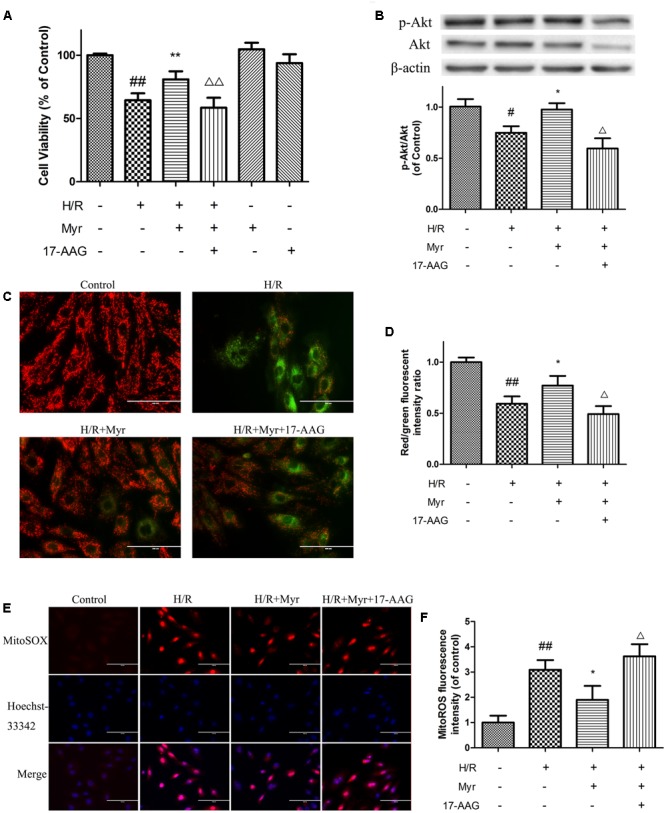
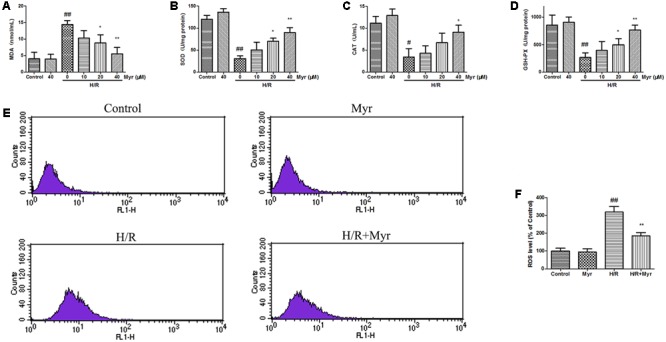
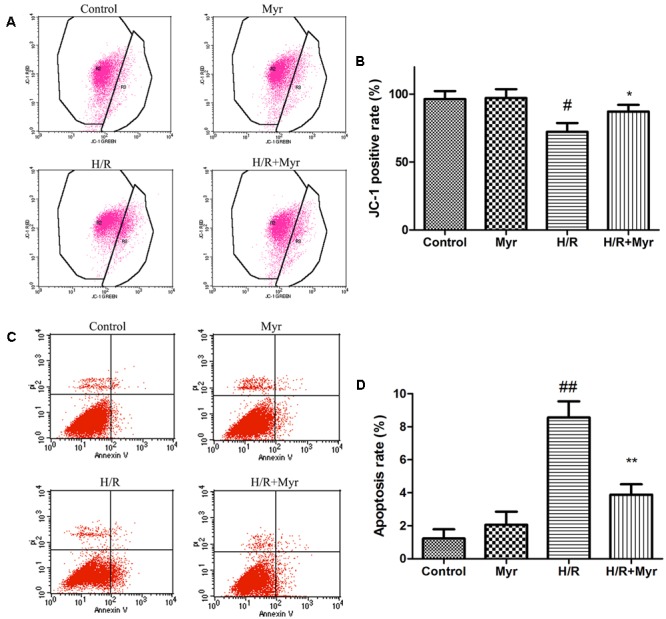
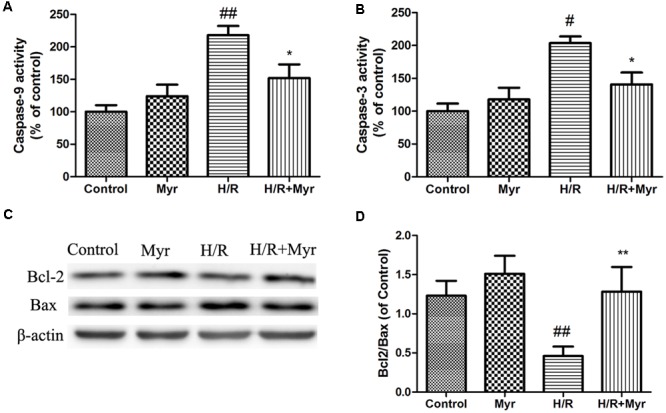
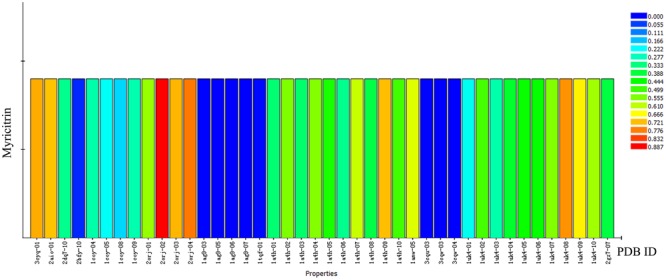
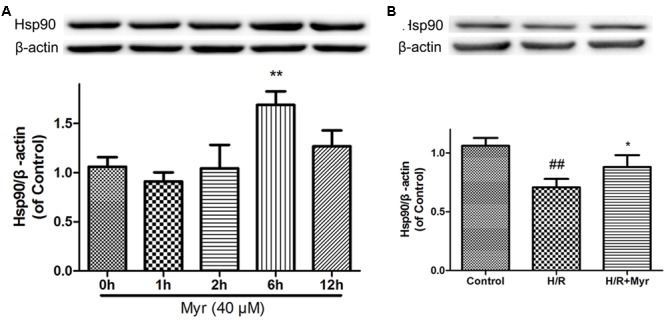
Modulation of oxidative stress is therapeutically effective in ischemia/reperfusion (I/R) injury. Myricitrin, a naturally occurring phenolic compound, is a potent antioxidant. However, little is known about its effect on I/R injury to cardiac myocytes. The present study was performed to investigate the potential protective effect of myricitrin against hypoxia/reoxygenation (H/R)-induced H9c2 cardiomyocyte injury and its underlying mechanisms. Myricitrin pretreatment improved cardiomyocyte viability, inhibited ROS generation, maintained the mitochondrial membrane potential, reduced apoptotic cardiomyocytes, decreased the caspase-3 activity, upregulated antiapoptotic proteins and downregulated proapoptotic proteins during H/R injury. Moreover, the potential targets of myricitrin was predicted using Discovery Studio software, and heat shock protein 90 (Hsp90) was identified as the main disease-related target. Further mechanistic investigation revealed that 17-AAG, a pharmacologic inhibitor of Hsp90, significantly blocked the myricitrin-induced cardioprotective effect demonstrated by increased apoptosis and ROS generation. These results suggested that myricitrin provides protection to H9c2 cardiomyocytes against H/R-induced oxidative stress and apoptosis, most likely via increased expression of Hsp90.
调节氧化应激在缺血/再灌注(I/R)损伤的治疗中具有有效性。杨梅素是一种天然存在的酚类化合物,是一种有效的抗氧化剂。然而,其对心肌细胞I/R损伤的影响却鲜为人知。本研究旨在探讨杨梅素对缺氧/复氧(H/R)诱导的H9c2心肌细胞损伤的潜在保护作用及其潜在机制。杨梅素预处理可提高心肌细胞活力,抑制活性氧生成,维持线粒体膜电位,减少凋亡心肌细胞,降低半胱天冬酶-3活性,上调抗凋亡蛋白并下调H/R损伤期间的促凋亡蛋白。此外,使用Discovery Studio软件预测了杨梅素的潜在靶点,热休克蛋白90(Hsp90)被确定为主要的疾病相关靶点。进一步的机制研究表明,Hsp90的药理抑制剂17-AAG可显著阻断杨梅素诱导的心脏保护作用,表现为凋亡增加和活性氧生成。这些结果表明,杨梅素可保护H9c2心肌细胞免受H/R诱导的氧化应激和凋亡,最有可能是通过增加Hsp90的表达来实现的。