Stapleton Molly, Sawamoto Kazuki, Alméciga-Díaz Carlos J, Mackenzie William G, Mason Robert W, Orii Tadao, Tomatsu Shunji
Department of Biological Sciences, University of Delaware, Newark, DE 19716, USA.
Nemours/Alfred I. duPont Hospital for Children, Wilmington, DE 19803, USA.
Int J Mol Sci. 2017 Jun 23;18(7):1345. doi: 10.3390/ijms18071345.
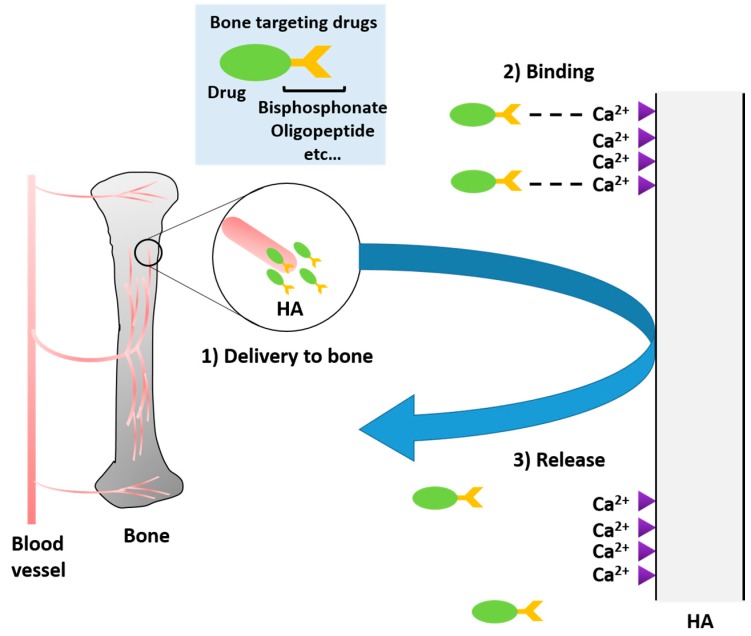
The skeletal system, comprising bones, ligaments, cartilage and their connective tissues, is critical for the structure and support of the body. Diseases that affect the skeletal system can be difficult to treat, mainly because of the avascular cartilage region. Targeting drugs to the site of action can not only increase efficacy but also reduce toxicity. Bone-targeting drugs are designed with either of two general targeting moieties, aimed at the entire skeletal system or a specific cell type. Most bone-targeting drugs utilize an affinity to hydroxyapatite, a major component of the bone matrix that includes a high concentration of positively-charged Ca. The strategies for designing such targeting moieties can involve synthetic and/or biological components including negatively-charged amino acid peptides or bisphosphonates. Efficient delivery of bone-specific drugs provides significant impact in the treatment of skeletal related disorders including infectious diseases (osteoarthritis, osteomyelitis, etc.), osteoporosis, and metabolic skeletal dysplasia. Despite recent advances, however, both delivering the drug to its target without losing activity and avoiding adverse local effects remain a challenge. In this review, we investigate the current development of bone-targeting moieties, their efficacy and limitations, and discuss future directions for the development of these specific targeted treatments.
骨骼系统由骨骼、韧带、软骨及其结缔组织组成,对身体的结构和支撑至关重要。影响骨骼系统的疾病可能难以治疗,主要是因为软骨区域无血管。将药物靶向作用部位不仅可以提高疗效,还可以降低毒性。骨靶向药物是通过两种一般靶向部分之一设计的,旨在作用于整个骨骼系统或特定细胞类型。大多数骨靶向药物利用对羟基磷灰石的亲和力,羟基磷灰石是骨基质的主要成分,其中含有高浓度的带正电荷的钙。设计此类靶向部分的策略可涉及合成和/或生物成分,包括带负电荷的氨基酸肽或双膦酸盐。高效递送骨特异性药物对治疗骨骼相关疾病具有重大影响,这些疾病包括传染病(骨关节炎、骨髓炎等)、骨质疏松症和代谢性骨骼发育不良。然而,尽管最近取得了进展,但在不丧失活性的情况下将药物递送至靶点并避免局部不良反应仍然是一项挑战。在这篇综述中,我们研究了骨靶向部分的当前发展、它们的疗效和局限性,并讨论了这些特定靶向治疗的未来发展方向。