Lan Chou-Chin, Peng Chung-Kan, Tang Shih-En, Huang Kun-Lun, Wu Chin-Pyng
Division of Pulmonary Medicine, Department of Internal Medicine,Taipei Tzu Chi Hospital, Buddhist Tzu Chi Medical Foundation, New Taipei City, Taiwan, Republic of China.
School of Medicine, Tzu-Chi University, Hualien, Taiwan, Republic of China.
PLoS One. 2017 Jun 23;12(6):e0179822. doi: 10.1371/journal.pone.0179822. eCollection 2017.
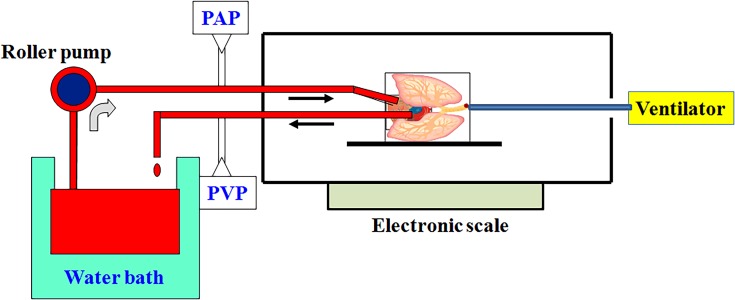
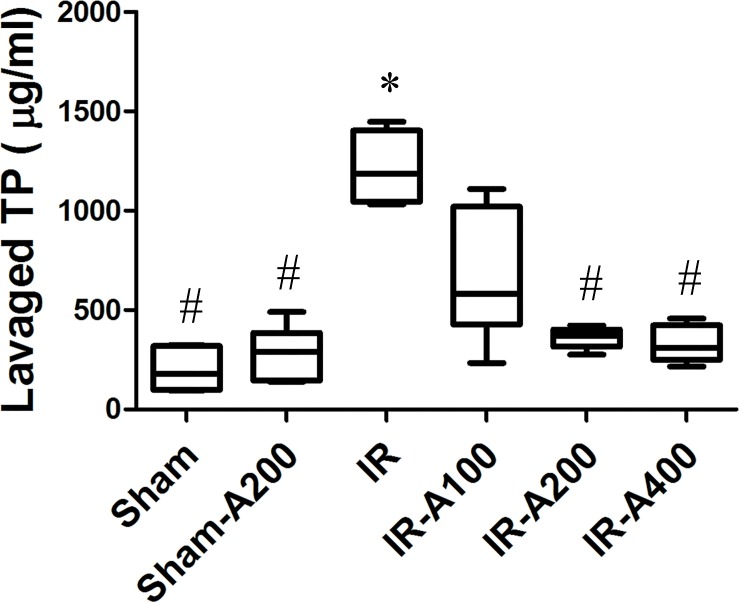
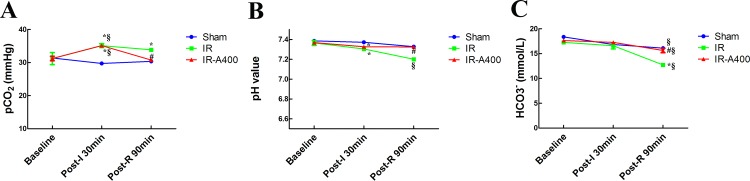
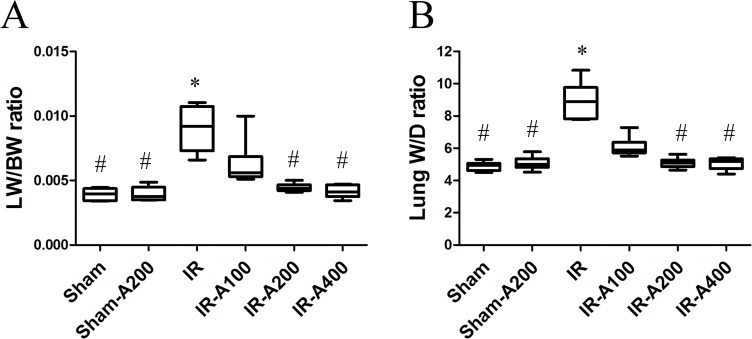
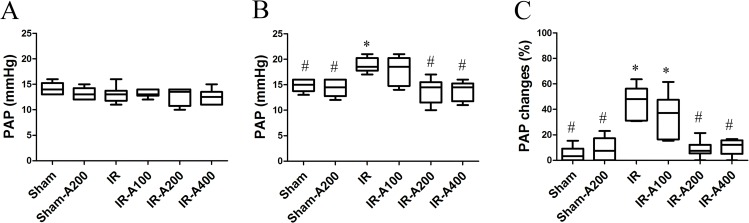
Ischemia-reperfusion (IR)-induced acute lung injury (ALI) is implicated in several clinical conditions including lung transplantation, cardiopulmonary bypass surgery, re-expansion of collapsed lung from pneumothorax or pleural effusion and etc. IR-induced ALI remains a challenge in the current treatment. Carbonic anhydrase has important physiological function and influences on transport of CO2. Some investigators suggest that CO2 influences lung injury. Therefore, carbonic anhydrase should have the role in ALI. This study was undertaken to define the effect of a carbonic anhydrase inhibitor, acetazolamide (AZA), in IR-induced ALI, that was conducted in a rat model of isolated-perfused lung with 30 minutes of ischemia and 90 minutes of reperfusion. The animals were divided into six groups (n = 6 per group): sham, sham + AZA 200 mg/kg body weight (BW), IR, IR + AZA 100 mg/kg BW, IR + AZA 200 mg/kg BW and IR+ AZA 400 mg/kg BW. IR caused significant pulmonary micro-vascular hyper-permeability, pulmonary edema, pulmonary hypertension, neutrophilic sequestration, and an increase in the expression of pro-inflammatory cytokines. Increases in carbonic anhydrase expression and perfusate pCO2 levels were noted, while decreased Na-K-ATPase expression was noted after IR. Administration of 200mg/kg BW and 400mg/kg BW AZA significantly suppressed the expression of pro-inflammatory cytokines (TNF-α, IL-1, IL-6 and IL-17) and attenuated IR-induced lung injury, represented by decreases in pulmonary hyper-permeability, pulmonary edema, pulmonary hypertension and neutrophilic sequestration. AZA attenuated IR-induced lung injury, associated with decreases in carbonic anhydrase expression and pCO2 levels, as well as restoration of Na-K-ATPase expression.
缺血再灌注(IR)诱导的急性肺损伤(ALI)与多种临床情况有关,包括肺移植、体外循环手术、气胸或胸腔积液导致的萎陷肺复张等。IR诱导的ALI在当前治疗中仍然是一个挑战。碳酸酐酶具有重要的生理功能,并影响二氧化碳的运输。一些研究人员认为二氧化碳会影响肺损伤。因此,碳酸酐酶在ALI中应该发挥作用。本研究旨在确定碳酸酐酶抑制剂乙酰唑胺(AZA)在IR诱导的ALI中的作用,该研究在一个离体灌注肺大鼠模型中进行,缺血30分钟,再灌注90分钟。动物被分为六组(每组n = 6):假手术组、假手术 + 200 mg/kg体重(BW)AZA组、IR组、IR + 100 mg/kg BW AZA组、IR + 200 mg/kg BW AZA组和IR + 400 mg/kg BW AZA组。IR导致显著的肺微血管高通透性、肺水肿、肺动脉高压、中性粒细胞滞留以及促炎细胞因子表达增加。IR后碳酸酐酶表达和灌注液pCO2水平升高,而Na-K-ATP酶表达降低。给予200mg/kg BW和400mg/kg BW的AZA显著抑制促炎细胞因子(TNF-α、IL-1、IL-6和IL-17)的表达,并减轻IR诱导的肺损伤,表现为肺高通透性、肺水肿、肺动脉高压和中性粒细胞滞留的减轻。AZA减轻IR诱导的肺损伤,与碳酸酐酶表达和pCO2水平降低以及Na-K-ATP酶表达恢复有关。