• 文献检索
  • 文档翻译
  • 深度研究
  • 学术资讯
  • Suppr Zotero 插件Zotero 插件
  • 邀请有礼
  • 套餐&价格
  • 历史记录
应用&插件
Suppr Zotero 插件Zotero 插件浏览器插件Mac 客户端Windows 客户端微信小程序
定价
高级版会员购买积分包购买API积分包
服务
文献检索文档翻译深度研究API 文档MCP 服务
关于我们
关于 Suppr公司介绍联系我们用户协议隐私条款
关注我们

Suppr 超能文献

核心技术专利:CN118964589B侵权必究
粤ICP备2023148730 号-1Suppr @ 2026

文献检索

告别复杂PubMed语法,用中文像聊天一样搜索,搜遍4000万医学文献。AI智能推荐,让科研检索更轻松。

立即免费搜索

文件翻译

保留排版,准确专业,支持PDF/Word/PPT等文件格式,支持 12+语言互译。

免费翻译文档

深度研究

AI帮你快速写综述,25分钟生成高质量综述,智能提取关键信息,辅助科研写作。

立即免费体验

一种基于规则的命名实体识别方法,用于循证饮食建议的知识提取。

A rule-based named-entity recognition method for knowledge extraction of evidence-based dietary recommendations.

作者信息

Eftimov Tome, Koroušić Seljak Barbara, Korošec Peter

机构信息

Computer Systems Department, Jožef Stefan Institute, Ljubljana, Slovenia.

Jožef Stefan International Postgraduate School, Ljubljana, Slovenia.

出版信息

PLoS One. 2017 Jun 23;12(6):e0179488. doi: 10.1371/journal.pone.0179488. eCollection 2017.

DOI:10.1371/journal.pone.0179488
PMID:28644863
原文链接:https://pmc.ncbi.nlm.nih.gov/articles/PMC5482438/
Abstract

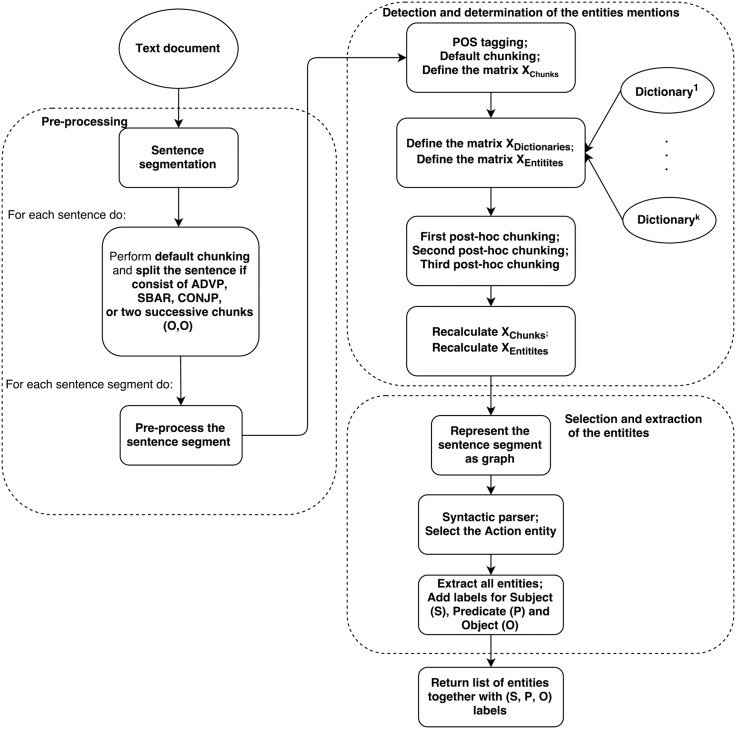
Evidence-based dietary information represented as unstructured text is a crucial information that needs to be accessed in order to help dietitians follow the new knowledge arrives daily with newly published scientific reports. Different named-entity recognition (NER) methods have been introduced previously to extract useful information from the biomedical literature. They are focused on, for example extracting gene mentions, proteins mentions, relationships between genes and proteins, chemical concepts and relationships between drugs and diseases. In this paper, we present a novel NER method, called drNER, for knowledge extraction of evidence-based dietary information. To the best of our knowledge this is the first attempt at extracting dietary concepts. DrNER is a rule-based NER that consists of two phases. The first one involves the detection and determination of the entities mention, and the second one involves the selection and extraction of the entities. We evaluate the method by using text corpora from heterogeneous sources, including text from several scientifically validated web sites and text from scientific publications. Evaluation of the method showed that drNER gives good results and can be used for knowledge extraction of evidence-based dietary recommendations.

摘要

以非结构化文本形式呈现的循证饮食信息是至关重要的信息,为帮助营养师跟上随着新发表的科学报告每日涌现的新知识,需要获取这些信息。此前已引入不同的命名实体识别(NER)方法,从生物医学文献中提取有用信息。例如,它们专注于提取基因提及、蛋白质提及、基因与蛋白质之间的关系、化学概念以及药物与疾病之间的关系。在本文中,我们提出了一种名为drNER的新型NER方法,用于循证饮食信息的知识提取。据我们所知,这是首次尝试提取饮食概念。DrNER是一种基于规则的NER,由两个阶段组成。第一个阶段涉及实体提及的检测和确定,第二个阶段涉及实体的选择和提取。我们通过使用来自异构源的文本语料库来评估该方法,这些源包括来自几个经过科学验证的网站的文本和科学出版物中的文本。对该方法的评估表明,drNER取得了良好的结果,可用于循证饮食建议的知识提取。
https://cdn.ncbi.nlm.nih.gov/pmc/blobs/9499/5482438/8de4f76b1960/pone.0179488.g007.jpg
https://cdn.ncbi.nlm.nih.gov/pmc/blobs/9499/5482438/299bc64144c3/pone.0179488.g001.jpg
https://cdn.ncbi.nlm.nih.gov/pmc/blobs/9499/5482438/5edde61c99f9/pone.0179488.g002.jpg
https://cdn.ncbi.nlm.nih.gov/pmc/blobs/9499/5482438/9f4e1b776879/pone.0179488.g003.jpg
https://cdn.ncbi.nlm.nih.gov/pmc/blobs/9499/5482438/a0c58598cf6f/pone.0179488.g004.jpg
https://cdn.ncbi.nlm.nih.gov/pmc/blobs/9499/5482438/3ea12629b6a6/pone.0179488.g005.jpg
https://cdn.ncbi.nlm.nih.gov/pmc/blobs/9499/5482438/9a70d7b48e11/pone.0179488.g006.jpg
https://cdn.ncbi.nlm.nih.gov/pmc/blobs/9499/5482438/8de4f76b1960/pone.0179488.g007.jpg
https://cdn.ncbi.nlm.nih.gov/pmc/blobs/9499/5482438/299bc64144c3/pone.0179488.g001.jpg
https://cdn.ncbi.nlm.nih.gov/pmc/blobs/9499/5482438/5edde61c99f9/pone.0179488.g002.jpg
https://cdn.ncbi.nlm.nih.gov/pmc/blobs/9499/5482438/9f4e1b776879/pone.0179488.g003.jpg
https://cdn.ncbi.nlm.nih.gov/pmc/blobs/9499/5482438/a0c58598cf6f/pone.0179488.g004.jpg
https://cdn.ncbi.nlm.nih.gov/pmc/blobs/9499/5482438/3ea12629b6a6/pone.0179488.g005.jpg
https://cdn.ncbi.nlm.nih.gov/pmc/blobs/9499/5482438/9a70d7b48e11/pone.0179488.g006.jpg
https://cdn.ncbi.nlm.nih.gov/pmc/blobs/9499/5482438/8de4f76b1960/pone.0179488.g007.jpg

相似文献

1
A rule-based named-entity recognition method for knowledge extraction of evidence-based dietary recommendations.一种基于规则的命名实体识别方法,用于循证饮食建议的知识提取。
PLoS One. 2017 Jun 23;12(6):e0179488. doi: 10.1371/journal.pone.0179488. eCollection 2017.
2
Extraction of knowledge graph of Covid-19 through mining of unstructured biomedical corpora.通过挖掘非结构化生物医学语料库提取新冠病毒知识图谱。
Comput Biol Chem. 2023 Feb;102:107808. doi: 10.1016/j.compbiolchem.2022.107808. Epub 2023 Jan 2.
3
Chemical named entity recognition in patents by domain knowledge and unsupervised feature learning.基于领域知识和无监督特征学习的专利中化学命名实体识别
Database (Oxford). 2016 Apr 17;2016. doi: 10.1093/database/baw049. Print 2016.
4
PKDE4J: Entity and relation extraction for public knowledge discovery.PKDE4J:用于公共知识发现的实体与关系提取
J Biomed Inform. 2015 Oct;57:320-32. doi: 10.1016/j.jbi.2015.08.008. Epub 2015 Aug 12.
5
Text mining in livestock animal science: introducing the potential of text mining to animal sciences.文本挖掘在畜牧动物科学中的应用:介绍文本挖掘在动物科学中的应用潜力。
J Anim Sci. 2012 Oct;90(10):3666-76. doi: 10.2527/jas.2011-4841. Epub 2012 Jun 4.
6
Automated recognition of malignancy mentions in biomedical literature.生物医学文献中恶性肿瘤提及的自动识别。
BMC Bioinformatics. 2006 Nov 7;7:492. doi: 10.1186/1471-2105-7-492.
7
Identifying non-elliptical entity mentions in a coordinated NP with ellipses.识别带省略的并列名词短语中的非椭圆实体提及。
J Biomed Inform. 2014 Feb;47:139-52. doi: 10.1016/j.jbi.2013.10.002. Epub 2013 Oct 20.
8
POSBIOTM-NER: a trainable biomedical named-entity recognition system.POSBIOTM-NER:一个可训练的生物医学命名实体识别系统。
Bioinformatics. 2005 Jun 1;21(11):2794-6. doi: 10.1093/bioinformatics/bti414. Epub 2005 Apr 6.
9
GENA: A knowledge graph for nutrition and mental health.GENA:一个营养与心理健康的知识图谱。
J Biomed Inform. 2023 Sep;145:104460. doi: 10.1016/j.jbi.2023.104460. Epub 2023 Aug 1.
10
Curatable Named-Entity Recognition Using Semantic Relations.利用语义关系进行可治愈命名实体识别
IEEE/ACM Trans Comput Biol Bioinform. 2015 Jul-Aug;12(4):785-92. doi: 10.1109/TCBB.2014.2366770.

引用本文的文献

1
Large language model powered knowledge graph construction for mental health exploration.用于心理健康探索的由大语言模型驱动的知识图谱构建。
Nat Commun. 2025 Aug 13;16(1):7526. doi: 10.1038/s41467-025-62781-z.
2
Knowledge discovery of diseases symptoms and rehabilitation measures in Q&A communities.问答社区中疾病症状与康复措施的知识发现
Sci Rep. 2025 Apr 19;15(1):13593. doi: 10.1038/s41598-025-98300-9.
3
SciLinker: a large-scale text mining framework for mapping associations among biological entities.SciLinker:一个用于映射生物实体之间关联的大规模文本挖掘框架。

本文引用的文献

1
Knowledge Representation and Management: a Linked Data Perspective.知识表示与管理:关联数据视角
Yearb Med Inform. 2016 Nov 10(1):178-183. doi: 10.15265/IY-2016-022.
2
BioCreative V BioC track overview: collaborative biocurator assistant task for BioGRID.生物创意V生物C轨迹概述:生物网格的协作生物编目员助手任务。
Database (Oxford). 2016 Sep 1;2016. doi: 10.1093/database/baw121. Print 2016.
3
Overview of the interactive task in BioCreative V.生物创意V中交互式任务概述。
Front Artif Intell. 2025 Mar 19;8:1528562. doi: 10.3389/frai.2025.1528562. eCollection 2025.
4
Zero-shot evaluation of ChatGPT for food named-entity recognition and linking.ChatGPT在食品命名实体识别与链接方面的零样本评估。
Front Nutr. 2024 Aug 13;11:1429259. doi: 10.3389/fnut.2024.1429259. eCollection 2024.
5
Computational gastronomy: capturing culinary creativity by making food computable.计算美食学:通过使食物可计算来捕捉烹饪创意。
NPJ Syst Biol Appl. 2024 Jul 8;10(1):72. doi: 10.1038/s41540-024-00399-5.
6
Leveraging GPT-4 for identifying cancer phenotypes in electronic health records: a performance comparison between GPT-4, GPT-3.5-turbo, Flan-T5, Llama-3-8B, and spaCy's rule-based and machine learning-based methods.利用GPT-4在电子健康记录中识别癌症表型:GPT-4、GPT-3.5-turbo、Flan-T5、Llama-3-8B与spaCy基于规则和基于机器学习的方法之间的性能比较。
JAMIA Open. 2024 Jul 3;7(3):ooae060. doi: 10.1093/jamiaopen/ooae060. eCollection 2024 Oct.
7
BERT-based tourism named entity recognition: making use of social media for travel recommendations.基于BERT的旅游命名实体识别:利用社交媒体进行旅游推荐。
PeerJ Comput Sci. 2023 Dec 21;9:e1731. doi: 10.7717/peerj-cs.1731. eCollection 2023.
8
Disease- and Drug-Related Knowledge Extraction for Health Management from Online Health Communities Based on BERT-BiGRU-ATT.基于 BERT-BiGRU-ATT 的在线健康社区健康管理相关疾病和药物知识提取
Int J Environ Res Public Health. 2022 Dec 9;19(24):16590. doi: 10.3390/ijerph192416590.
9
CafeteriaSA corpus: scientific abstracts annotated across different food semantic resources.自助餐厅 SA 语料库:在不同的食物语义资源中进行标注的科学摘要。
Database (Oxford). 2022 Dec 16;2022. doi: 10.1093/database/baac107.
10
Entity relation extraction in the medical domain: based on data augmentation.医学领域中的实体关系提取:基于数据增强
Ann Transl Med. 2022 Oct;10(19):1061. doi: 10.21037/atm-22-3991.
Database (Oxford). 2016 Sep 1;2016. doi: 10.1093/database/baw119. Print 2016.
4
Assessing the state of the art in biomedical relation extraction: overview of the BioCreative V chemical-disease relation (CDR) task.评估生物医学关系抽取的技术现状:生物创意V化学-疾病关系(CDR)任务概述。
Database (Oxford). 2016 Mar 19;2016. doi: 10.1093/database/baw032. Print 2016.
5
Bridging semantics and syntax with graph algorithms-state-of-the-art of extracting biomedical relations.用图算法弥合语义与句法——提取生物医学关系的研究现状
Brief Bioinform. 2017 Jan;18(1):160-178. doi: 10.1093/bib/bbw001. Epub 2016 Feb 5.
6
Using text mining techniques to extract phenotypic information from the PhenoCHF corpus.使用文本挖掘技术从PhenoCHF语料库中提取表型信息。
BMC Med Inform Decis Mak. 2015;15 Suppl 2(Suppl 2):S3. doi: 10.1186/1472-6947-15-S2-S3. Epub 2015 Jun 15.
7
LeadMine: a grammar and dictionary driven approach to entity recognition.LeadMine:一种基于语法和词典的实体识别方法。
J Cheminform. 2015 Jan 19;7(Suppl 1 Text mining for chemistry and the CHEMDNER track):S5. doi: 10.1186/1758-2946-7-S1-S5. eCollection 2015.
8
The CHEMDNER corpus of chemicals and drugs and its annotation principles.CHEMDNER 化学物质和药物语料库及其标注原则。
J Cheminform. 2015 Jan 19;7(Suppl 1 Text mining for chemistry and the CHEMDNER track):S2. doi: 10.1186/1758-2946-7-S1-S2. eCollection 2015.
9
CHEMDNER: The drugs and chemical names extraction challenge.CHEMDNER:药物和化学名称提取挑战赛。
J Cheminform. 2015 Jan 19;7(Suppl 1 Text mining for chemistry and the CHEMDNER track):S1. doi: 10.1186/1758-2946-7-S1-S1. eCollection 2015.
10
BioCreative-IV virtual issue.生物创意四期虚拟特刊。
Database (Oxford). 2014 May 22;2014. doi: 10.1093/database/bau039. Print 2014.