Hargreaves-Allen Venetia Alexa, Mourato Susana, Milner-Gulland Eleanor Jane
Centre for Environmental Policy, Imperial College, London, United Kingdom.
Department of Geography and Environment, London School of Economics and Political Science, London, United Kingdom.
PLoS One. 2017 Jun 23;12(6):e0179394. doi: 10.1371/journal.pone.0179394. eCollection 2017.
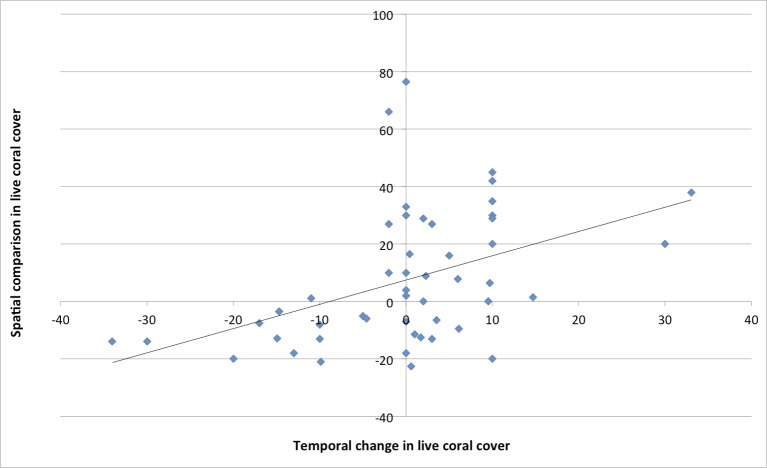
Coral reefs are severely threatened and a principal strategy for their conservation is marine protected areas (MPAs). However the drivers of MPA performance are complex and there are likely to be trade-offs between different types of performance (e.g. conservation or welfare related outcomes). We compiled a global dataset from expert knowledge for 76 coral reef MPAs in 33 countries and identified a set of performance measures reflecting ecological and socio-economic outcomes, achievement of aims and reduction of threats, using spatial or temporal comparisons wherever possible. We wanted to test the extent to which distinct types of performance occurred simultaneously, understood as win-win outcomes. Although certain performance measures were correlated, most were not, suggesting trade-offs that limit the usefulness of composite performance scores. Hypotheses were generated as to the impact of MPA features, aims, location, management and contextual variables on MPA performance from the literature. A multivariate analysis was used to test hypotheses as to the relative importance of these "drivers" on eight uncorrelated performance measures. The analysis supported some hypotheses (e.g. benefit provision for the local community improved performance), but not others (e.g. higher overall budget and more research activity did not). Factors endogenous to the MPA (such as size of the no-take area) were generally more significant drivers of performance than exogenous ones (such as national GDP). Different types of performance were associated with different drivers, exposing the trade-offs inherent in management decisions. The study suggests that managers are able to influence MPA performance in spite of external threats and could inform adaptive management by providing an approach to test for the effects of MPA features and management actions in different contexts and so to inform decisions for allocation of effort or funds to achieve specific goals.
珊瑚礁受到严重威胁,而海洋保护区(MPA)是其保护的主要策略。然而,MPA绩效的驱动因素很复杂,不同类型的绩效(如与保护或福利相关的成果)之间可能存在权衡。我们从33个国家的76个珊瑚礁MPA的专家知识中汇编了一个全球数据集,并确定了一套绩效指标,这些指标反映了生态和社会经济成果、目标的实现以及威胁的减少,尽可能使用空间或时间比较。我们想测试不同类型的绩效在多大程度上同时出现,即被理解为双赢的结果。虽然某些绩效指标是相关的,但大多数并非如此,这表明存在权衡,限制了综合绩效得分的有用性。从文献中得出了关于MPA特征、目标、位置、管理和背景变量对MPA绩效影响的假设。使用多变量分析来测试这些“驱动因素”对八个不相关绩效指标的相对重要性的假设。分析支持了一些假设(如为当地社区提供福利可提高绩效),但不支持其他假设(如总体预算较高和研究活动较多则不然)。MPA的内生因素(如禁捕区的大小)通常比外生因素(如国家国内生产总值)更能显著驱动绩效。不同类型的绩效与不同的驱动因素相关,揭示了管理决策中固有的权衡。该研究表明,尽管存在外部威胁,管理者仍能够影响MPA的绩效,并可以通过提供一种方法来测试MPA特征和管理行动在不同背景下的效果,从而为适应性管理提供信息,进而为实现特定目标的努力或资金分配决策提供信息。