University of Texas Southwestern Medical Center, Dallas, TX, USA.
University of Texas Southwestern Medical Center, Dallas, TX, USA.
Atherosclerosis. 2017 Aug;263:156-162. doi: 10.1016/j.atherosclerosis.2017.06.007. Epub 2017 Jun 3.
Myeloperoxidase (MPO), a product of systemic inflammation, promotes oxidation of lipoproteins; whereas, high-density lipoprotein (HDL) exerts anti-oxidative effects in part via paraoxonase-1 (PON1). MPO induces dysfunctional HDL particles; however, the interaction of circulating levels of these measures in cardiovascular disease (CVD) has not been studied in humans. We tested whether serum levels of MPO indexed to HDL particle concentration (MPO/HDLp) are associated with increased CVD risk in a large multiethnic population sample, free of CVD at baseline.
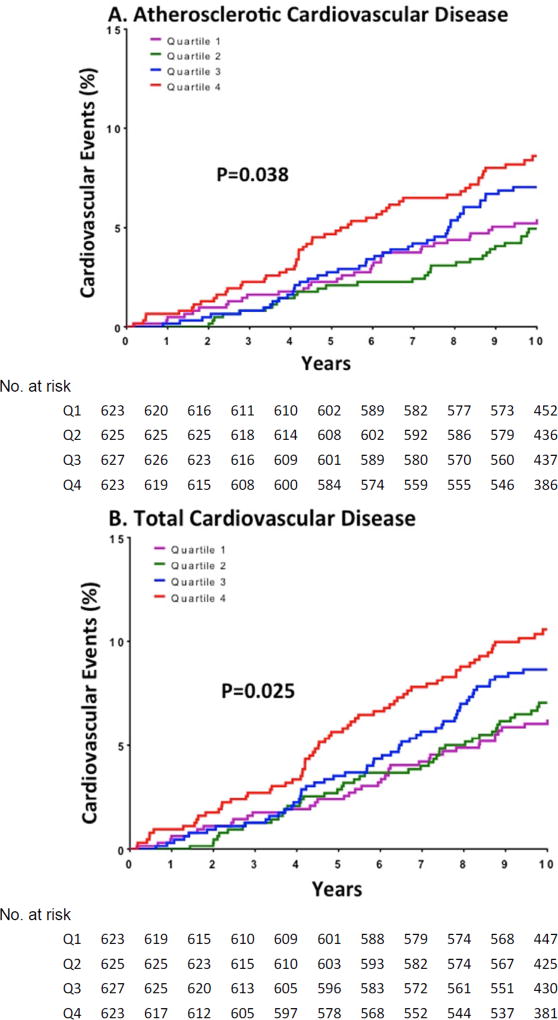
Levels of MPO, HDL-C, and HDL particle concentration (HDLp) by NMR were measured at baseline in 2924 adults free of CVD. The associations of MPO/HDLp with incident ASCVD (first non-fatal myocardial infarction, non-fatal stroke, coronary revascularization, or CVD death) and total CVD were assessed in Cox proportional-hazards models adjusted for traditional risk factors. The median follow-up period was 9.4 years.
Adjusted for sex and race/ethnicity, MPO/HDLp was associated directly with body mass index, smoking status, high-sensitivity C-reactive protein, and interleukin 18, and inversely with age, HDL-C levels, HDL size, and PON1 arylesterase activity, but not with cholesterol efflux. In fully adjusted models, the highest versus lowest quartile of MPO/HDLp was associated with a 74% increase in incident ASCVD (aHR, 1.74, 95% CI 1.12-2.70) and a 91% increase in total incident CVD (aHR, 1.91, 95% CI 1.27-2.85).
Increased MPO indexed to HDL particle concentration (MPO/HDLp) at baseline is associated with increased risk of incident CVD events in a population initially free of CVD over the 9.4 year period.
髓过氧化物酶(MPO)是全身炎症的产物,可促进脂蛋白氧化;而高密度脂蛋白(HDL)则通过对氧磷酶-1(PON1)发挥抗氧化作用。MPO 诱导 HDL 颗粒功能障碍;然而,在心血管疾病(CVD)患者中,这些指标的循环水平之间的相互作用尚未得到研究。我们检测了在基线时无 CVD 的大型多民族人群样本中,MPO 与 HDL 颗粒浓度之比(MPO/HDLp)与 CVD 风险增加的相关性。
在基线时,通过 NMR 测量 2924 名无 CVD 的成年人的 MPO、HDL-C 和 HDL 颗粒浓度(HDLp)。在 Cox 比例风险模型中,调整传统危险因素后,评估 MPO/HDLp 与 ASCVD 事件(首次非致命性心肌梗死、非致命性卒中和冠状动脉血运重建术或 CVD 死亡)和总 CVD 的相关性。中位随访时间为 9.4 年。
在调整性别和种族/民族因素后,MPO/HDLp 与体重指数、吸烟状态、高敏 C 反应蛋白和白细胞介素 18 呈正相关,与年龄、HDL-C 水平、HDL 大小和 PON1 芳基酯酶活性呈负相关,但与胆固醇流出无关。在完全调整模型中,MPO/HDLp 的最高四分位数与 ASCVD 事件的发生率增加 74%相关(调整后 HR,1.74,95%CI 1.12-2.70),总 CVD 事件的发生率增加 91%(调整后 HR,1.91,95%CI 1.27-2.85)。
在无 CVD 的人群中,基线时 MPO 与 HDL 颗粒浓度之比(MPO/HDLp)增加与 9.4 年内 CVD 事件的发生率增加相关。