Chan Deva D, Li Jun, Luo Wei, Predescu Dan N, Cole Brian J, Plaas Anna
Division of Rheumatology, Department of Internal Medicine, Rush University Medical Center, 1653 West Congress Parkway, Chicago 60612, Illinois.
Department of Biomedical Engineering, Rensselaer Polytechnic Institute, 110 8th St, BT 3141, Troy, New York.
J Orthop Res. 2018 Jan;36(1):365-376. doi: 10.1002/jor.23635. Epub 2017 Jul 21.
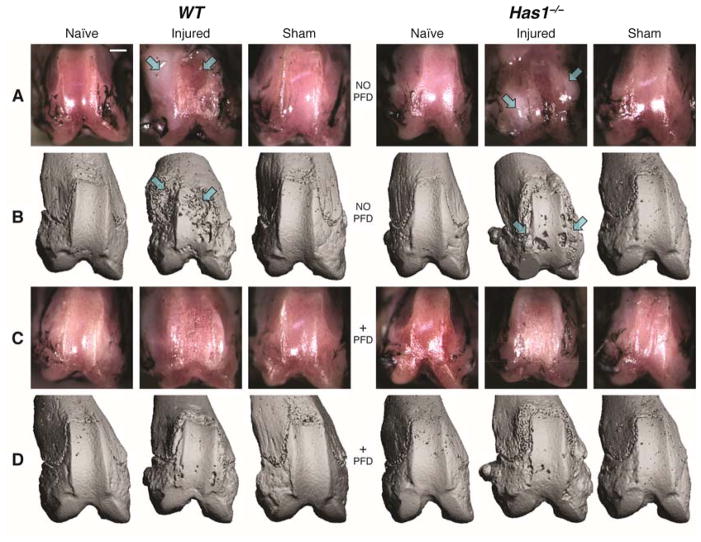
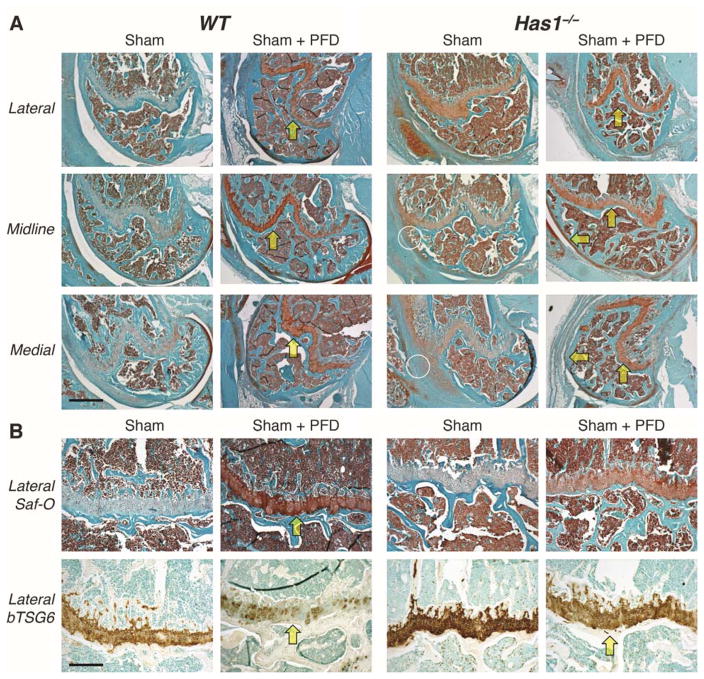
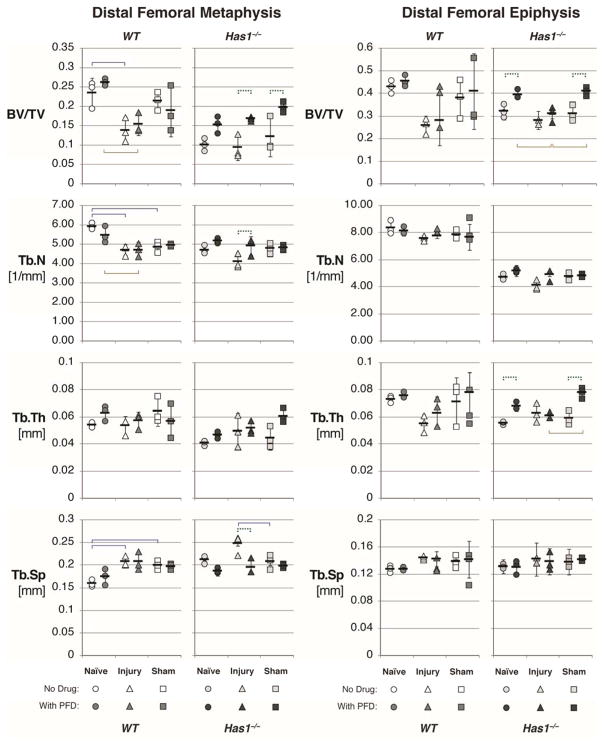
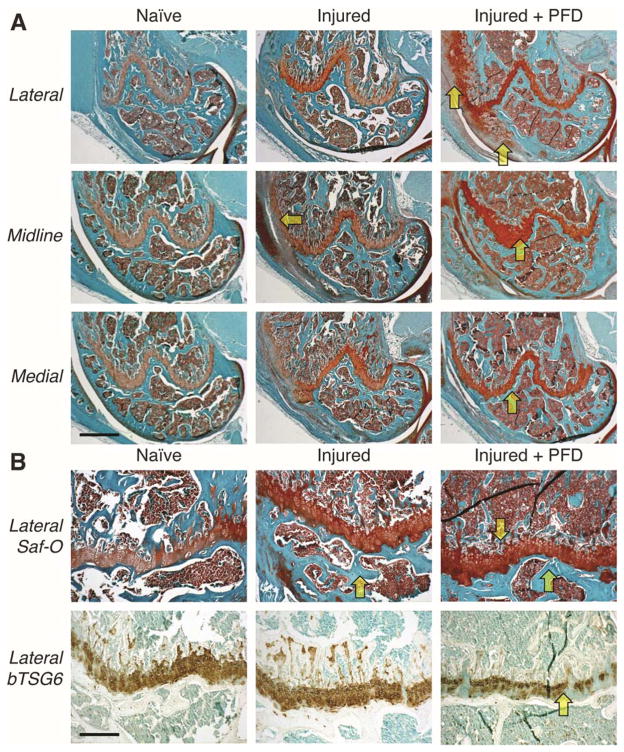
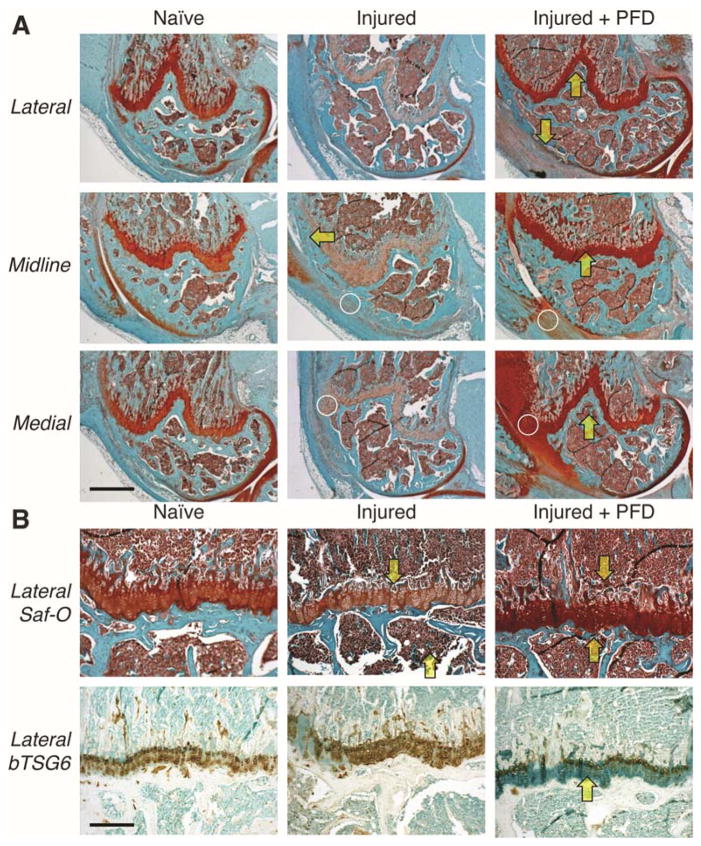
Pirfenidone is an anti-inflammatory and anti-fibrotic drug that has shown efficacy in lung and kidney fibrosis. Because inflammation and fibrosis have been linked to the progression of osteoarthritis, we investigated the effects of oral Pirfenidone in a mouse model of cartilage injury, which results in chronic inflammation and joint-wide fibrosis in mice that lack hyaluronan synthase 1 (Has1 ) in comparison to wild-type. Femoral cartilage was surgically injured in wild-type and Has1 mice, and Pirfenidone was administered in food starting after 3 days. At 4 weeks, Pirfenidone reduced the appearance, on micro-computed tomography, of pitting in subchondral bone at, and cortical bone surrounding, the site of cartilage injury. This corresponded with a reduction in fibrotic tissue deposits as observed with gross joint surface photography. Pirfenidone resulted in significant recovery of trabecular bone parameters affected by joint injury in Has1 mice, although the effect in wild-type was less pronounced. Pirfenidone also increased Safranin-O staining of growth plate cartilage after cartilage injury and sham operation in both genotypes. Taken together with the expression of selected extracellular matrix, inflammation, and fibrosis genes, these results indicate that Pirfenidone may confer chondrogenic and bone-protective effects, although the well-known anti-fibrotic effects of Pirfenidone may occur earlier in the wound-healing response than the time point examined in this study. Further investigations to identify the specific cell populations in the joint and signaling pathways that are responsive to Pirfenidone are warranted, as Pirfenidone and other anti-fibrotic drugs may encourage tissue repair and prevent progression of post-traumatic osteoarthritis. © 2017 Orthopaedic Research Society. Published by Wiley Periodicals, Inc. J Orthop Res 36:365-376, 2018.
吡非尼酮是一种抗炎和抗纤维化药物,已在肺和肾纤维化中显示出疗效。由于炎症和纤维化与骨关节炎的进展有关,我们研究了口服吡非尼酮在软骨损伤小鼠模型中的作用,与野生型相比,该模型会导致缺乏透明质酸合酶1(Has1)的小鼠发生慢性炎症和全关节纤维化。对野生型和Has1小鼠的股骨软骨进行手术损伤,并在3天后开始在食物中添加吡非尼酮。4周时,吡非尼酮减少了微计算机断层扫描中软骨损伤部位及其周围皮质骨下骨出现的凹坑。这与通过关节表面大体摄影观察到的纤维化组织沉积减少相对应。吡非尼酮使Has1小鼠中受关节损伤影响的小梁骨参数得到显著恢复,尽管在野生型中的效果不太明显。在两种基因型的软骨损伤和假手术后,吡非尼酮还增加了生长板软骨的番红O染色。结合所选细胞外基质、炎症和纤维化基因的表达,这些结果表明吡非尼酮可能具有软骨生成和骨保护作用,尽管吡非尼酮众所周知的抗纤维化作用可能在伤口愈合反应中比本研究中检查的时间点更早出现。有必要进一步研究以确定关节中对吡非尼酮有反应的特定细胞群和信号通路,因为吡非尼酮和其他抗纤维化药物可能促进组织修复并预防创伤后骨关节炎的进展。©2017骨科研究协会。由威利期刊公司出版。《矫形外科学研究》36:365 - 376,2018年。