Yin Jie, You Shuling, Liu Haopeng, Chen Li, Zhang Chengdong, Hu Hesheng, Xue Mei, Cheng Wenjuan, Wang Ye, Li Xinran, Shi Yugen, Li Nannan, Yan Suhua, Li Xiaolu
Department of Cardiology, Shandong Provincial Qianfoshan Hospital, Shandong University, No. 16766 Jingshi Road, Lixia District, Jinan, Shandong Province, China.
Adicon Company, Department of Pathology, Wangkai Infectious Diseases Hospital of Zaozhuang City, Zaozhuang, Shandong Province, China.
Respir Res. 2017 Jun 24;18(1):127. doi: 10.1186/s12931-017-0603-0.
Pulmonary arterial hypertension (PAH) is a devastating disease that lacks sufficient treatment. Studies have shown that the Nod-like receptor family, pyrin domain containing 3 (NLRP3) inflammasome contributes to PAH pathogenesis, but the role of the upstream molecular P2X receptor (P2XR) has remained unexplored. We investigated the role of P2X7R in the pathogenesis of PAH.
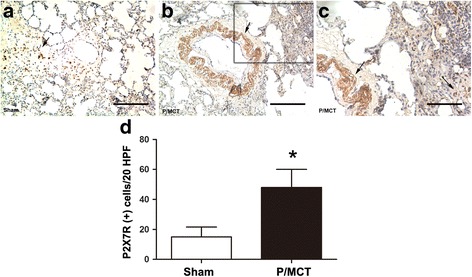
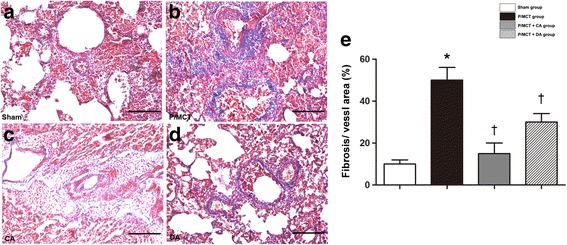
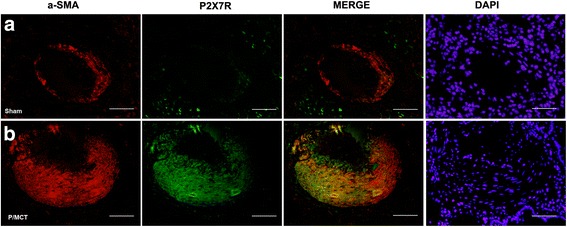
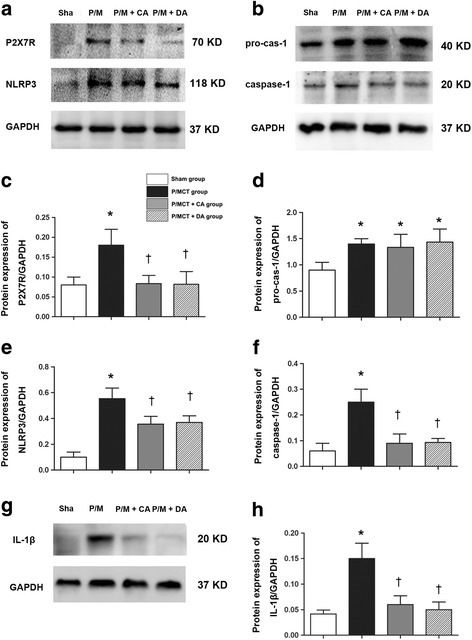
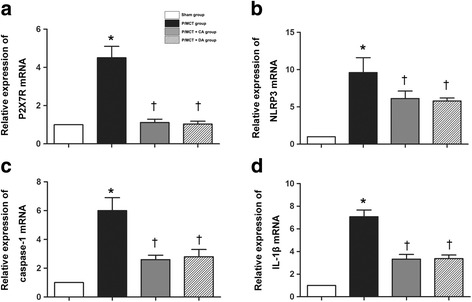
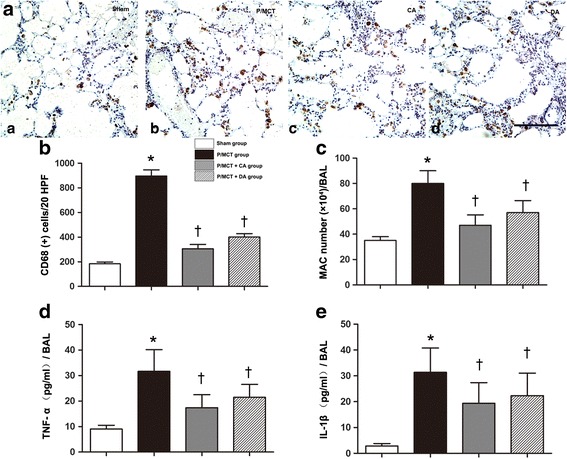
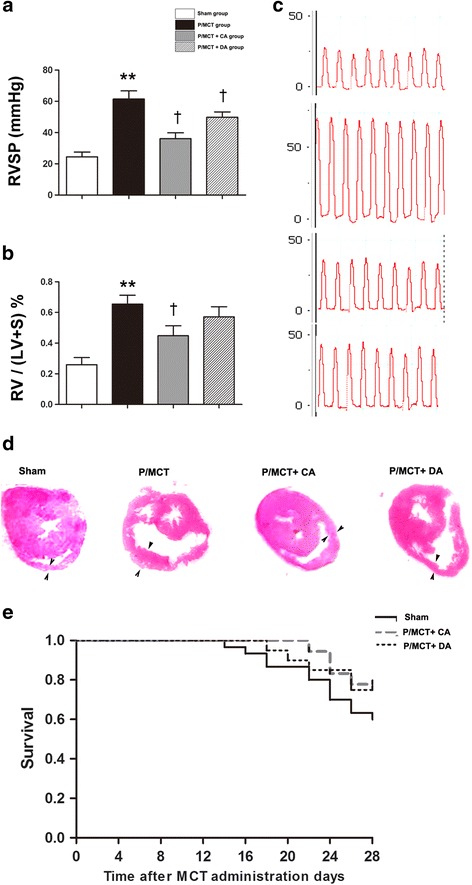
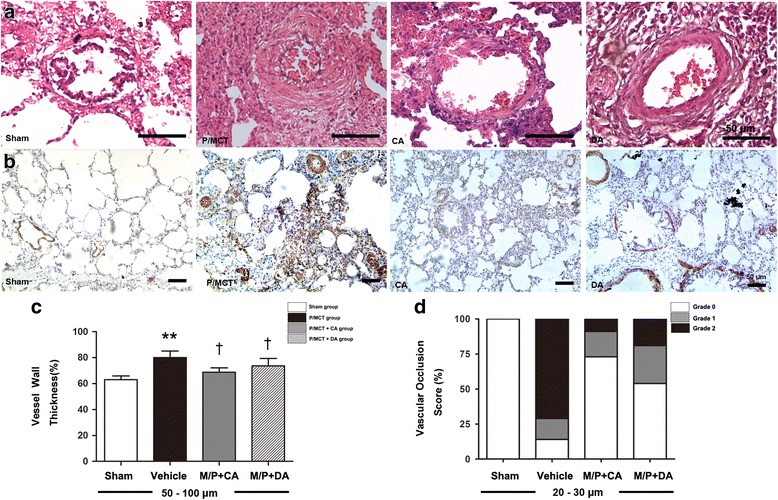
PH was induced by a single subcutaneous injection of monocrotaline (MCT) (60 mg/kg) on left pneumonectomised Sprague-Dawley rats, as validated by significant increases in pulmonary artery pressure and vessel wall thickness. Marked P2XR was detected by predominant PA immunostaining in lungs from PH rats. Western blot revealed a significant increase in the protein levels of P2XR as well as NLRP3 and caspase-1 in the diseased lung tissue compared with normal tissue. The rats received A-740003 (a selective P2X receptor antagonist, 30 mg/kg) daily starting from 1 week before or 2 weeks after MCT injection. Consequently, A-740003 reversed the NLRP3 inflammasome upregulation, significantly decreased the mean right ventricular (RV) pressure and RV hypertrophy, and reversed pulmonary arterial remodelling 4 weeks after MCT injection, as both a pretreatment and rescue intervention. Notably, A-740003 significantly reduced macrophage and pro-inflammatory cytokine levels, as measured via bronchoalveolar lavage. The recruitment of macrophages as well as collagen fibre deposition in the perivascular areas were also reduced, as confirmed by histological staining.
P2XR contributes to the pathogenesis of PH, probably in association with activation of the NLRP3 inflammasome. Blockade of P2X7R might be applied as a novel therapeutic approach for the treatment of PAH.
肺动脉高压(PAH)是一种缺乏有效治疗方法的毁灭性疾病。研究表明,含吡咯结构域的Nod样受体家族3(NLRP3)炎性小体参与PAH的发病机制,但上游分子P2X受体(P2XR)的作用尚未得到探索。我们研究了P2X7R在PAH发病机制中的作用。
通过对左肺切除的Sprague-Dawley大鼠单次皮下注射野百合碱(MCT,60mg/kg)诱导肺动脉高压,肺动脉压力和血管壁厚度显著增加证实了这一点。通过PA免疫染色在肺动脉高压大鼠的肺组织中检测到明显的P2XR。蛋白质印迹法显示,与正常组织相比,患病肺组织中P2XR以及NLRP3和半胱天冬酶-1的蛋白质水平显著增加。从MCT注射前1周或注射后2周开始,大鼠每天接受A-740003(一种选择性P2X受体拮抗剂,30mg/kg)。因此,作为预处理和挽救干预措施,A-740003在MCT注射4周后逆转了NLRP3炎性小体的上调,显著降低了平均右心室(RV)压力和RV肥厚,并逆转了肺动脉重塑。值得注意的是,通过支气管肺泡灌洗测量,A-740003显著降低了巨噬细胞和促炎细胞因子水平。组织学染色证实,血管周围区域的巨噬细胞募集以及胶原纤维沉积也减少。
P2XR参与肺动脉高压发病机制,可能与NLRP3炎性小体的激活有关。阻断P2X7R可能作为一种治疗PAH的新方法。