Seow Syntyche Ling Sing, Hong Sok Lai, Lee Guan Serm, Malek Sri Nurestri Abd, Sabaratnam Vikineswary
Mushroom Research Centre, Faculty of Science, University of Malaya, 50603, Kuala Lumpur, Malaysia.
Institute of Biological Sciences, Faculty of Science, University of Malaya, 50603, Kuala Lumpur, Malaysia.
BMC Complement Altern Med. 2017 Jun 24;17(1):334. doi: 10.1186/s12906-017-1837-6.
Ginger is a popular spice and food preservative. The rhizomes of the common ginger have been used as traditional medicine to treat various ailments. 6-Shogaol, a pungent compound isolated from the rhizomes of jahe gajah (Zingiber officinale var officinale) has shown numerous pharmacological activities, including neuroprotective and anti-neuroinflammatory activities. The aim of this study was to investigate the potential of 6-shogaol to mimic the neuritogenic activity of nerve growth factor (NGF) in rat pheochromocytoma (PC-12) cells.
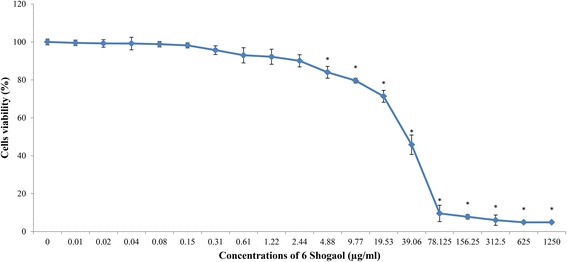
The cytotoxic effect of 6-shogaol was determined by 3-(4,5-dimethythiazol-2-yl)-2,5-diphenyltetrazolium bromide (MTT) assay. The neuritogenic activity was assessed by neurite outgrowth stimulation assay while the concentration of extracellular NGF in cell culture supernatant was assessed by enzyme-linked immunosorbent assay (ELISA). Involvement of cellular signaling pathways, mitogen-activated protein kinase kinase/extracellular signal-regulated kinase1/2 (MEK/ERK1/2) and phosphoinositide-3-kinase/protein kinase B (PI3K/AKT) in 6-shogaol-stimulated neuritogenesis were examined by using specific pharmacological inhibitors.
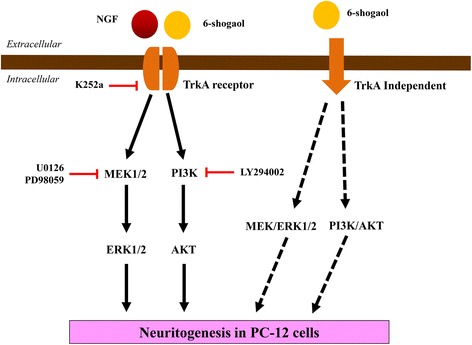
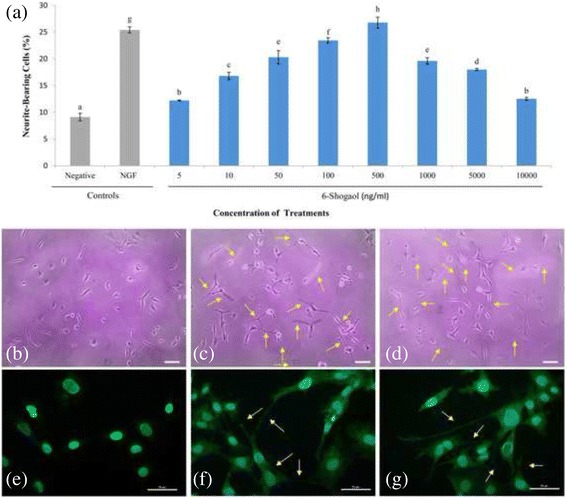
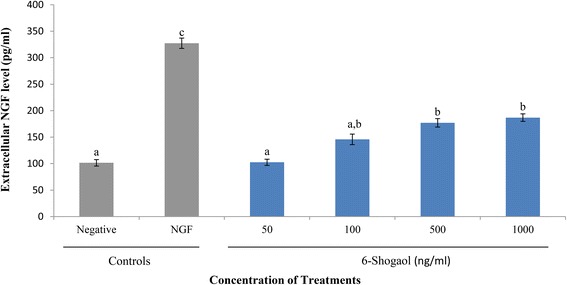
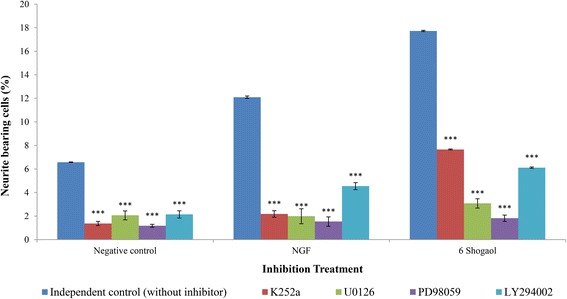
6-Shogaol (500 ng/ml) induced neuritogenesis that was comparable to NGF (50 ng/ml) and was not cytotoxic towards PC-12 cells. 6-Shogaol induced low level of NGF biosynthesis in PC-12 cells, showing that 6-shogaol stimulated neuritogenesis possibly by inducing NGF biosynthesis, and also acting as a substitute for NGF (NGF mimic) in PC-12 cells. The inhibitors of Trk receptor (K252a), MEK/ERK1/2 (U0126 and PD98059) and PI3K/AKT (LY294002) attenuated the neuritogenic activity of both NGF and 6-shogaol, respectively.
The present findings demonstrated that 6-shogaol induced neuritogenic activity in PC-12 cells via the activation MEK/ERK1/2 and PI3K/AKT signaling pathways. This study suggests that 6-shogaol could act as an NGF mimic, which may be beneficial for preventive and therapeutic uses in neurodegenerative diseases.
生姜是一种广受欢迎的香料和食品防腐剂。普通生姜的根茎已被用作传统药物来治疗各种疾病。6-姜烯酚是从爪哇姜(姜的变种)根茎中分离出的一种辛辣化合物,已显示出多种药理活性,包括神经保护和抗神经炎症活性。本研究的目的是探讨6-姜烯酚在大鼠嗜铬细胞瘤(PC-12)细胞中模拟神经生长因子(NGF)促神经突生长活性的潜力。
采用3-(4,5-二甲基噻唑-2-基)-2,5-二苯基四氮唑溴盐(MTT)法测定6-姜烯酚的细胞毒性作用。通过神经突生长刺激试验评估促神经突生长活性,同时采用酶联免疫吸附测定(ELISA)法评估细胞培养上清液中细胞外NGF的浓度。使用特异性药理抑制剂检测细胞信号通路丝裂原活化蛋白激酶激酶/细胞外信号调节激酶1/2(MEK/ERK1/2)和磷脂酰肌醇-3-激酶/蛋白激酶B(PI3K/AKT)在6-姜烯酚刺激的神经突生长中的作用。
6-姜烯酚(500 ng/ml)诱导的神经突生长与NGF(50 ng/ml)相当,且对PC-12细胞无细胞毒性。6-姜烯酚诱导PC-12细胞中NGF生物合成水平较低,表明6-姜烯酚可能通过诱导NGF生物合成刺激神经突生长,并且在PC-12细胞中可作为NGF的替代品(NGF模拟物)。Trk受体抑制剂(K252a)、MEK/ERK1/2抑制剂(U0126和PD98059)以及PI3K/AKT抑制剂(LY294002)分别减弱了NGF和6-姜烯酚的促神经突生长活性。
本研究结果表明,6-姜烯酚通过激活MEK/ERK1/2和PI3K/AKT信号通路在PC-12细胞中诱导神经突生长活性。本研究提示6-姜烯酚可作为NGF模拟物,这可能对神经退行性疾病的预防和治疗有益。