Sridhar Ashwin N, Briggs Tim P, Kelly John D, Nathan Senthil
Department of Urology, University College London Hospital NHS Trust, London, UK.
Division of Surgery and Cancer, University College London, London, UK.
Curr Urol Rep. 2017 Aug;18(8):58. doi: 10.1007/s11934-017-0710-y.
There has been a rapid and widespread adoption of the robotic surgical system with a lag in the development of a comprehensive training and credentialing framework. A literature search on robotic surgical training techniques and benchmarks was conducted to provide an evidence-based road map for the development of a robotic surgical skills for the novice robotic surgeon.
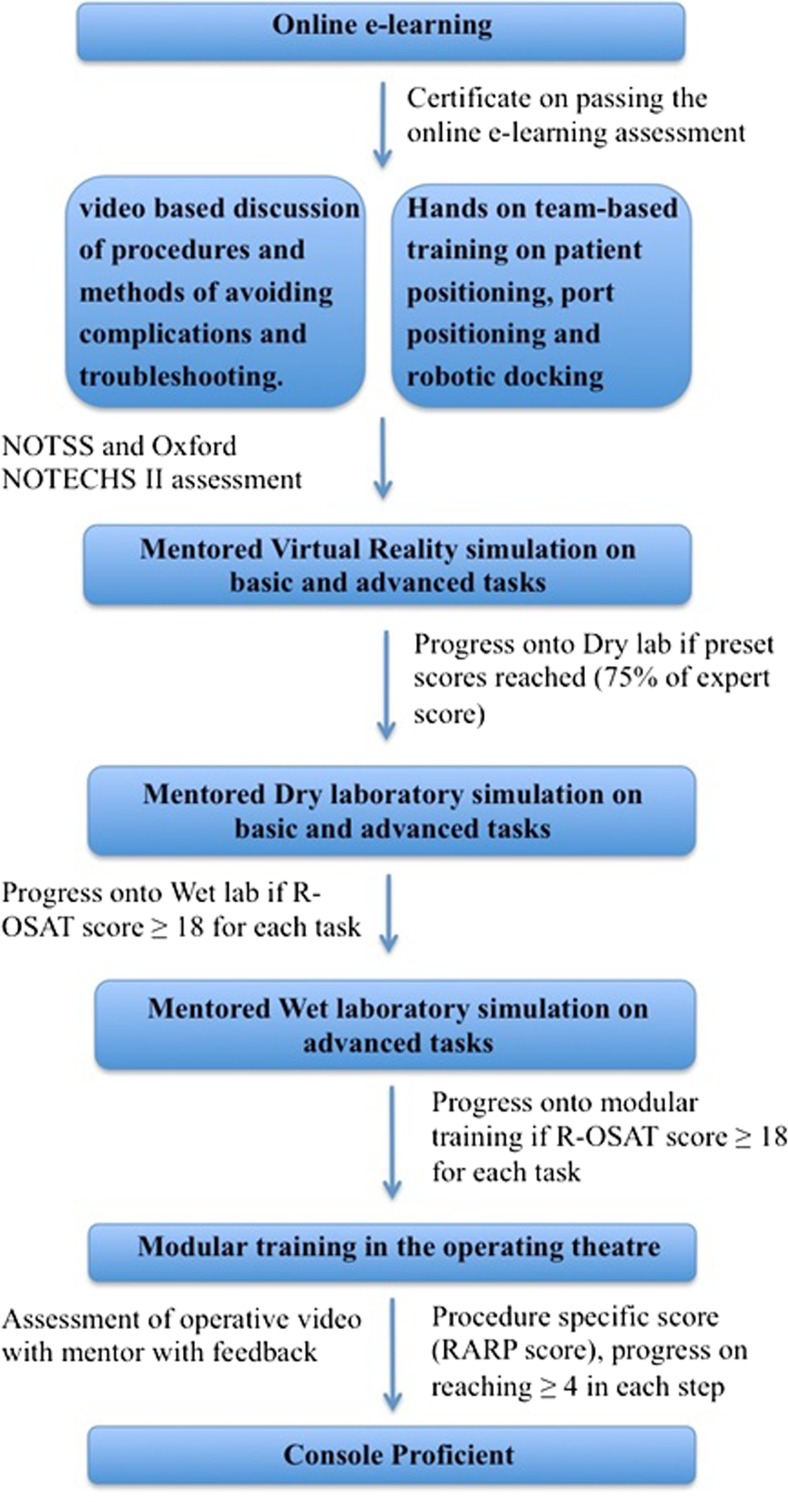
A structured training curriculum is suggested incorporating evidence-based training techniques and benchmarks for progress. This usually involves sequential progression from observation, case assisting, acquisition of basic robotic skills in the dry and wet lab setting along with achievement of individual and team-based non-technical skills, modular console training under supervision, and finally independent practice. Robotic surgical training must be based on demonstration of proficiency and safety in executing basic robotic skills and procedural tasks prior to independent practice.
机器人手术系统已迅速广泛采用,但在全面的培训和认证框架的发展方面存在滞后。进行了一项关于机器人手术培训技术和基准的文献检索,以提供一个基于证据的路线图,用于为新手机器人外科医生开发机器人手术技能。
建议采用结构化培训课程,纳入基于证据的培训技术和进步基准。这通常包括从观察、病例协助、在干式和湿式实验室环境中获取基本机器人技能,以及实现个人和团队的非技术技能,在监督下进行模块化控制台培训,最后进行独立实践。在独立实践之前,机器人手术培训必须基于在执行基本机器人技能和程序任务方面的熟练程度和安全性的证明。