Ferreira Sabrina S, Nunes Fernanda P B, Casagrande Felipe B, Martins Joilson O
Laboratory of Immunoendocrinology, Department of Clinical and Toxicological Analyses, Faculty of Pharmaceutical Sciences of University São Paulo (FCF/USP), São Paulo, Brazil.
Front Immunol. 2017 Jun 9;8:633. doi: 10.3389/fimmu.2017.00633. eCollection 2017.
The role of insulin in lung remodeling in a model of asthma in healthy and diabetic mice was evaluated.
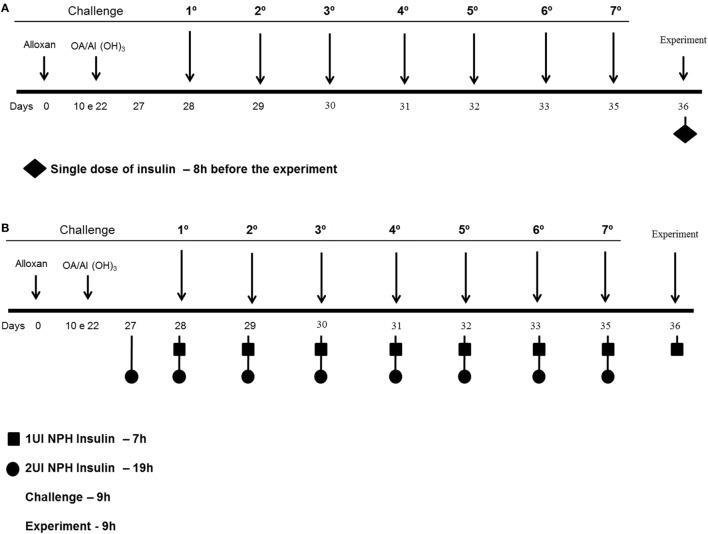
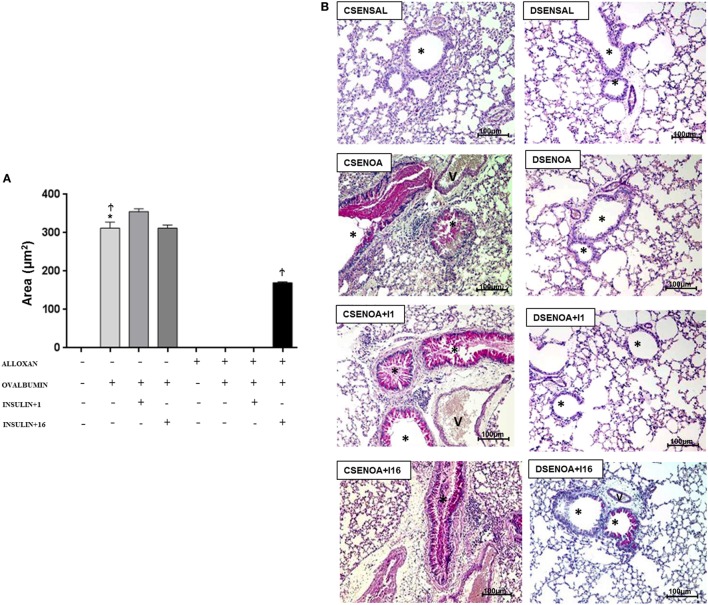
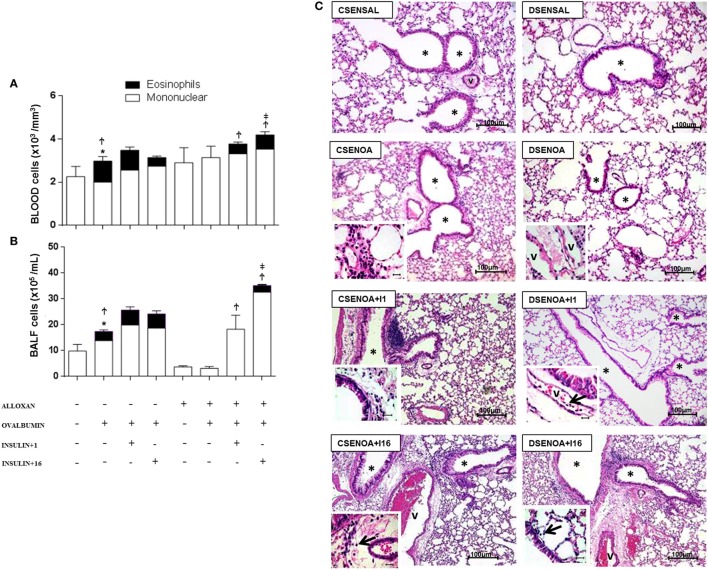
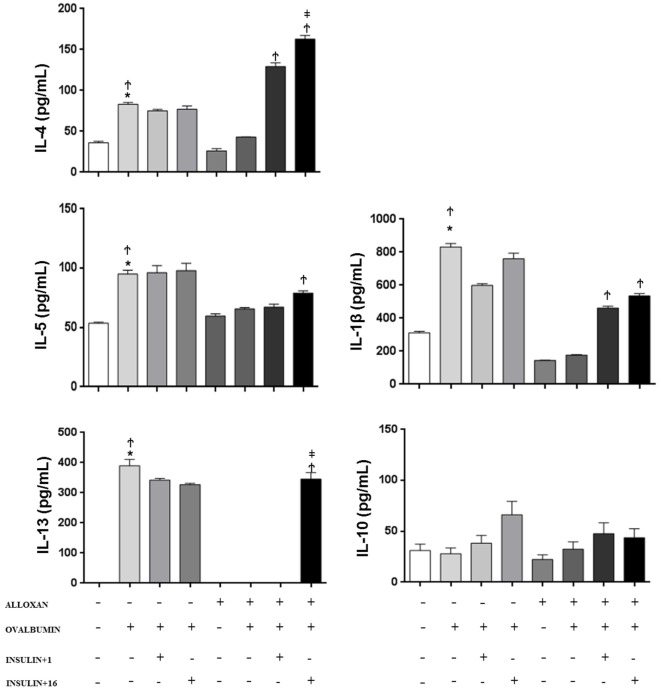
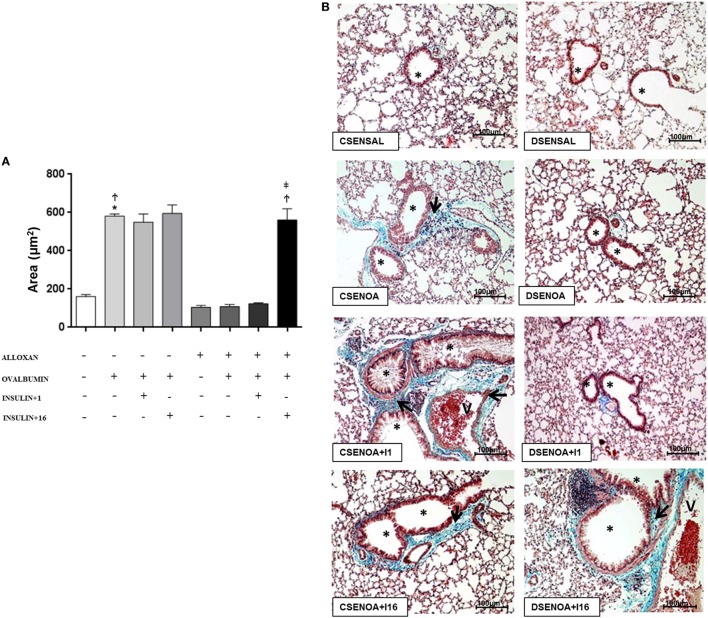
Diabetic male BALB/c mice (alloxan, 50 mg/kg, intravenous) and controls were sensitized by subcutaneous (s.c.) injection of ovalbumin (OA, 20 µg) in aluminum hydroxide (Al(OH), 2 mg) 10 days after the alloxan injection and received the same dose 12 days later. Six days after the last sensitization, animals were nebulized with OA solution for 7 days. The first set of diabetic and control mice received 2 and 1 IU, respectively, of s.c. neutral protamine Hagedorn (NPH) insulin and were analyzed 8 h later. The second set of diabetic and control mice received 2 and 1 IU, respectively, of insulin 12 h before the OA challenge and half doses of insulin 2 h before each the seven OA challenges. Twenty-four hours after the last challenge, the following analyses were performed: (a) quantification of the cells in the bronchoalveolar lavage fluid (BALF), the white cell count, and blood glucose; (b) morphological analysis of lung tissues by hematoxylin and eosin staining; (c) quantification of collagen deposition in lung tissues and mucus by morphometric analysis of histological sections stained with Masson's trichrome and periodic acid-Schiff (PAS), respectively; and (d) quantification of the cytokine concentrations (IL-4, IL-5, and IL-13) in the BALF supernatant.
Compared to controls, diabetic mice had significantly reduced inflammatory cells (81%) in the BALF, no eosinophils in the BALF and peripheral blood and reduced collagen deposition and mucus in the lungs. BALF concentrations of IL-4 (48%) and IL-5 (31%) decreased and IL-13 was absent. A single dose of insulin restored peripheral blood eosinophils and BALF mononuclear cells but not BALF eosinophils, collagen deposition, and mucus levels. However, multiple doses of insulin restored both total cells and eosinophils in the BALF and peripheral blood, BALF cytokines, and collagen deposition and mucus secretion into the lungs.
The results suggest that insulin modulates the production/release of cytokines, cell migration, deposition of collagen, and mucus secretion in lung remodeling of a mouse model of asthma.
评估了胰岛素在健康和糖尿病小鼠哮喘模型中肺重塑过程中的作用。
糖尿病雄性BALB/c小鼠(用50mg/kg四氧嘧啶静脉注射)和对照组小鼠,在四氧嘧啶注射10天后,通过皮下注射氢氧化铝(2mg)中的卵清蛋白(20μg)进行致敏,并在12天后接受相同剂量的致敏。在最后一次致敏6天后,用卵清蛋白溶液对动物进行雾化7天。第一组糖尿病和对照小鼠分别皮下注射2和1IU的中性鱼精蛋白锌胰岛素(NPH),并在8小时后进行分析。第二组糖尿病和对照小鼠在卵清蛋白激发前12小时分别注射2和1IU胰岛素,并在七次卵清蛋白激发前2小时注射半剂量胰岛素。在最后一次激发24小时后,进行以下分析:(a)支气管肺泡灌洗液(BALF)中的细胞定量分析、白细胞计数以及血糖测定;(b)通过苏木精和伊红染色对肺组织进行形态学分析;(c)分别通过对用马松三色染色和过碘酸-希夫(PAS)染色的组织学切片进行形态计量分析,对肺组织中的胶原蛋白沉积和黏液进行定量分析;(d)对BALF上清液中的细胞因子浓度(IL-4、IL-5和IL-13)进行定量分析。
与对照组相比,糖尿病小鼠BALF中的炎性细胞显著减少(降低81%),BALF和外周血中无嗜酸性粒细胞,肺中的胶原蛋白沉积和黏液减少。BALF中IL-4(降低48%)和IL-5(降低31%)浓度下降,且不存在IL-13。单剂量胰岛素可恢复外周血嗜酸性粒细胞和BALF单核细胞,但不能恢复BALF嗜酸性粒细胞、胶原蛋白沉积和黏液水平。然而,多剂量胰岛素可恢复BALF和外周血中的总细胞数和嗜酸性粒细胞、BALF细胞因子以及肺中的胶原蛋白沉积和黏液分泌。
结果表明,胰岛素在小鼠哮喘模型的肺重塑过程中调节细胞因子的产生/释放、细胞迁移、胶原蛋白沉积和黏液分泌。