Dong Liyang, Wang Ying, Zheng Tingting, Pu Yanan, Ma Yongbin, Qi Xin, Zhang Wenzhe, Xue Fei, Shan Zirui, Liu Jiameng, Wang Xuefeng, Mao Chaoming
Department of Nuclear Medicine, The Affiliated Hospital of Jiangsu University, Zhenjiang, Jiangsu, 212000, People's Republic of China.
Department of Respiratory Diseases, The Affiliated Huai'an Hospital of Xuzhou Medical University, Huai'an, Jiangsu, 223002, People's Republic of China.
Stem Cell Res Ther. 2021 Jan 6;12(1):4. doi: 10.1186/s13287-020-02072-0.
As one of the main functional forms of mesenchymal stem cells (MSCs), MSC-derived extracellular vesicles (MSC-EVs) have shown an alternative therapeutic option in experimental models of allergic asthma. Oxygen concentration plays an important role in the self-renewal, proliferation, and EV release of MSCs and a recent study found that the anti-asthma effect of MSCs was enhanced by culture in hypoxic conditions. However, the potential of hypoxic MSC-derived EVs (Hypo-EVs) in asthma is still unknown.
BALB/c female mice were sensitized and challenged with ovalbumin (OVA), and each group received PBS, normoxic human umbilical cord MSC-EVs (Nor-EVs), or Hypo-EVs weekly. After treatment, the animals were euthanized, and their lungs and bronchoalveolar lavage fluid (BALF) were collected. With the use of hematoxylin and eosin (HE), periodic acid-Schiff (PAS) and Masson's trichrome staining, enzyme-linked immune sorbent assay (ELISA), Western blot analysis, and real-time PCR, the inflammation and collagen fiber content of airways and lung parenchyma were investigated.
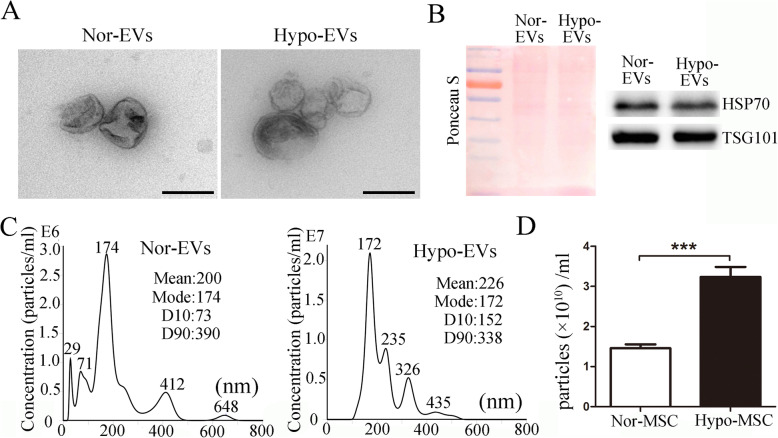
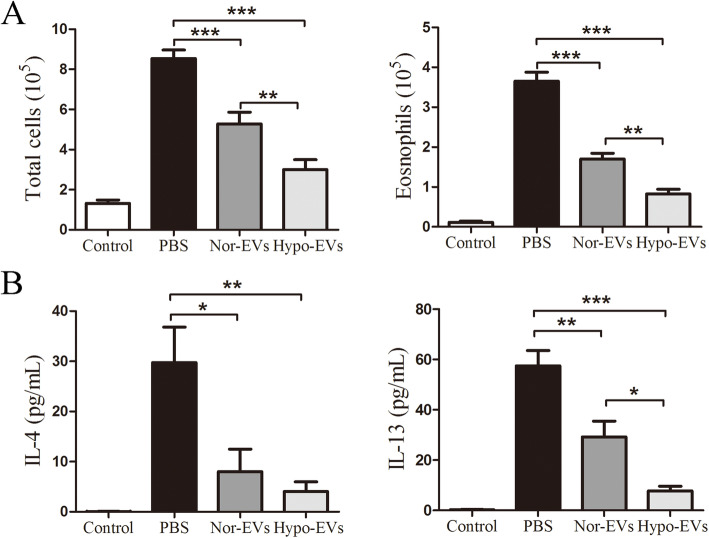
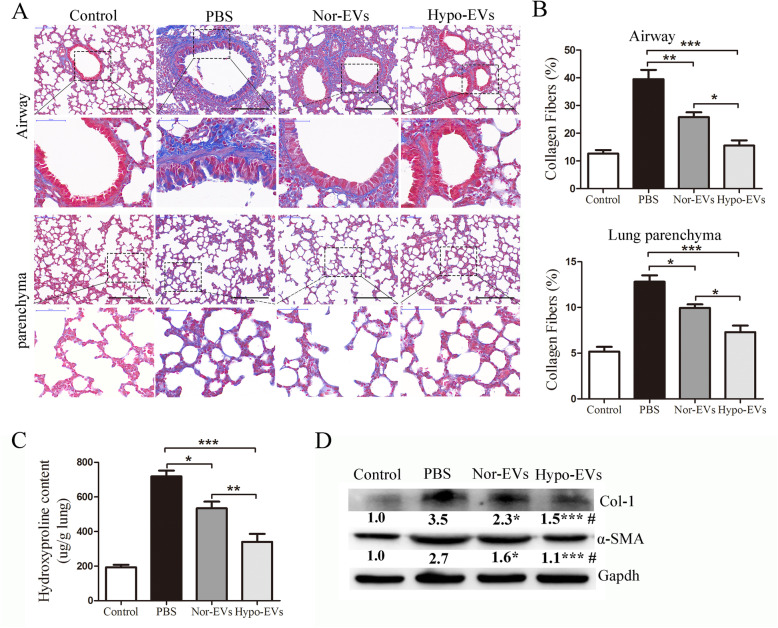
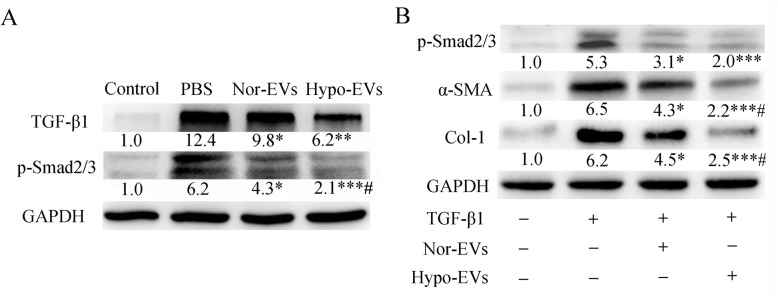
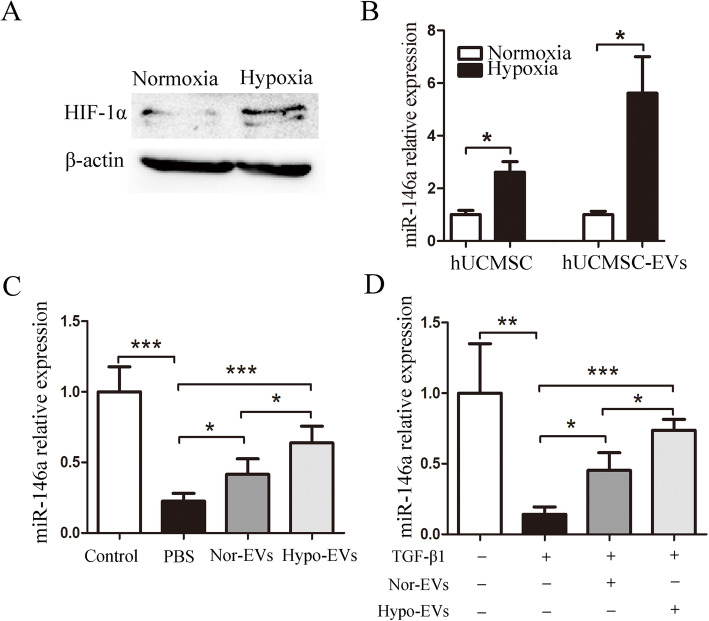
Hypoxic environment can promote human umbilical cord MSCs (hUCMSCs) to release more EVs. In OVA animals, the administration of Nor-EVs or Hypo-EVs significantly ameliorated the BALF total cells, eosinophils, and pro-inflammatory mediators (IL-4 and IL-13) in asthmatic mice. Moreover, Hypo-EVs were generally more potent than Nor-EVs in suppressing airway inflammation in asthmatic mice. Compared with Nor-EVs, Hypo-EVs further prevented mouse chronic allergic airway remodeling, concomitant with the decreased expression of pro-fibrogenic markers α-smooth muscle actin (α-SMA), collagen-1, and TGF-β1-p-smad2/3 signaling pathway. In vitro, Hypo-EVs decreased the expression of p-smad2/3, α-SMA, and collagen-1 in HLF-1 cells (human lung fibroblasts) stimulated by TGF-β1. In addition, we showed that miR-146a-5p was enriched in Hypo-EVs compared with that in Nor-EVs, and Hypo-EV administration unregulated the miR-146a-5p expression both in asthma mice lung tissues and in TGF-β1-treated HLF-1. More importantly, decreased miR-146a-5p expression in Hypo-EVs impaired Hypo-EV-mediated lung protection in OVA mice.
Our findings provided the first evidence that hypoxic hUCMSC-derived EVs attenuated allergic airway inflammation and airway remodeling in chronic asthma mice, potentially creating new avenues for the treatment of asthma.
作为间充质干细胞(MSCs)的主要功能形式之一,源自MSCs的细胞外囊泡(MSC-EVs)已在过敏性哮喘实验模型中显示出一种替代治疗选择。氧浓度在MSCs的自我更新、增殖和细胞外囊泡释放中起重要作用,最近一项研究发现,在低氧条件下培养可增强MSCs的抗哮喘作用。然而,低氧来源的MSC-EVs(Hypo-EVs)在哮喘中的潜力仍不清楚。
用卵清蛋白(OVA)对BALB/c雌性小鼠进行致敏和激发,每组每周接受磷酸盐缓冲液(PBS)、常氧人脐带MSC-EVs(Nor-EVs)或Hypo-EVs。治疗后,对动物实施安乐死,并收集其肺组织和支气管肺泡灌洗液(BALF)。使用苏木精和伊红(HE)染色、过碘酸希夫(PAS)染色和Masson三色染色、酶联免疫吸附测定(ELISA)、蛋白质印迹分析和实时聚合酶链反应(PCR),研究气道和肺实质的炎症及胶原纤维含量。
低氧环境可促进人脐带间充质干细胞(hUCMSCs)释放更多细胞外囊泡。在OVA诱导的动物中,给予Nor-EVs或Hypo-EVs可显著改善哮喘小鼠BALF中的总细胞数、嗜酸性粒细胞以及促炎介质(白细胞介素-4和白细胞介素-13)。此外,在抑制哮喘小鼠气道炎症方面,Hypo-EVs通常比Nor-EVs更有效。与Nor-EVs相比,Hypo-EVs进一步预防了小鼠慢性过敏性气道重塑,同时降低了促纤维化标志物α-平滑肌肌动蛋白(α-SMA)、胶原蛋白-1以及转化生长因子-β1-p-smad2/3信号通路的表达。在体外,Hypo-EVs降低了转化生长因子-β1刺激的人肺成纤维细胞(HLF-1细胞)中p-smad2/3、α-SMA和胶原蛋白-1的表达。此外,我们发现与Nor-EVs相比,Hypo-EVs中富含miR-146a-5p,给予Hypo-EVs可调节哮喘小鼠肺组织以及转化生长因子-β1处理的HLF-1细胞中miR-146a-5p的表达。更重要的是,Hypo-EVs中miR-146a-5p表达降低削弱了其在OVA小鼠中对肺的保护作用。
我们的研究结果首次证明,低氧hUCMSC来源的细胞外囊泡可减轻慢性哮喘小鼠的过敏性气道炎症和气道重塑,这可能为哮喘治疗开辟新途径。