Jang Hongchul, Rusconi Roberto, Stocker Roman
Ralph M. Parsons Laboratory, Department of Civil & Environmental Engineering, Massachusetts Institute of Technology, Cambridge, MA 02139 USA.
Department of Civil, Environmental and Geomatic Engineering Institute for Environmental Engineering, ETH Zurich Zurich, 8093 Switzerland.
NPJ Biofilms Microbiomes. 2017 Mar 3;3:6. doi: 10.1038/s41522-017-0014-5. eCollection 2017.
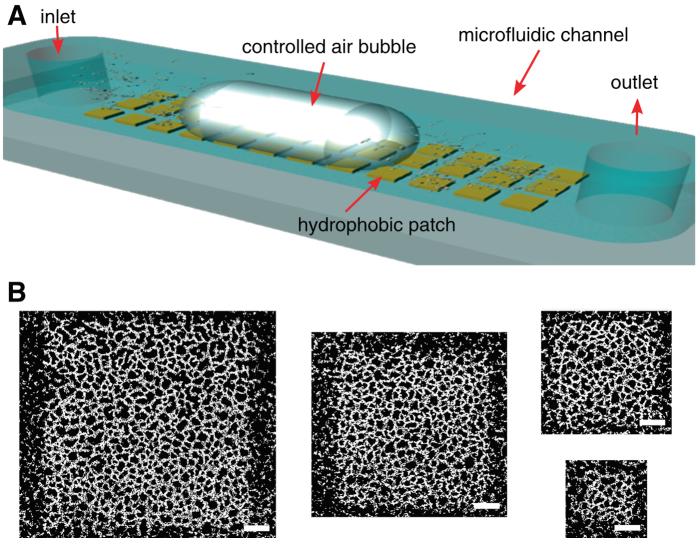
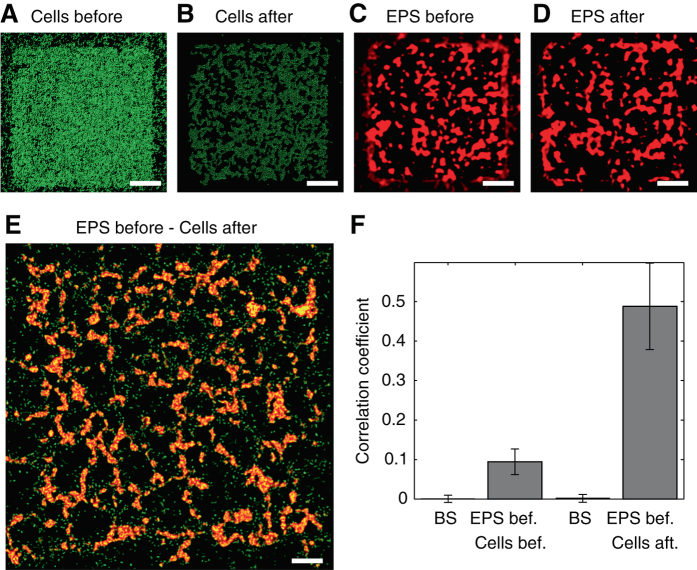
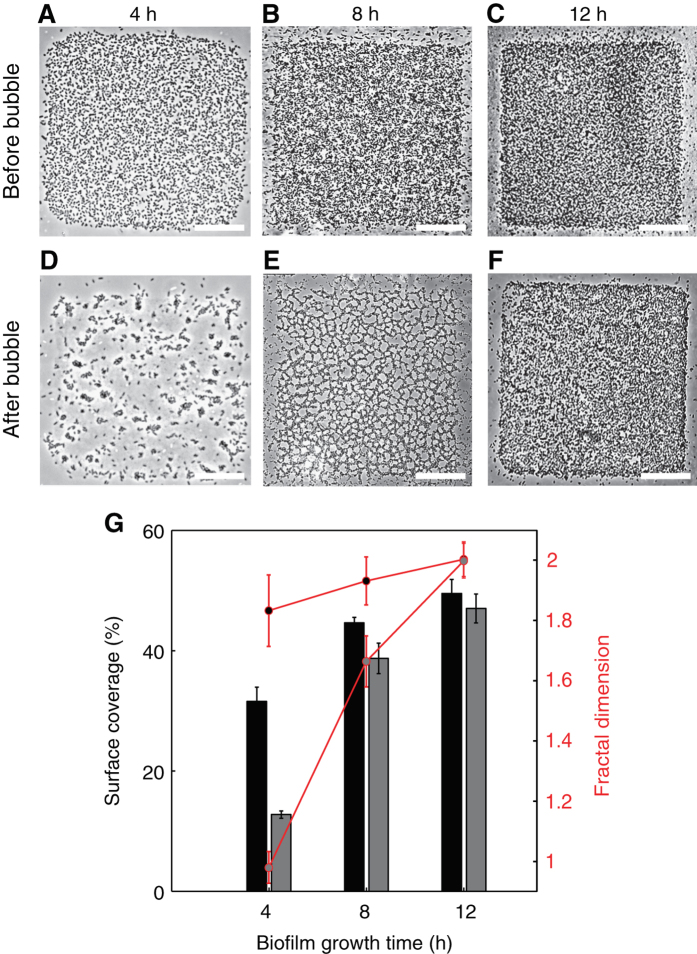
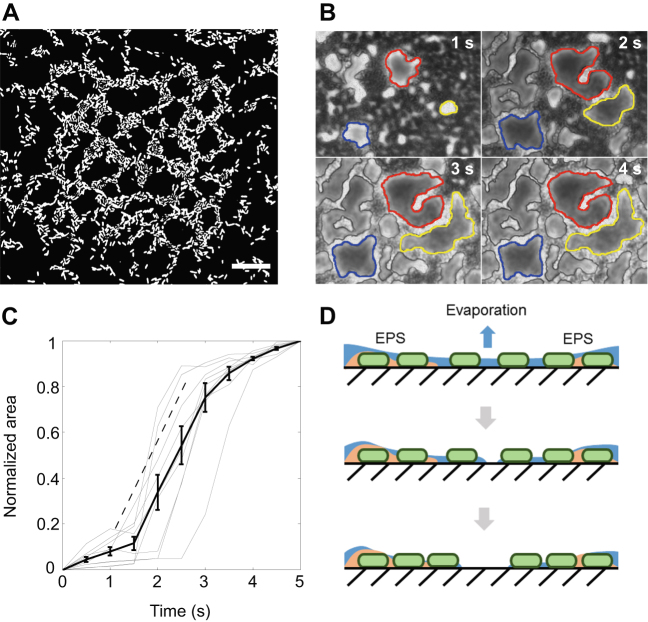
Bacteria often adhere to surfaces, where they form communities known as biofilms. Recently, it has been shown that biofilm formation initiates with the microscopically heterogeneous deposition of a skeleton of extracellular polymeric substances (EPS) by individual cells crawling on the surface, followed by growth of the biofilm into a surface-covering continuum. Here we report microfluidic experiments with biofilms showing that their "hidden" heterogeneity can affect the later dynamics of their disruption. Using controlled air bubbles as a model for mechanical insult, we demonstrate that biofilm disruption is strongly dependent on biofilm age, and that disruption to early-stage biofilms can take the shape of a semi-regular pattern of ~15 µm diameter holes from which bacteria have been removed. We explain hole formation in terms of the rupture and retreat of the thin liquid layer created by the long bubble, which scrapes bacteria off the surface and rearranges their distribution. We find that the resulting pattern correlates with the spatial distribution of EPS: holes form where there is less EPS, whereas regions with more EPS act as strongholds against the scraping liquid front. These results show that heterogeneity in the microscale EPS skeleton of biofilms has profound consequences for later dynamics, including disruption. Because few attached cells suffice to regrow a biofilm, these results point to the importance of considering microscale heterogeneity when designing and assessing the effectiveness of biofilm removal strategies by mechanical forces.
细菌常常附着于表面,在那里它们形成被称为生物膜的群落。最近的研究表明,生物膜的形成始于单个细胞在表面爬行时以微观异质方式沉积细胞外聚合物(EPS)骨架,随后生物膜生长为覆盖表面的连续体。在此,我们报告了对生物膜进行的微流控实验,结果表明其“隐藏”的异质性会影响其后续的破坏动态。我们使用受控气泡作为机械损伤的模型,证明生物膜的破坏强烈依赖于生物膜的年龄,并且早期生物膜的破坏会呈现出一种直径约15微米的半规则孔洞模式,细菌已从这些孔洞中被清除。我们从长气泡产生的薄液层的破裂和退缩角度解释了孔洞的形成,长气泡将细菌从表面刮下并重新排列其分布。我们发现所形成的模式与EPS的空间分布相关:孔洞形成于EPS较少的地方,而EPS较多的区域则作为抵御刮擦液前沿的据点。这些结果表明,生物膜微观尺度EPS骨架中的异质性对包括破坏在内的后续动态具有深远影响。由于很少的附着细胞就足以使生物膜重新生长,这些结果表明在设计和评估通过机械力去除生物膜策略的有效性时,考虑微观尺度异质性的重要性。