Mazzola Priscila Nicolao, Teixeira Bruno Costa, Schirmbeck Gabriel Henrique, Reischak-Oliveira Alvaro, Derks Terry G J, van Spronsen Francjan J, Dutra-Filho Carlos Severo, Schwartz Ida Vanessa Doederlein
Programa de Pós-Graduação em Ciências Biológicas: Bioquímica, Universidade Federal do Rio Grande do Sul (UFRGS), Rua Ramiro Barcelos 2600 anexo, 90035-003, Porto Alegre, Brazil.
Beatrix Children's Hospital, University Medical Center Groningen, University of Groningen, PO Box 30.001, 9700 RB, Groningen, The Netherlands.
Mol Genet Metab Rep. 2015 Oct 22;5:55-59. doi: 10.1016/j.ymgmr.2015.10.003. eCollection 2015 Dec.
In phenylketonuria, dietary treatment prevents most of the severe brain disease. However, patients have to follow a diet restricted in several natural components, what may cause decreased bone density and obesity. Exercise is known to improve both mental functioning and bone density also avoiding obesity, and could optimize aspects of central and peripheral outcome, regardless changes in phenylalanine (Phe) levels. However, the acute effects of exercise on metabolic parameters in phenylketonuria patients are unknown and thereby long-term adaptations are unclear. Therefore, this study aimed to evaluate patients' basal metabolic rate (BMR), and their acute response to an aerobic exercise session on plasma concentrations of Phe, tyrosine (Tyr), and branched-chain amino acids (BCAA), as well as metabolic and hormonal responses.
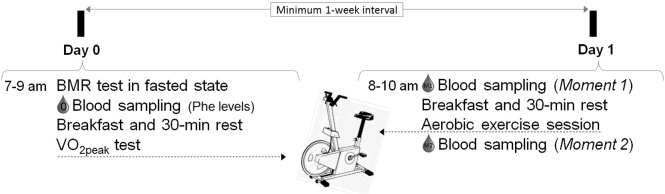
Five early- and four late diagnosed phenylketonuria patients aged 21 ± 4 years and 17 sex-, age-, and BMI-matched controls were evaluated for BMR, peak oxygen consumption (VO) and plasma amino acid, glucose, lipid profile and hormonal levels. At least one week later, participants performed a 30-min aerobic exercise session (intensities individually calculated using the VO results). Blood samples were collected in fasted state (moment 1, M1) and immediately after a small breakfast, which included the metabolic formula for patients but not for controls, and the exercise session (moment 2, M2).
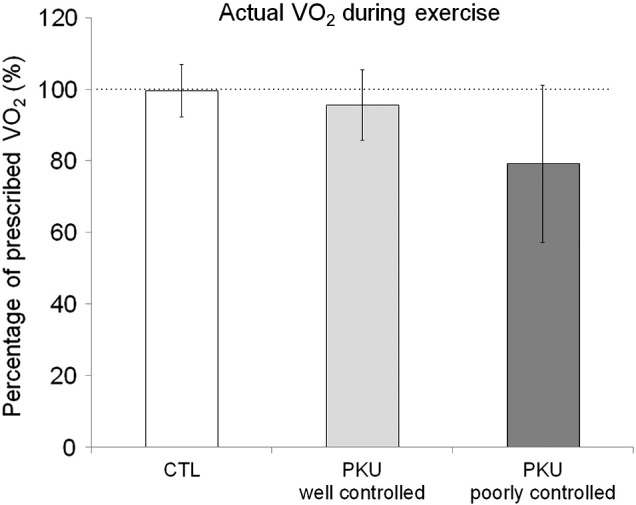
Phenylketonuria patients and controls showed similar BMR and physical capacities. At M1, patients presented higher Phe concentration and Phe/Tyr ratio; and lower levels of BCAA and total cholesterol than controls. Besides that, poorly controlled patients tended to stay slightly below the prescribed VO during exercise. Both patients and controls showed increased levels of total cholesterol and LDL at M2 compared with M1. Only controls showed increased levels of Tyr, lactate, and HDL; and decreased Phe/Tyr ratio and glucose levels at M2 compared to values at M1.
Acute aerobic exercise followed by a Phe-restricted breakfast did not change Phe concentrations in treated phenylketonuria patients, but it was associated with decreased Phe/Tyr only in controls. Further studies are necessary to confirm our results in a higher number of patients.
在苯丙酮尿症中,饮食治疗可预防大多数严重脑部疾病。然而,患者必须遵循限制多种天然成分的饮食,这可能导致骨密度降低和肥胖。已知运动可改善心理功能和骨密度,还能避免肥胖,并且无论苯丙氨酸(Phe)水平如何变化,都可优化中枢和外周结局的各个方面。然而,运动对苯丙酮尿症患者代谢参数的急性影响尚不清楚,因此长期适应性也不明确。因此,本研究旨在评估患者的基础代谢率(BMR),以及他们对有氧运动 session 的急性反应,包括血浆中苯丙氨酸、酪氨酸(Tyr)和支链氨基酸(BCAA)浓度,以及代谢和激素反应。
对 5 名早诊断和 4 名晚诊断的 21±4 岁苯丙酮尿症患者以及 17 名性别、年龄和体重指数匹配的对照者进行基础代谢率、峰值耗氧量(VO)以及血浆氨基酸、葡萄糖、血脂谱和激素水平的评估。至少一周后,参与者进行 30 分钟的有氧运动 session(强度根据 VO 结果单独计算)。在空腹状态(时刻 1,M1)以及食用一份小早餐(其中包括患者的代谢配方但不包括对照者的)和运动 session 后立即(时刻 2,M2)采集血样。
苯丙酮尿症患者和对照者的基础代谢率和身体能力相似。在 M1 时,患者的苯丙氨酸浓度和苯丙氨酸/酪氨酸比值较高;支链氨基酸和总胆固醇水平低于对照者。除此之外,控制不佳的患者在运动期间往往略低于规定的 VO。与 M1 相比,患者和对照者在 M2 时的总胆固醇和低密度脂蛋白水平均升高。只有对照者在 M2 时酪氨酸、乳酸和高密度脂蛋白水平升高;与 M1 时的值相比,苯丙氨酸/酪氨酸比值和葡萄糖水平降低。
在食用低苯丙氨酸早餐后进行的急性有氧运动并未改变接受治疗的苯丙酮尿症患者的苯丙氨酸浓度,但仅在对照者中与苯丙氨酸/酪氨酸比值降低有关。需要进一步研究以在更多患者中证实我们的结果。