Zoeller Jason J, Bronson Roderick T, Selfors Laura M, Mills Gordon B, Brugge Joan S
Department of Cell Biology, Harvard Medical School, 240 Longwood Avenue, Boston, 02115 MA USA.
Rodent Histopathology Core, Harvard Medical School, Boston, MA USA.
NPJ Breast Cancer. 2017 May 1;3:18. doi: 10.1038/s41523-017-0020-z. eCollection 2017.
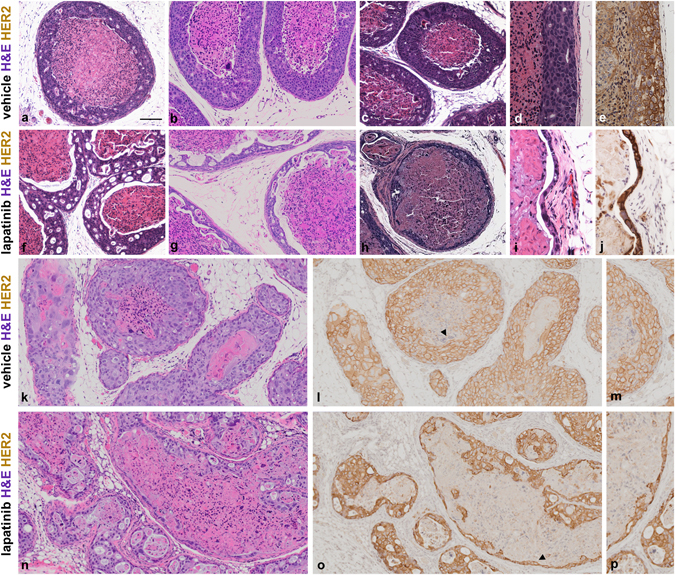
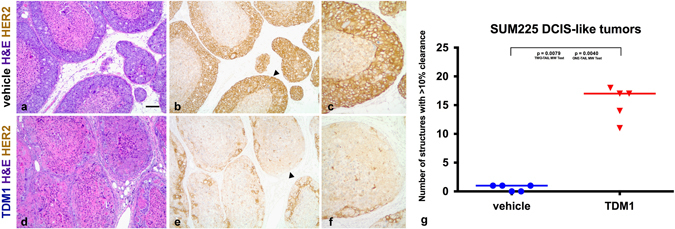
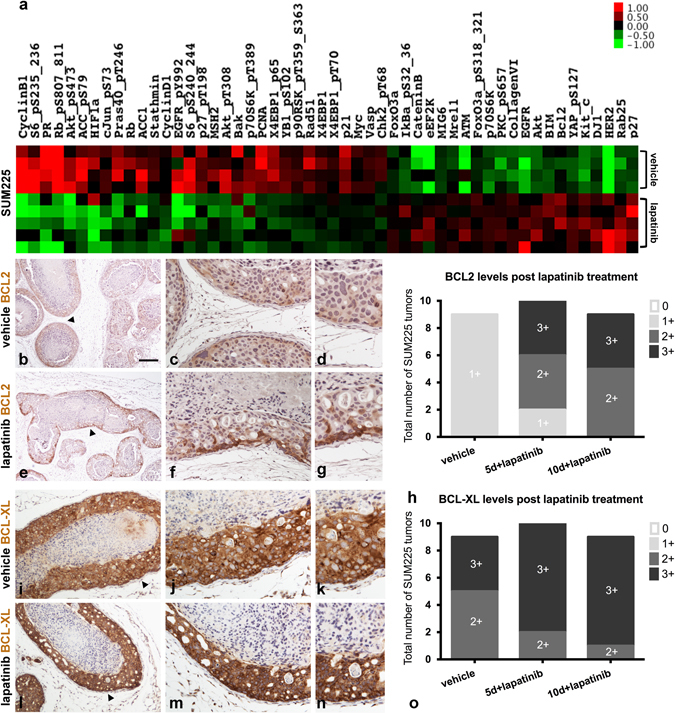
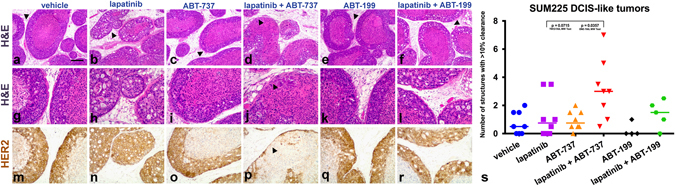
Several lines of evidence suggest that components of the tumor microenvironment, specifically basement membrane and extracellular matrix proteins, influence drug sensitivities. We previously reported differential drug sensitivity of tumor cells localized adjacent to laminin-rich extracellular matrix in three-dimensional tumor spheroid cultures. To evaluate whether differential intra-tumor responses to targeted therapy occur in vivo, we examined the sensitivity of human epidermal growth factor receptor 2-positive tumors to lapatinib using a previously described ductal carcinoma in situ-like model characterized by tumor cell confinement within ductal structures surrounded by an organized basement membrane. Here we show that tumor cells localized to a 'niche' in the outer layer of the intraductal tumors adjacent to myoepithelial cells and basement membrane are resistant to lapatinib. We found that the pro-survival protein BCL2 is selectively induced in the niche-protected tumor cells following lapatinib treatment, and combined inhibition of HER2 and BCL-2/XL enhanced targeting of these residual tumor cells. Elimination of the niche-protected tumor cells was achieved with the HER2 antibody-drug conjugate T-DM1, which delivers a chemotherapeutic payload. Thus, these studies provide evidence that subpopulations of tumor cells within specific microenvironmental niches can adapt to inhibition of critical oncogenic pathways, and furthermore reveal effective strategies to eliminate these resistant subpopulations.
多条证据表明,肿瘤微环境的成分,特别是基底膜和细胞外基质蛋白,会影响药物敏感性。我们之前报道过,在三维肿瘤球体培养中,定位于富含层粘连蛋白的细胞外基质附近的肿瘤细胞具有不同的药物敏感性。为了评估肿瘤内对靶向治疗的不同反应在体内是否会发生,我们使用了一种先前描述的原位导管癌样模型,该模型的特征是肿瘤细胞局限于由有组织的基底膜包围的导管结构内,来检测人表皮生长因子受体2阳性肿瘤对拉帕替尼的敏感性。在这里我们表明,定位于导管内肿瘤外层与肌上皮细胞和基底膜相邻的“生态位”中的肿瘤细胞对拉帕替尼具有抗性。我们发现,在拉帕替尼治疗后,促生存蛋白BCL2在生态位保护的肿瘤细胞中被选择性诱导,并且联合抑制HER2和BCL-2/XL可增强对这些残留肿瘤细胞的靶向作用。使用携带化疗药物的HER2抗体-药物偶联物T-DM1可实现对生态位保护的肿瘤细胞的清除。因此,这些研究提供了证据,证明特定微环境生态位内的肿瘤细胞亚群可以适应对关键致癌途径的抑制,并且还揭示了消除这些抗性亚群的有效策略。