Steele Kendra H, Stone Barbara J, Franklin Kathleen M, Fath-Goodin Angelika, Zhang Xiufeng, Jiang Haobo, Webb Bruce A, Geisler Christoph
ParaTechs Corporation, Lexington, KY.
Dept. of Entomology and Plant Pathology, Oklahoma State University, Stillwater, Oklahoma.
Biotechnol Prog. 2017 Nov;33(6):1496-1507. doi: 10.1002/btpr.2516. Epub 2017 Jul 6.
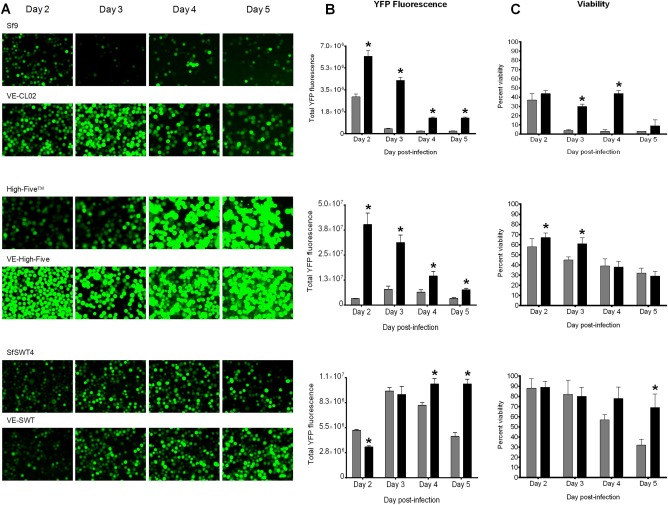
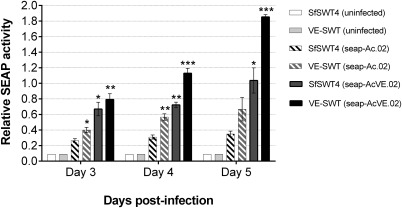
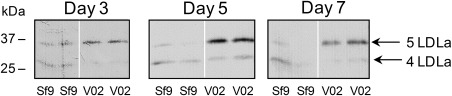
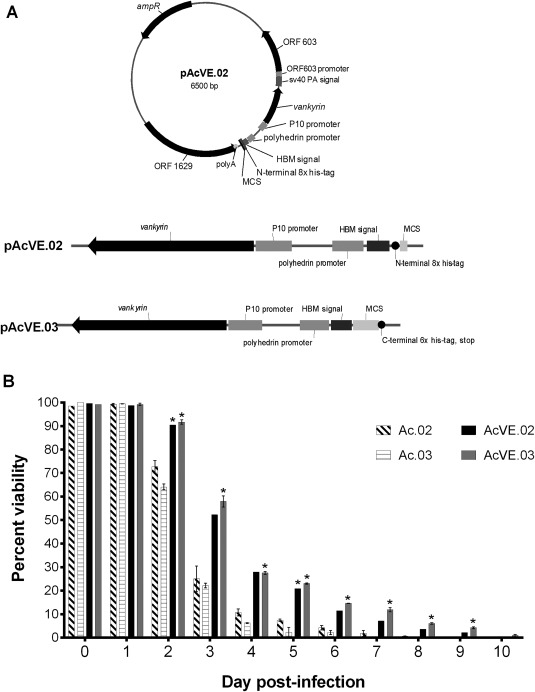
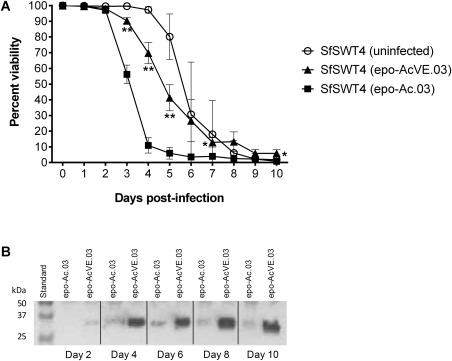
The baculovirus expression vector system (BEVS) is a widely used platform for the production of recombinant eukaryotic proteins. However, the BEVS has limitations in comparison to other higher eukaryotic expression systems. First, the insect cell lines used in the BEVS cannot produce glycoproteins with complex-type N-glycosylation patterns. Second, protein production is limited as cells die and lyse in response to baculovirus infection. To delay cell death and lysis, we transformed several insect cell lines with an expression plasmid harboring a vankyrin gene (P-vank-1), which encodes an anti-apoptotic protein. Specifically, we transformed Sf9 cells, Trichoplusia ni High Five cells, and SfSWT-4 cells, which can produce glycoproteins with complex-type N-glycosylation patterns. The latter was included with the aim to increase production of glycoproteins with complex N-glycans, thereby overcoming the two aforementioned limitations of the BEVS. To further increase vankyrin expression levels and further delay cell death, we also modified baculovirus vectors with the P-vank-1 gene. We found that cell lysis was delayed and recombinant glycoprotein yield increased when SfSWT-4 cells were infected with a vankyrin-encoding baculovirus. A synergistic effect in elevated levels of recombinant protein production was observed when vankyrin-expressing cells were combined with a vankyrin-encoding baculovirus. These effects were observed with various model proteins including medically relevant therapeutic proteins. In summary, we found that cell lysis could be delayed and recombinant protein yields could be increased by using cell lines constitutively expressing vankyrin or vankyrin-encoding baculovirus vectors. © 2017 American Institute of Chemical Engineers Biotechnol. Prog., 33:1496-1507, 2017.
杆状病毒表达载体系统(BEVS)是一种广泛用于生产重组真核蛋白的平台。然而,与其他高等真核表达系统相比,BEVS存在局限性。首先,BEVS中使用的昆虫细胞系不能产生具有复杂型N-糖基化模式的糖蛋白。其次,由于细胞在杆状病毒感染后死亡并裂解,蛋白质产量受到限制。为了延迟细胞死亡和裂解,我们用携带泛素基因(P-vank-1)的表达质粒转化了几种昆虫细胞系,该基因编码一种抗凋亡蛋白。具体来说,我们转化了Sf9细胞、粉纹夜蛾High Five细胞和SfSWT-4细胞,这些细胞可以产生具有复杂型N-糖基化模式的糖蛋白。包括后者的目的是增加具有复杂N-聚糖的糖蛋白的产量,从而克服BEVS上述的两个局限性。为了进一步提高泛素的表达水平并进一步延迟细胞死亡,我们还用P-vank-1基因修饰了杆状病毒载体。我们发现,当SfSWT-4细胞感染编码泛素的杆状病毒时,细胞裂解被延迟,重组糖蛋白产量增加。当表达泛素的细胞与编码泛素的杆状病毒结合时,观察到重组蛋白产量升高的协同效应。在包括医学相关治疗蛋白在内的各种模型蛋白中都观察到了这些效应。总之,我们发现通过使用组成型表达泛素的细胞系或编码泛素的杆状病毒载体,可以延迟细胞裂解并提高重组蛋白产量。©2017美国化学工程师学会生物技术进展,33:1496 - 1507,2017。