Li Linda C, Sayre Eric C, Xie Hui, Clayton Cam, Feehan Lynne M
Department of Physical Therapy, University of British Columbia, Vancouver, BC, Canada.
Arthritis Research Canada, Richmond, BC, Canada.
JMIR Mhealth Uhealth. 2017 Jun 26;5(6):e86. doi: 10.2196/mhealth.7863.
Physical activity can improve health outcomes in people with knee osteoarthritis (OA); however, participation in physical activity is very low in this population.
The objective of our study was to assess the feasibility and preliminary efficacy of the use of wearables (Fitbit Flex) and telephone counselling by a physical therapist (PT) for improving physical activity in people with a physician-confirmed diagnosis of knee OA, or who have passed 2 validated criteria for early OA.
We conducted a community-based feasibility randomized controlled trial. The immediate group (n=17) received a brief education session by a physical therapist, a Fitbit Flex activity tracker, and a weekly telephone call for activity counselling with the physical therapist. The delayed group (n=17) received the same intervention 1 month later. All participants were assessed at baseline (T0), and the end of 1 month (T1) and 2 months (T2). Outcomes were (1) mean moderate to vigorous physical activity time, (2) mean time spent on sedentary behavior, (3) Knee Injury and Osteoarthritis Outcome Score (KOOS), and (4) Partners in Health Scale. Feasibility data were summarized with descriptive statistics. We used analysis of covariance to evaluate the effect of the group type on the outcome measures at T1 and T2, after adjusting for blocking and T0. We assessed planned contrasts of changes in outcome measures over measurement periods.
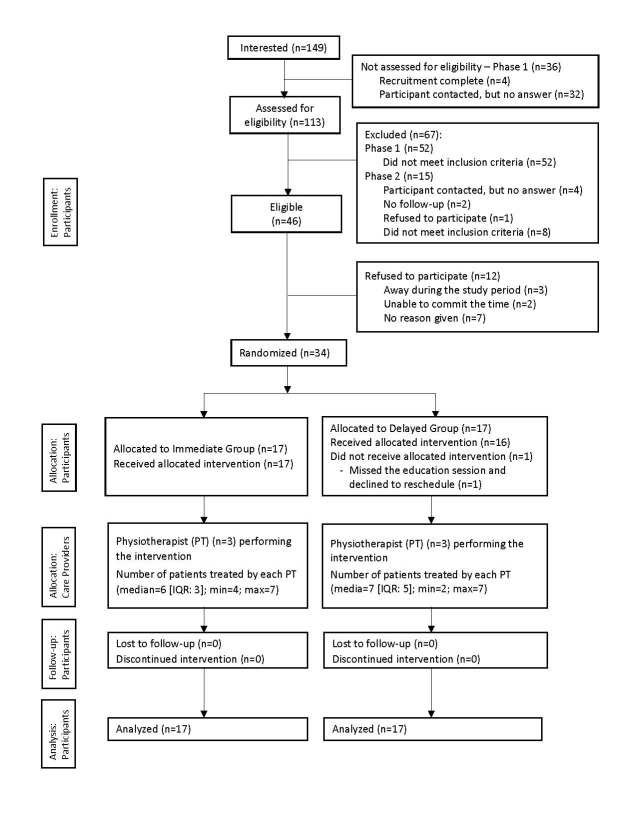
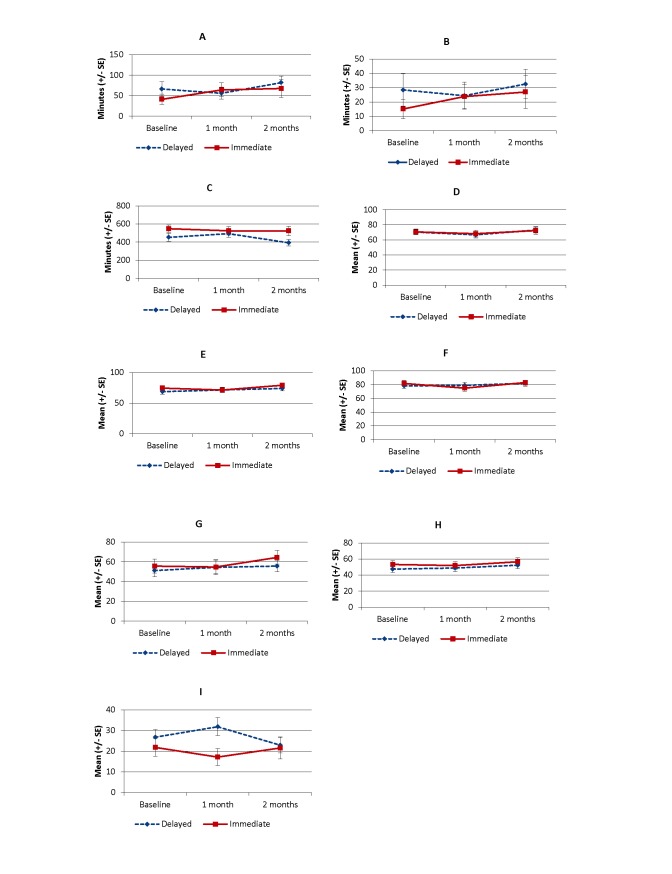
We identified 46 eligible individuals; of those, 34 (74%) enrolled and no one dropped out. All but 1 participant adhered to the intervention protocol. We found a significant effect, with the immediate intervention group having improved in the moderate to vigorous physical activity time and in the Partners in Health Scale at T0 to T1 compared with the delayed intervention group. The planned contrast of the immediate intervention group at T0 to T1 versus the delayed group at T1 to T2 showed a significant effect in the sedentary time and the KOOS symptoms subscale, favoring the delayed group.
This study demonstrated the feasibility of a behavioral intervention, supported by the use of a wearable device, to promote physical activity among people with knee OA.
ClinicalTrials.gov NCT02313506; https://clinicaltrials.gov/ct2/show/NCT02313506 (Archived by WebCite at http://www.webcitation.org/6r4P3Bub0).
体育活动可改善膝骨关节炎(OA)患者的健康状况;然而,该人群的体育活动参与率非常低。
我们研究的目的是评估使用可穿戴设备(Fitbit Flex)和物理治疗师(PT)进行电话咨询对改善经医生确诊为膝OA或已通过两项早期OA验证标准的人群体育活动的可行性和初步疗效。
我们进行了一项基于社区的可行性随机对照试验。即时干预组(n = 17)接受了物理治疗师的简短教育课程、一个Fitbit Flex活动追踪器以及每周与物理治疗师进行一次活动咨询的电话。延迟干预组(n = 17)在1个月后接受相同的干预。所有参与者在基线(T0)、1个月结束时(T1)和2个月结束时(T2)进行评估。结局指标包括:(1)中度至剧烈体育活动的平均时间,(2)久坐行为的平均时间,(3)膝关节损伤和骨关节炎结局评分(KOOS),以及(4)健康伙伴量表。可行性数据用描述性统计进行总结。在调整了区组和T0后,我们使用协方差分析来评估组类型对T₁和T₂时结局指标的影响。我们评估了测量期间结局指标变化的计划对比。
我们确定了46名符合条件的个体;其中34名(74%)登记入组,且无人退出。除1名参与者外,所有参与者均遵守干预方案。我们发现了显著效果,与延迟干预组相比,即时干预组在T0至T1时中度至剧烈体育活动时间和健康伙伴量表方面有所改善。即时干预组在T0至T1与延迟干预组在T1至T2的计划对比显示,在久坐时间和KOOS症状子量表方面有显著效果,有利于延迟干预组。
本研究证明了在可穿戴设备支持下的行为干预对促进膝OA患者体育活动的可行性。
ClinicalTrials.gov NCT02313506;https://clinicaltrials.gov/ct2/show/NCT02313506(由WebCite存档于http://www.webcitation.org/6r4P3Bub0)。