Herten Monika, Idelevich Evgeny A, Sielker Sonja, Becker Karsten, Scherzinger Anna S, Osada Nani, Torsello Giovanni B, Bisdas Theodosios
Clinic for Vascular and Endovascular Surgery, University Hospital Muenster, Muenster, Germany.
Institute of Medical Microbiology, University Hospital Muenster, Muenster, Germany.
Med Sci Monit Basic Res. 2017 Jun 27;23:250-257. doi: 10.12659/msmbr.902879.
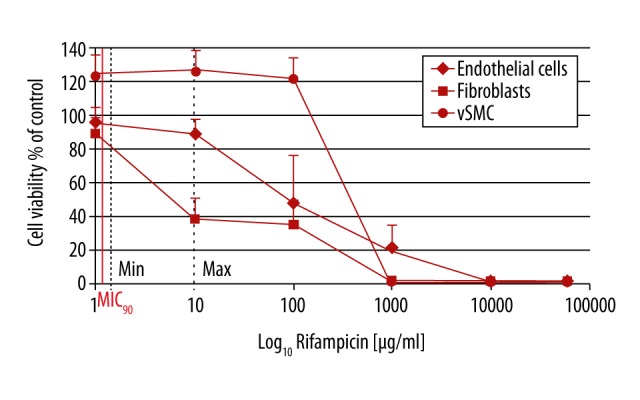
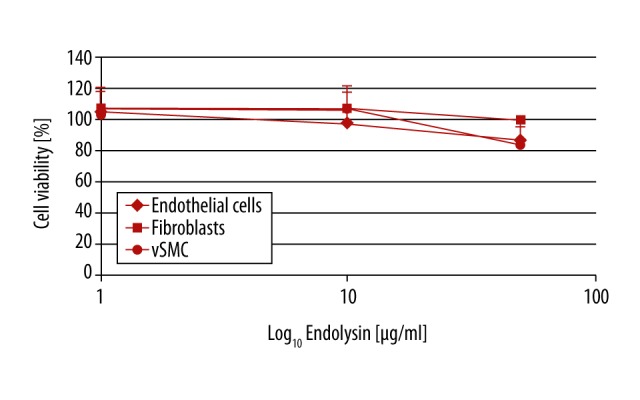
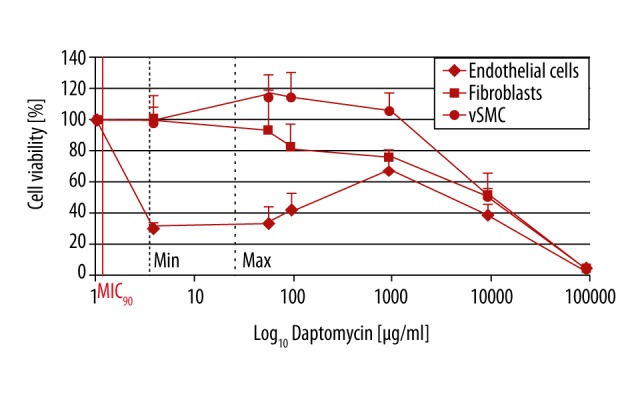
BACKGROUND Rifampin-soaked synthetic prosthetic grafts have been widely used for prevention or treatment of vascular graft infections (VGIs). This in vitro study investigated the effect of the antibiotics daptomycin and vancomycin and the new recombinant bacteriophage endolysin HY-133 on vascular cells, as potential alternatives compared to rifampin. MATERIAL AND METHODS Primary human ECs, vascular smooth muscle cells (vSMC), and fibroblasts were cultivated in 96-well plates and incubated with rifampin, daptomycin, vancomycin, and endolysin HY-133 for 24 h. Subsequently, after washing, cell viability was determined by measuring mitochondrial ATP concentration. Antibiotics were used in their corresponding minimum and maximum serum concentrations, in decimal multiples and in maximum soaking concentration. The experiments were performed in triplicate. RESULTS The 10-fold max serum concentrations of rifampin, daptomycin, and vancomycin did not influence viability of EC and vSMC (100 µg/ml, p>0.170). Higher concentrations of rifampin (>1 mg/ml) significantly (p<0.001) reduced cell viability of all cell types. For the other antibiotics, high concentrations (close to maximum soaking concentration) were most cytotoxic for EC and vSMC and fibroblasts (p<0.001). Endolysin did not display any cytotoxicity towards vascular cells. CONCLUSIONS Results of this in vitro study show the high cytotoxicity of rifampin against vascular cells, and may re-initiate the discussion about the benefit of prophylactic pre-soaking in high concentrations of rifampin. Further studies are necessary to determine the influence of rifampin on the restoration of vessel functionality versus its prophylactic effect against VGIs. Future use of recombinant phage endolysins for alternative prophylactic strategies needs further investigations.
背景 利福平浸泡的合成人工血管移植物已广泛用于预防或治疗血管移植物感染(VGI)。本体外研究调查了抗生素达托霉素和万古霉素以及新型重组噬菌体溶菌酶HY-133对血管细胞的影响,作为与利福平相比的潜在替代物。材料与方法 原代人内皮细胞(EC)、血管平滑肌细胞(vSMC)和成纤维细胞在96孔板中培养,并与利福平、达托霉素、万古霉素和溶菌酶HY-133孵育24小时。随后,洗涤后,通过测量线粒体ATP浓度来确定细胞活力。抗生素以其相应的最低和最高血清浓度、十进制倍数和最大浸泡浓度使用。实验重复进行三次。结果 利福平、达托霉素和万古霉素的10倍最高血清浓度不影响EC和vSMC的活力(100μg/ml,p > 0.170)。较高浓度的利福平(>1mg/ml)显著(p < 0.001)降低了所有细胞类型的细胞活力。对于其他抗生素,高浓度(接近最大浸泡浓度)对EC、vSMC和成纤维细胞的细胞毒性最大(p < 0.001)。溶菌酶对血管细胞未显示任何细胞毒性。结论 本体外研究结果表明利福平对血管细胞具有高细胞毒性,可能会重新引发关于高浓度利福平预防性预浸泡益处的讨论。需要进一步研究以确定利福平对血管功能恢复的影响与其对VGI的预防作用。重组噬菌体溶菌酶在未来替代预防策略中的应用需要进一步研究。