Löbs Ann-Kathrin, Engel Ronja, Schwartz Cory, Flores Andrew, Wheeldon Ian
Department of Chemical and Environmental Engineering, University of California, Riverside, 900 University Ave, Riverside, 92521 USA.
Mannheim University of Applied Sciences, Mannheim, Germany.
Biotechnol Biofuels. 2017 Jun 24;10:164. doi: 10.1186/s13068-017-0854-5. eCollection 2017.
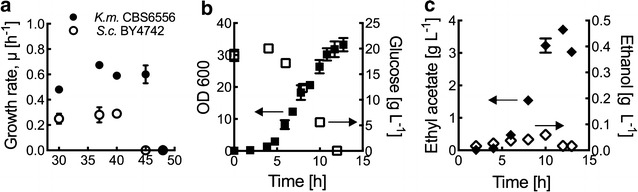
The thermotolerant yeast shows promise as an industrial host for the biochemical production of fuels and chemicals. Wild-type strains are known to ferment high titers of ethanol and can effectively convert a wide range of C, C, and C sugars into the volatile short-chain ester ethyl acetate. Strain engineering, however, has been limited due to a lack of advanced genome-editing tools and an incomplete understanding of ester and ethanol biosynthesis.
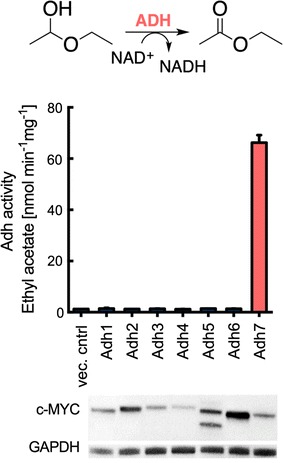
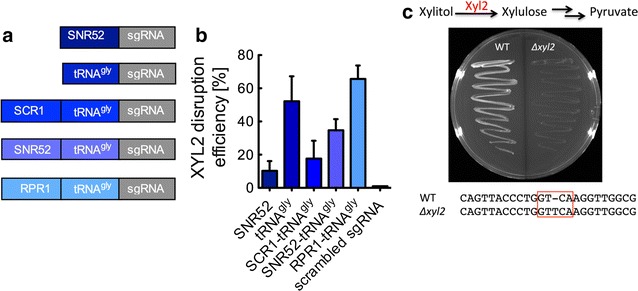
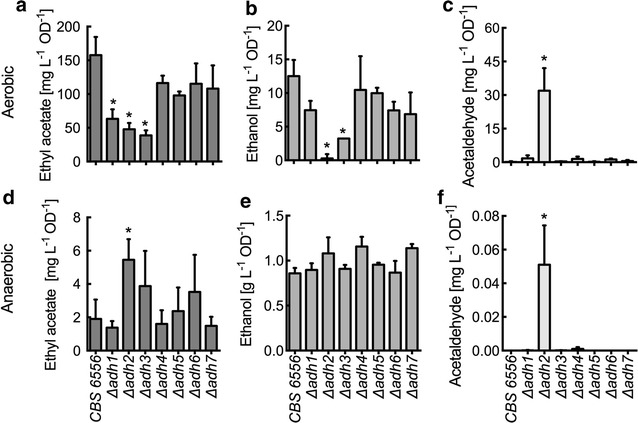
Enabled by the design of hybrid RNA polymerase III promoters, this work adapts the CRISPR-Cas9 system from for use in . The system was used to rapidly create functional disruptions to alcohol dehydrogenase (ADH) and alcohol--acetyltransferase (ATF) genes with putative function in ethyl acetate and ethanol biosynthesis. Screening of the ATF disrupted strain revealed that Atf activity contributes to ethyl acetate biosynthesis, but the knockout reduced ethyl acetate titers by only ~15%. Overexpression experiments revealed that Adh7 can catalyze the oxidation of hemiacetal to ethyl acetate. Finally, analysis of the ADH2 disrupted strain showed that the knockout almost completely eliminated ethanol production and resulted in the accumulation of acetaldehyde.
Newly designed RNA polymerase III promoters for sgRNA expression in enable a CRISPR-Cas9 genome-editing system for the thermotolerant yeast. This system was used to disrupt genes involved in ethyl acetate biosynthesis, specifically ADH1-7 and ATF. Adh2 was found to be critical for aerobic and anaerobic ethanol production. Aerobically produced ethanol supplies the biosynthesis of ethyl acetate catalyzed by Atf. Adh7 was found to exhibit activity toward the oxidation of hemiacetal, a possible alternative route for the synthesis of ethyl acetate.
耐热酵母有望成为用于生物化学生产燃料和化学品的工业宿主。已知野生型菌株能发酵高滴度的乙醇,并能有效地将多种C3、C4和C5糖转化为挥发性短链酯乙酸乙酯。然而,由于缺乏先进的基因组编辑工具以及对酯和乙醇生物合成的理解不完整,菌株工程受到了限制。
在杂交RNA聚合酶III启动子设计的推动下,本研究将来自[具体来源1]的CRISPR-Cas9系统改编用于[目标耐热酵母名称]。该系统用于快速对在乙酸乙酯和乙醇生物合成中具有假定功能的乙醇脱氢酶(ADH)和乙醇-乙酰转移酶(ATF)基因进行功能破坏。对ATF破坏菌株的筛选表明,Atf活性有助于乙酸乙酯的生物合成,但基因敲除仅使乙酸乙酯滴度降低了约15%。过表达实验表明,Adh7可以催化半缩醛氧化为乙酸乙酯。最后,对ADH2破坏菌株的分析表明,基因敲除几乎完全消除了乙醇的产生,并导致乙醛的积累。
新设计的用于在[目标耐热酵母名称]中表达sgRNA的RNA聚合酶III启动子,使耐热酵母能够使用CRISPR-Cas9基因组编辑系统。该系统用于破坏参与乙酸乙酯生物合成的基因,特别是ADH1-7和ATF。发现Adh2对需氧和厌氧乙醇生产至关重要。需氧产生的乙醇为Atf催化的乙酸乙酯生物合成提供原料。发现Adh7对半缩醛氧化具有活性,这是乙酸乙酯合成的一种可能替代途径。