Wang Min, Wang Qiong, Gao Xiang, Su Zhong
University of Science and Technology of China, Fei Xi Road, Hefei, 230000, China.
Laboratory of Immunobiology, Guangzhou Institute of Biomedicine and Health, Chinese Academy of Sciences, 190 Kai Yuan Road, Guangzhou, 510530, China.
Parasit Vectors. 2017 Jun 27;10(1):315. doi: 10.1186/s13071-017-2253-y.
Lipoic acid is a cofactor for α-keto acid dehydrogenase system that is involved in the central energy metabolism. In the apicomplexan parasite, Plasmodium, lipoic acid protein ligase 1 (LplA1) and LplA2 catalyse the ligation of acquired lipoic acid to the dehydrogenase complexes in the mitochondrion. The enzymes LipB and LipA mediate lipoic acid synthesis and ligation to the enzymes in the apicoplast. These enzymes in the lipoic acid metabolism machinery have been shown to play important roles in the biology of Plasmodium parasites, but the relationship between the enzymes is not fully elucidated.
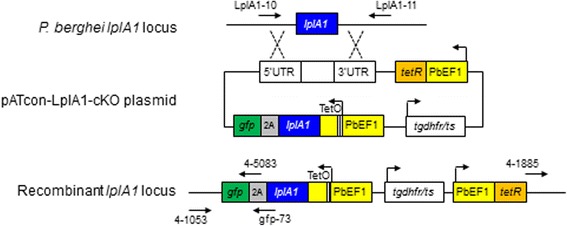
We used an anhydrotetracycline (ATc)-inducible transcription system to generate transgenic P. berghei parasites in which the lplA1 gene was conditionally knocked out (LplA1-cKO). Phenotypic changes and the lplA1 and lplA2 gene expression profiles of cloned LplA1-cKO parasites were analysed.
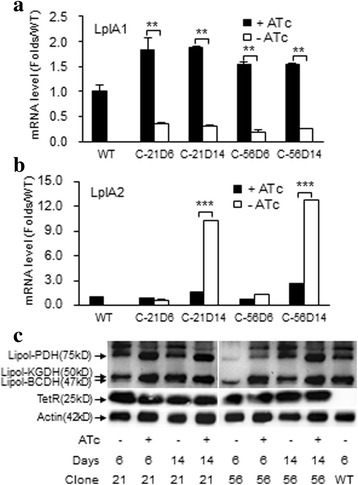
LplA1-cKO parasites showed severely impaired growth in vivo in the first 8 days of infection, and retarded blood-stage development in vitro, in the absence of ATc. However, these parasites resumed viability in the late stage of infection and mounted high levels of parasitemia leading to the death of the hosts. Although lplA1 mRNA expression was regulated tightly by ATc during the whole course of infection, lplA2 mRNA expression was significantly increased in the late stage of infection only in the LplA1-cKO parasites that were not exposed to ATc.
The lplA2 gene can be activated as an alternative pathway to compensate for the loss of LplA1 activity and to maintain lipoic acid metabolism.
硫辛酸是参与中心能量代谢的α-酮酸脱氢酶系统的一种辅因子。在顶复门寄生虫疟原虫中,硫辛酸蛋白连接酶1(LplA1)和LplA2催化所获取的硫辛酸与线粒体中的脱氢酶复合物的连接。LipB和LipA酶介导硫辛酸的合成以及与质体中酶的连接。硫辛酸代谢机制中的这些酶已被证明在疟原虫的生物学中发挥重要作用,但这些酶之间的关系尚未完全阐明。
我们使用了一种脱水四环素(ATc)诱导的转录系统来生成条件性敲除lplA1基因的转基因伯氏疟原虫(LplA1-cKO)。分析了克隆的LplA1-cKO寄生虫的表型变化以及lplA1和lplA2基因表达谱。
在没有ATc的情况下,LplA1-cKO寄生虫在感染的前8天体内生长严重受损,体外血液阶段发育迟缓。然而,这些寄生虫在感染后期恢复了活力,并出现高水平的寄生虫血症,导致宿主死亡。尽管在整个感染过程中lplA1 mRNA表达受到ATc的严格调控,但仅在未暴露于ATc的LplA1-cKO寄生虫的感染后期,lplA2 mRNA表达显著增加。
lplA2基因可被激活作为替代途径,以补偿LplA1活性的丧失并维持硫辛酸代谢。