Kazemi-Lomedasht Fatemeh, Pooshang-Bagheri Kamran, Habibi-Anbouhi Mahdi, Hajizadeh-Safar Ensiyeh, Shahbazzadeh Delavar, Mirzahosseini Hasan, Behdani Mahdi
Biotechnology Research Center, Biotechnology Department, Venom & Biotherapeutics Molecules Lab., Pasteur Institute of Iran, Tehran, Iran.
National Cell Bank of Iran, Pasteur Institute of Iran, Tehran, Iran.
Iran J Basic Med Sci. 2017 May;20(5):489-496. doi: 10.22038/IJBMS.2017.8672.
Lung cancer is the main leading cause of cancer death worldwide. Angiogenesis is the main step in proliferation and spreading of tumor cells. Targeting vascular endothelial growth factor (VEGF) is an effective approach for inhibition of cancer angiogenesis. Nanobodies (NBs) are a novel class of antibodies derived from the camel. Unique characteristics of Nbs like their small size and good penetration to tumor tissues makes them promising tools in drug development. Development of NBs targeting both human and mouse VEGF is required for understanding their functions. Therefore, development of cross-species reactive anti-VEGF Nbs for immunotherapy of lung cancer was the main aim of the current study.
Here we developed NBs from library with high specificity and binding affinity to both human and mouse VEGF. and function of developed NB was evaluated on human endothelial cells and lung epithelial tumor cells (TC-1).
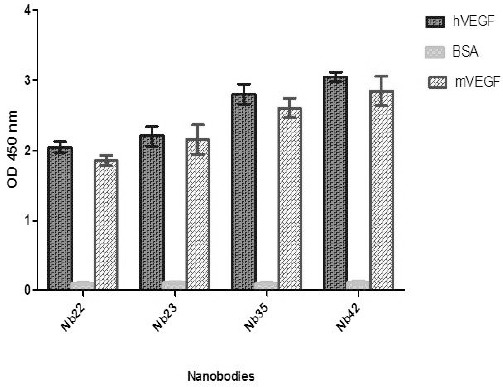
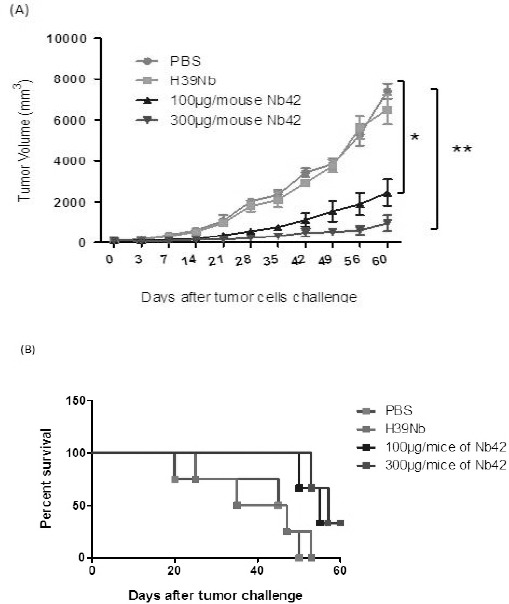
A nanobody showed the highest affinity to human and mouse VEGF and potently inhibited VEGF in the ELISA experiment. Anti-VEGF NBs significantly inhibited human endothelial cell migration through blockade of VEGF (=0.045). Anti-VEGF NBs also significantly inhibited TC-1 growth in a dose-dependent manner (=0.001) and resulted in higher survival rate in the nanobody treated group.
These findings demonstrate the potential of anti-VEGF NBs in tumor growth inhibition and are promising as novel cancer therapeutic candidate.
肺癌是全球癌症死亡的主要原因。血管生成是肿瘤细胞增殖和扩散的主要步骤。靶向血管内皮生长因子(VEGF)是抑制癌症血管生成的有效方法。纳米抗体(NBs)是一类源自骆驼的新型抗体。纳米抗体的独特特性,如它们的小尺寸和对肿瘤组织的良好穿透性,使其成为药物开发中有前景的工具。开发针对人和小鼠VEGF的纳米抗体对于了解它们的功能是必要的。因此,开发用于肺癌免疫治疗的跨物种反应性抗VEGF纳米抗体是本研究的主要目的。
在此,我们从文库中开发出对人和小鼠VEGF均具有高特异性和结合亲和力的纳米抗体。并在人内皮细胞和肺上皮肿瘤细胞(TC-1)上评估了所开发纳米抗体的功能。
一种纳米抗体对人和小鼠VEGF表现出最高亲和力,并在ELISA实验中有效抑制VEGF。抗VEGF纳米抗体通过阻断VEGF显著抑制人内皮细胞迁移(P=0.045)。抗VEGF纳米抗体还以剂量依赖性方式显著抑制TC-1生长(P=0.001),并导致纳米抗体治疗组的存活率更高。
这些发现证明了抗VEGF纳米抗体在抑制肿瘤生长方面的潜力,有望成为新型癌症治疗候选药物。