Department of Clinical Medicine, Ruijin Hospital, Jiaotong University School of Medicine, Shanghai 200025, P.R. China.
Department of Clinical Medicine, Ruijin Hospital North, Jiaotong University School of Medicine, Shanghai 201801, P.R. China.
Int J Oncol. 2017 Aug;51(2):489-497. doi: 10.3892/ijo.2017.4055. Epub 2017 Jun 23.
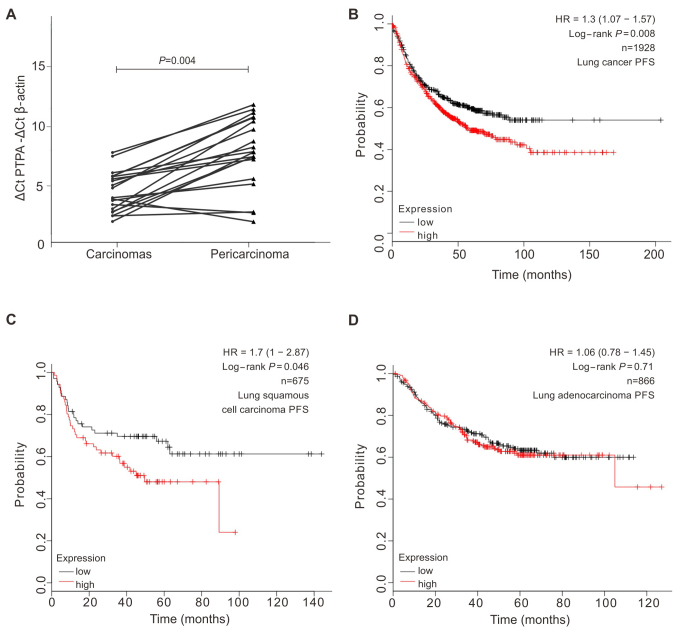
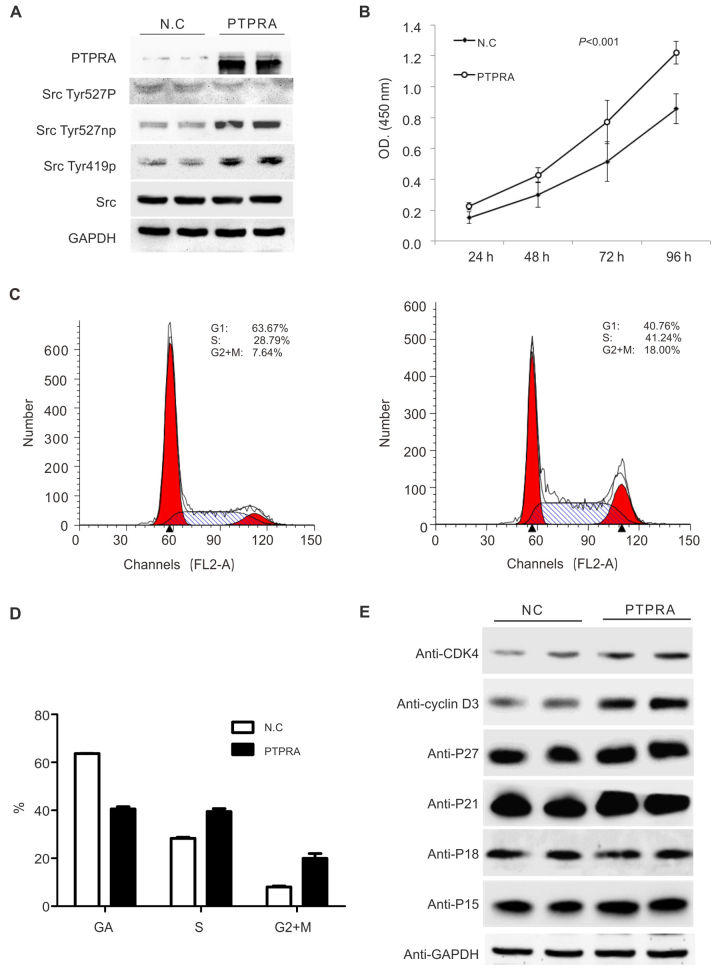
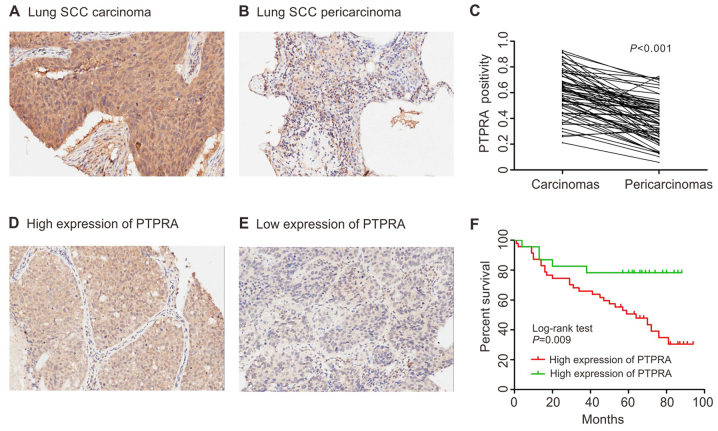
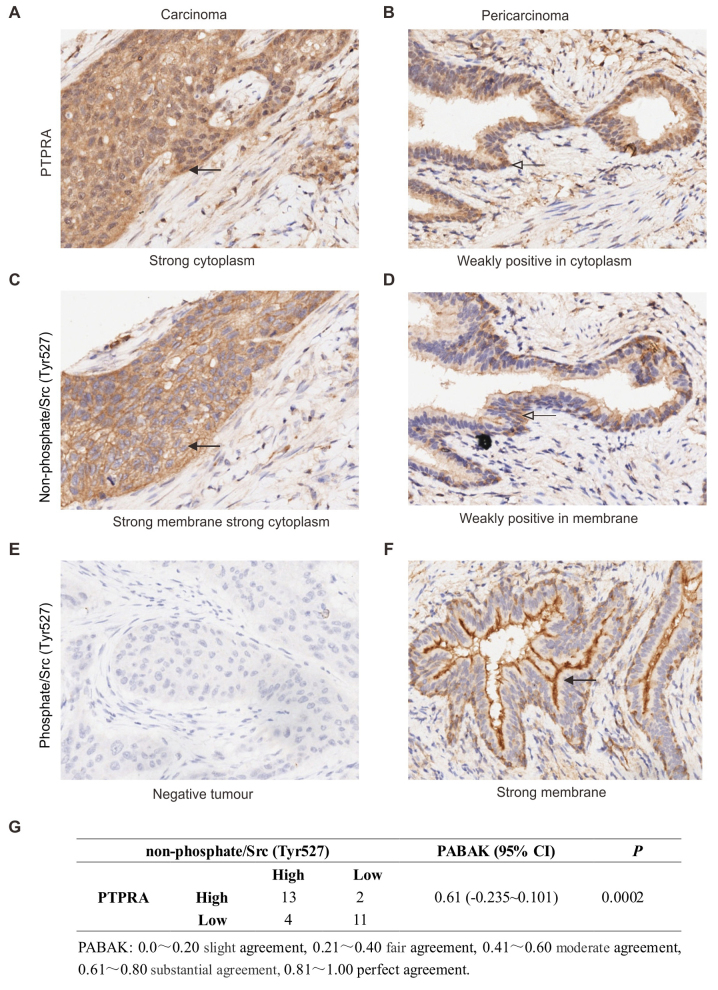
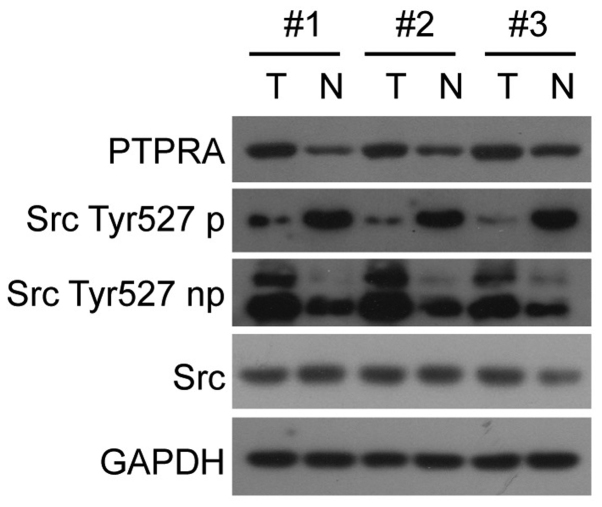
PTPRA is reported to be involved in cancer development and progression through activating the Src family kinase (SFK) signaling pathways, however, the roles of PTPRA in the squamous cell lung cancer (SCC) development are unclear. The purpose of this study was to clarify the clinical relevance and biological roles of PTPRA in SCC. We found that PTPRA was upregulated in squamous cell lung cancer compared to matched normal tissues at the mRNA (N=20, P=0.004) and protein expression levels (N=75, P<0.001). Notably, high mRNA level of PTPRA was significantly correlated with poorer prognosis in 675 SCC patients from the Kaplan-Meier plotter database. With 75 cases, we found that PTPRA protein expression was significantly correlated with tumor size (P=0.002), lymph node metastasis (P=0.008), depth of tumor invasion (P<0.001) and clinical stage (P<0.001). The Kaplan-Meier plot suggested that high expression of PTPRA had poorer overall survival in SCC patients (P=0.009). Multivariate Cox regression analysis suggested that PTPRA expression was an independent prognostic factor in SCC patients. In the cellular models, PTPRA promotes SCC cell proliferation through modulating Src activation as well as cell cycle progression. In conclusion, higher PTPRA level was associated with worse prognosis of SCC patients and PTPRA could promote the cell cycle progression through stimulating the c-Src signaling pathways.
PTPRA 据报道通过激活 Src 家族激酶 (SFK) 信号通路参与癌症的发生和发展,然而,PTPRA 在鳞状细胞肺癌 (SCC) 发展中的作用尚不清楚。本研究旨在阐明 PTPRA 在 SCC 中的临床相关性和生物学作用。我们发现与匹配的正常组织相比,PTPRA 在鳞状细胞肺癌中的 mRNA(N=20,P=0.004)和蛋白表达水平(N=75,P<0.001)均上调。值得注意的是,Kaplan-Meier 绘谱器数据库中 675 例 SCC 患者的 mRNA 水平高表明预后不良。在 75 例病例中,我们发现 PTPRA 蛋白表达与肿瘤大小(P=0.002)、淋巴结转移(P=0.008)、肿瘤侵袭深度(P<0.001)和临床分期(P<0.001)显著相关。Kaplan-Meier 图表明 PTPRA 高表达的 SCC 患者总体生存率较差(P=0.009)。多变量 Cox 回归分析表明,PTPRA 表达是 SCC 患者的独立预后因素。在细胞模型中,PTPRA 通过调节 Src 激活以及细胞周期进展促进 SCC 细胞增殖。总之,较高的 PTPRA 水平与 SCC 患者的预后较差相关,PTPRA 可通过刺激 c-Src 信号通路促进细胞周期进展。