Chen Lei, Cui Ya-Bin, Si Yu-Ling, Su Wei-Dong, Wang Xin-Chao, Pang Hua, Qiu Li-Jun
Department of Clinical Laboratory, Tianjin Fourth Central Hospital, Tianjin 300140, P.R. China.
Department of Hematology, Tianjin Fourth Central Hospital, Tianjin 300140, P.R. China.
Mol Med Rep. 2017 Sep;16(3):2556-2562. doi: 10.3892/mmr.2017.6858. Epub 2017 Jun 27.
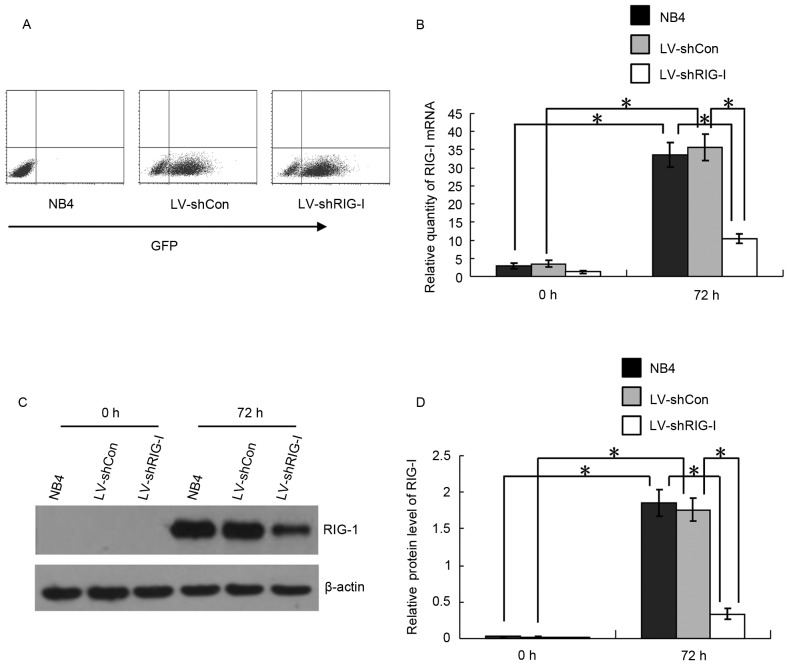
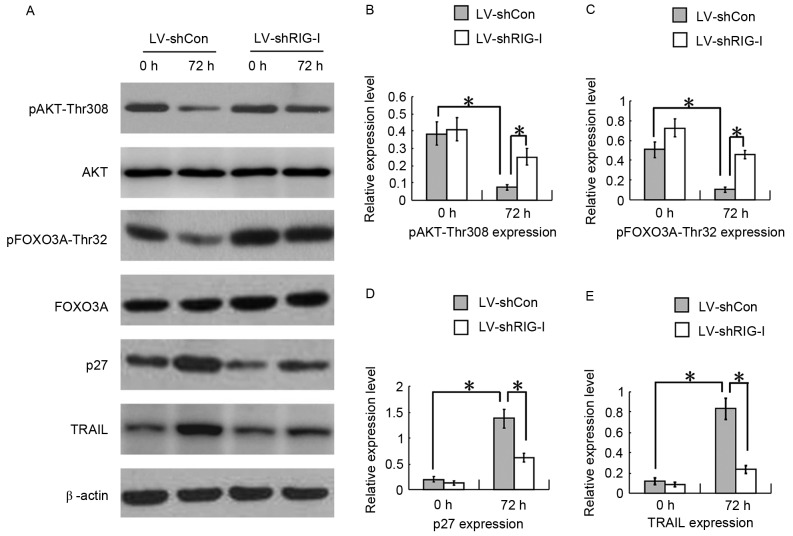
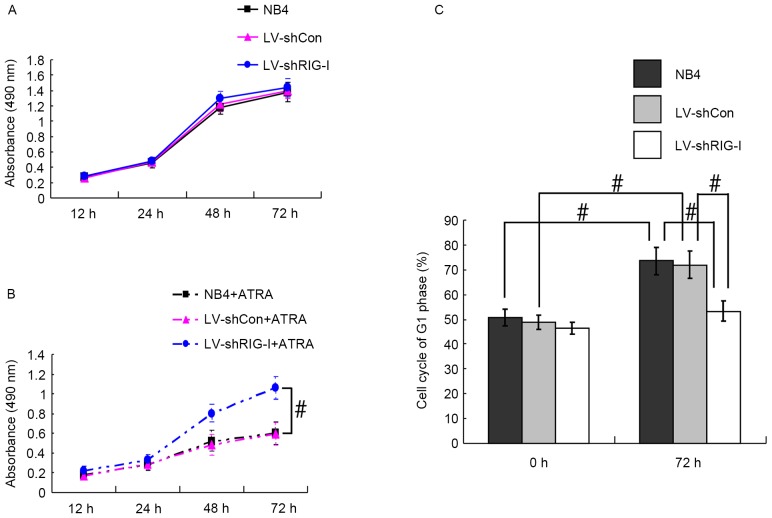
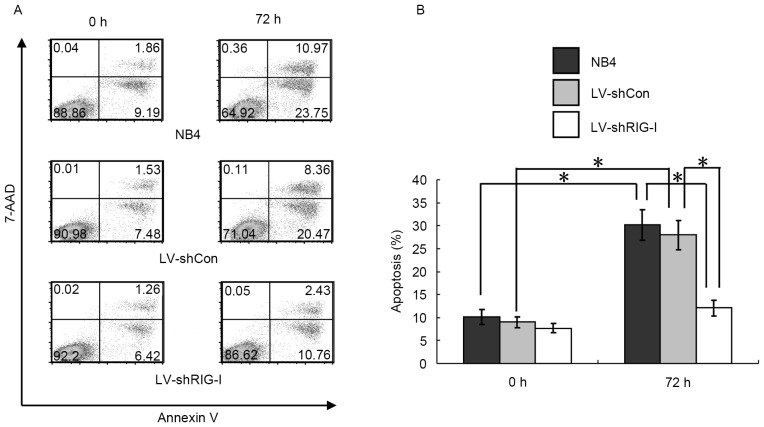
Retinoic acid inducible gene I (RIG‑I) is upregulated during all‑trans retinoic acid (ATRA)‑induced terminal granulocytic differentiation of NB4 acute promyelocytic leukemia (APL) cells. However, the function and mechanism of RIG‑I in NB4 cells remains to be fully elucidated. In the present study, lentivirus‑mediated RIG‑I‑knockdown was used to investigate the proliferation, cell cycle and apoptotic processes of ATRA‑induced NB4 cells in vitro using an MTT assay and flow cytometry, respectively. The roles of RIG‑I and the AKT‑FOXO3A signaling pathway were investigated using western blot analysis. The results showed that the ATRA‑induced expression of RIG‑I was specifically and effectively knocked down at the mRNA and protein levels by lentivirus mediated RIG‑I short hairpin RNA. In addition, silencing of RIG‑I reduced the ATRA‑induced inhibition of NB4 cell proliferation, cell cycle arrest and apoptosis. Further investigations indicated that with ATRA‑induced expression of RIG‑I, levels of phosphorylated (p)AKT‑Thr308 and pForkhead Box (FOX) O3A‑Thr32 were decreased, the expression levels of cell cycle arrest protein p27 and the apoptotic protein, tumor necrosis factor‑related apoptosis‑inducing ligand (TRAIL), directly transcribed by FOXO3A were increased. By contrast, following the knockdown of ATRA‑induced expression of RIG‑I, the levels of pAKT‑Thr308 and pFOXO3A‑Thr32 were increased, and the protein expression levels of p27 and TRAIL were decreased. Taken together, these results showed that the knockdown of RIG‑I reduced the inhibition of cell proliferation, cell cycle arrest and apoptosis in the ATRA‑induced NB4 cells via the AKT‑FOXO3A signaling pathway.
维甲酸诱导基因I(RIG-I)在全反式维甲酸(ATRA)诱导NB4急性早幼粒细胞白血病(APL)细胞终末粒细胞分化过程中上调。然而,RIG-I在NB4细胞中的功能和机制仍有待充分阐明。在本研究中,利用慢病毒介导的RIG-I基因敲低,分别采用MTT法和流式细胞术体外研究ATRA诱导的NB4细胞的增殖、细胞周期和凋亡过程。采用蛋白质免疫印迹分析研究RIG-I和AKT-FOXO3A信号通路的作用。结果显示,慢病毒介导的RIG-I短发夹RNA在mRNA和蛋白质水平上特异性且有效地敲低了ATRA诱导的RIG-I表达。此外,RIG-I沉默降低了ATRA诱导的NB4细胞增殖抑制、细胞周期阻滞和凋亡。进一步研究表明,随着ATRA诱导RIG-I表达,磷酸化(p)AKT-Thr308和p叉头框(FOX)O3A-Thr32水平降低,由FOXO3A直接转录的细胞周期阻滞蛋白p27和凋亡蛋白肿瘤坏死因子相关凋亡诱导配体(TRAIL)的表达水平升高。相反,在敲低ATRA诱导的RIG-I表达后,pAKT-Thr308和pFOXO3A-Thr32水平升高,p27和TRAIL的蛋白表达水平降低。综上所述,这些结果表明,RIG-I基因敲低通过AKT-FOXO3A信号通路降低了ATRA诱导的NB4细胞的增殖抑制、细胞周期阻滞和凋亡。