Department of Energy Engineering, Ulsan National Institute of Science and Technology (UNIST), Ulsan 44919, Republic of Korea.
Department of Chemical Engineering, University of Seoul, Seoul 02504, Republic of Korea.
Nat Commun. 2017 Jun 28;8:15967. doi: 10.1038/ncomms15967.
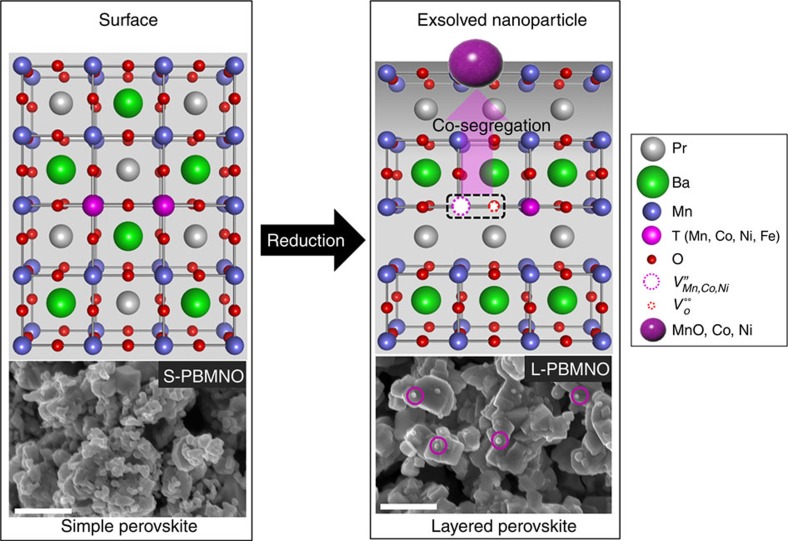
In perovskites, exsolution of transition metals has been proposed as a smart catalyst design for energy applications. Although there exist transition metals with superior catalytic activity, they are limited by their ability to exsolve under a reducing environment. When a doping element is present in the perovskite, it is often observed that the surface segregation of the doping element is changed by oxygen vacancies. However, the mechanism of co-segregation of doping element with oxygen vacancies is still an open question. Here we report trends in the exsolution of transition metal (Mn, Co, Ni and Fe) on the PrBaMnO layered perovskite oxide related to the co-segregation energy. Transmission electron microscopic observations show that easily reducible cations (Mn, Co and Ni) are exsolved from the perovskite depending on the transition metal-perovskite reducibility. In addition, using density functional calculations we reveal that co-segregation of B-site dopant and oxygen vacancies plays a central role in the exsolution.
在钙钛矿中,过渡金属的离溶被提议作为能源应用的智能催化剂设计。尽管存在具有优异催化活性的过渡金属,但它们受到其在还原环境下离溶能力的限制。当掺杂元素存在于钙钛矿中时,通常观察到掺杂元素的表面偏析会被氧空位改变。然而,掺杂元素与氧空位共偏析的机制仍然是一个悬而未决的问题。在这里,我们报告了与共离溶能有关的过渡金属(Mn、Co、Ni 和 Fe)在 PrBaMnO 层状钙钛矿氧化物上离溶的趋势。透射电子显微镜观察表明,根据过渡金属-钙钛矿的还原性,易还原的阳离子(Mn、Co 和 Ni)从钙钛矿中离溶。此外,我们通过密度泛函计算揭示了 B 位掺杂剂和氧空位的共偏析在离溶中起着核心作用。