Ohnishi Shunsuke, Watari Hidemichi, Kanno Maki, Ohba Yoko, Takeuchi Satoshi, Miyaji Tempei, Oyamada Shunsuke, Nomura Eiji, Kato Hidenori, Sugiyama Toru, Asaka Masahiro, Sakuragi Noriaki, Yamaguchi Takuhiro, Uezono Yasuhito, Iwase Satoru
Department of Gastroenterology and Hepatology, Hokkaido University Graduate School of Medicine, Sapporo, Japan.
Department of Obstetrics and Gynecology, Hokkaido University Graduate School of Medicine, Sapporo, Japan.
J Gynecol Oncol. 2017 Sep;28(5):e44. doi: 10.3802/jgo.2017.28.e44. Epub 2017 Mar 17.
Rikkunshito, an herbal medicine, is widely prescribed in Japan for the treatment of anorexia and functional dyspepsia, and has been reported to recover reductions in food intake caused by cisplatin. We investigated whether rikkunshito could improve chemotherapy-induced nausea and vomiting (CINV) and anorexia in patients treated with cisplatin.
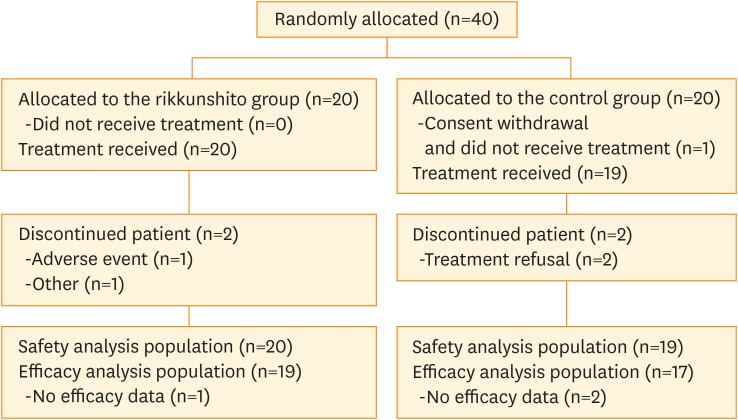
Patients with uterine cervical or corpus cancer who were to receive cisplatin (50 mg/m² day 1) and paclitaxel (135 mg/m² day 0) as first-line chemotherapy were randomly assigned to the rikkunshito group receiving oral administration on days 0-13 with standard antiemetics, or the control group receiving antiemetics only. The primary endpoint was the rate of complete control (CC: no emesis, no rescue medication, and no significant nausea) in the overall phase (0-120 hours). Two-tailed p<0.20 was considered significant in the planned analysis.
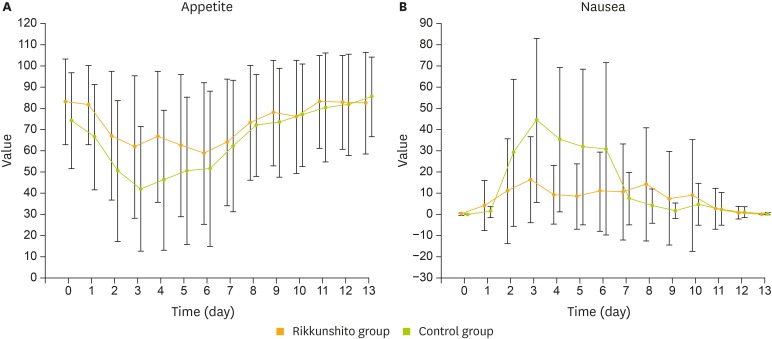
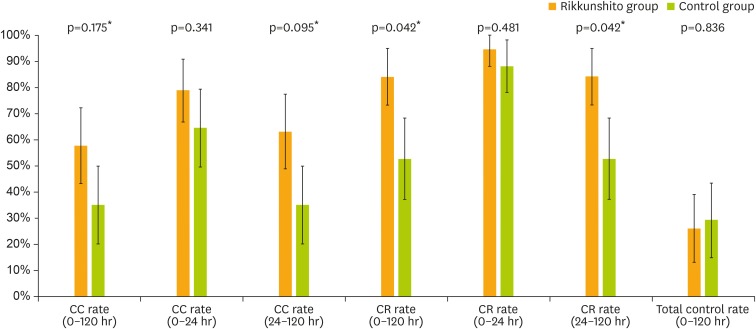
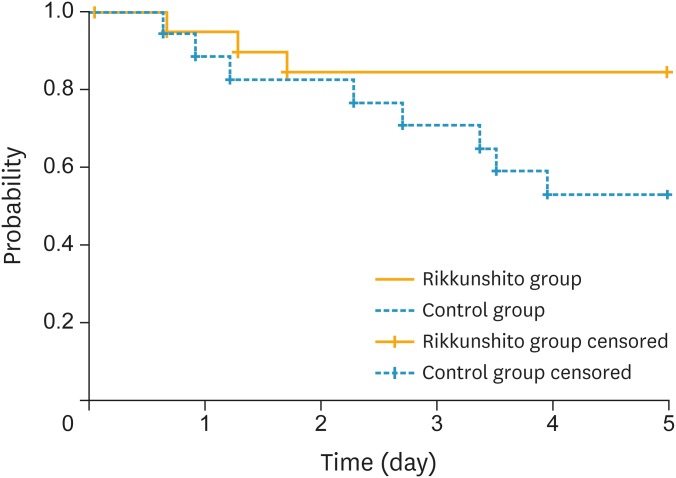
The CC rate in the overall phase was significantly higher in the rikkunshito group than in the control group (57.9% vs. 35.3%, p=0.175), as were the secondary endpoints: the CC rate in the delayed phase (24-120 hours), and the complete response (CR) rates (no emesis and no rescue medication) in the overall and delayed phases (63.2% vs. 35.3%, p=0.095; 84.2% vs. 52.9%, p=0.042; 84.2% vs. 52.9%, p=0.042, respectively), and time to treatment failure (p=0.059). Appetite assessed by visual analogue scale (VAS) appeared to be superior in the rikkunshito group from day 2 through day 6.
Rikkunshito provided additive effect for the prevention of CINV and anorexia.
理气和中汤是一种草药制剂,在日本被广泛用于治疗厌食症和功能性消化不良,据报道它能恢复顺铂引起的食物摄入量减少。我们研究了理气和中汤是否能改善顺铂治疗患者的化疗引起的恶心和呕吐(CINV)及厌食症。
将接受顺铂(第1天50mg/m²)和紫杉醇(第0天135mg/m²)作为一线化疗的子宫颈癌或子宫体癌患者随机分为理气和中汤组,在第0 - 13天口服并联合标准止吐药,或对照组仅接受止吐药。主要终点是整个阶段(0 - 120小时)的完全控制率(CC:无呕吐、无救援用药且无明显恶心)。在计划分析中,双侧p<0.20被认为具有显著性。
理气和中汤组在整个阶段的CC率显著高于对照组(57.9%对35.3%,p = 0.175),次要终点也是如此:延迟阶段(24 - 120小时)的CC率,以及整个阶段和延迟阶段的完全缓解(CR)率(无呕吐且无救援用药)(分别为63.2%对35.3%,p = 0.095;84.2%对52.9%,p = 0.042;84.2%对52.9%,p = 0.042),以及至治疗失败时间(p = 0.059)。从第2天到第6天,通过视觉模拟量表(VAS)评估的食欲在理气和中汤组似乎更好。
理气和中汤对预防CINV和厌食症具有附加作用。