Zhu Xinxin, Lang Jinghe
Department of Obstetrics and Gynecology, Peking Union Medical College Hospital, Peking Union Medical College, Chinese Academy of Medical Sciences, Beijing, China.
J Gynecol Oncol. 2017 Sep;28(5):e64. doi: 10.3802/jgo.2017.28.e64. Epub 2017 Jun 5.
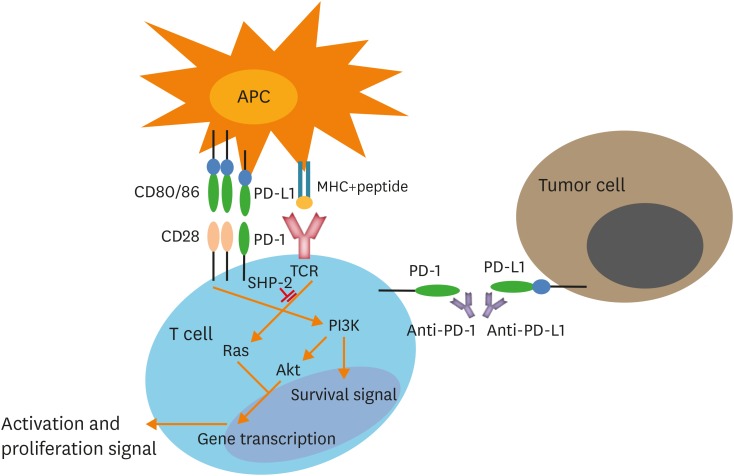
Programmed death-1 (PD-1) and its ligand are part of the immune checkpoint pathway that down-regulates effector T cells in immune response, thereby causing immune suppression. The PD-1/programmed death-ligand 1 (PD-L1) pathway can be blocked by antibodies to reverse tumor-mediated immunosuppression. However, advanced cancers such as stage III-IV ovarian cancer (OC) and certain types such as ID8 OC (a clone of C57BL/6 mouse OC) may hijack the PD-1/PD-L1 pathway to escape immune attack. When combined with chemotherapy, radiotherapy, targeted therapy, immunotherapy, or other agents, these PD-1/PD-L1 pathway blockages can produce a synergistic antitumor response in OC. Combined immunotherapy significantly prolongs overall survival by changing the tumor microenvironment through processes such as increasing the number of CD4⁺ or CD8⁺ T cells or cytokines in mice with OC and decreasing the number of regulatory T cells (Tregs) and myeloid-derived suppressor cells (MDSCs). OC patients treated with combined immunotherapy received better prognoses than those treated with monotherapy. This review reflects the move toward novel therapy combinations for OC and discusses these promising immunotherapeutic approaches, which are more cost-effective and effective than other approaches.
程序性死亡蛋白 1(PD - 1)及其配体是免疫检查点通路的一部分,该通路在免疫反应中下调效应 T 细胞,从而导致免疫抑制。PD - 1/程序性死亡配体 1(PD - L1)通路可被抗体阻断,以逆转肿瘤介导的免疫抑制。然而,晚期癌症如 III - IV 期卵巢癌(OC)以及某些类型如 ID8 OC(C57BL/6 小鼠 OC 的一个克隆)可能会劫持 PD - 1/PD - L1 通路以逃避免疫攻击。当与化疗、放疗、靶向治疗、免疫治疗或其他药物联合使用时,这些 PD - 1/PD - L1 通路阻断剂可在 OC 中产生协同抗肿瘤反应。联合免疫疗法通过改变肿瘤微环境,如增加 OC 小鼠体内 CD4⁺或 CD8⁺T 细胞或细胞因子的数量以及减少调节性 T 细胞(Tregs)和髓系来源的抑制细胞(MDSCs)的数量,显著延长总生存期。接受联合免疫疗法治疗的 OC 患者比接受单一疗法治疗的患者预后更好。本综述反映了 OC 治疗向新型联合疗法的转变,并讨论了这些有前景的免疫治疗方法,它们比其他方法更具成本效益且更有效。