Panorama Research Institute, Sunnyvale, California, USA.
Panorama Institute of Molecular Medicine, Sunnyvale, California, USA.
J Immunother Cancer. 2021 Dec;9(12). doi: 10.1136/jitc-2021-002772.
Stimulating antitumor immunity by blocking programmed death-1 (PD-1) or its ligand (programmed death-ligand 1 (PD-L1) is a promising antitumor therapy. However, numerous patients respond poorly to PD-1/PD-L1 blockade. Unresponsiveness to immune-checkpoint blockade (ICB) can cast significant challenges to the therapeutic options for patients with hard-to-treat tumors. There is an unmet clinical need to establish new therapeutic approaches for mitigating ICB unresponsiveness in patients. In this study, we investigated the efficacy and role of low-dose antineoplastic agent SN-38 or metformin in sensitizing unresponsive tumors to respond to ICB therapy.
We assessed the significant pathological relationships between PD-L1 and FOXO3 expression and between PD-L1 and c-Myc or STAT3 expression in patients with various tumors. We determined the efficacy of low-dose SN-38 or metformin in sensitizing unresponsive tumors to respond to anti-PD-1 therapy in a syngeneic tumor system. We deciphered novel therapeutic mechanisms underlying the SN-38 and anti-PD-1 therapy-mediated engagement of natural killer (NK) or CD8+ T cells to infiltrate tumors and boost antitumor immunity.
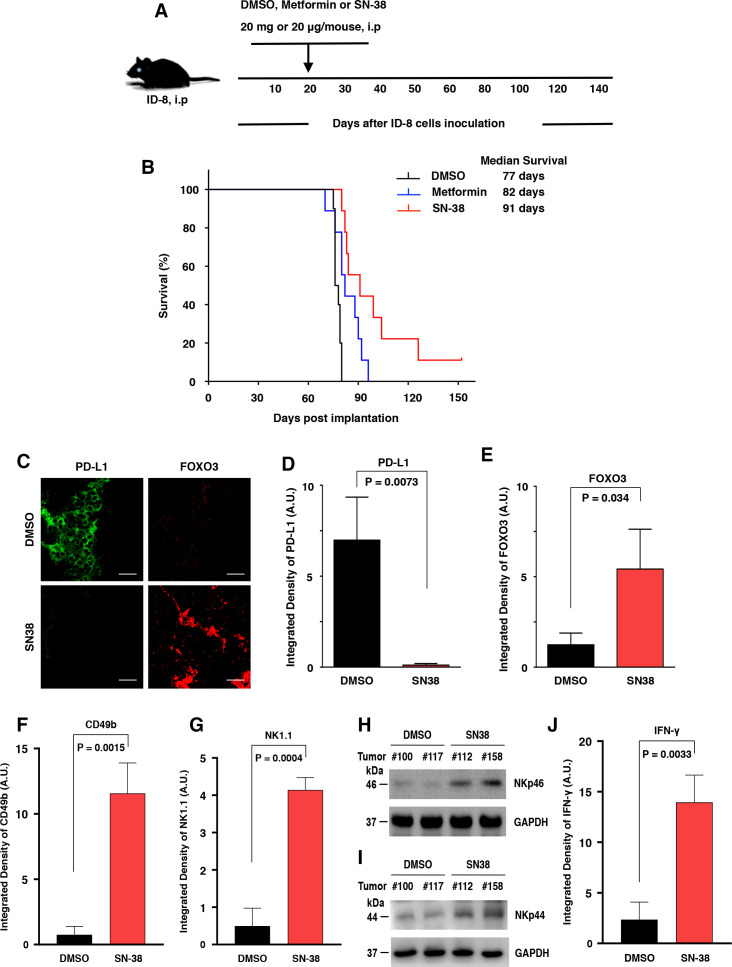
We showed that PD-L1 protein level was inversely associated with FOXO3 protein level in patients with ovarian, breast, and hepatocellular tumors. Low-dose SN-38 or metformin abrogated PD-L1 protein expression, promoted FOXO3 protein level, and significantly increased the animal survival rate in syngeneic mouse tumor models. SN-38 or metformin sensitized unresponsive tumors responding to anti-PD-1 therapy by engaging NK or CD8+ T cells to infiltrate the tumor microenvironment (TME) and secret interferon-γ and granzyme B to kill tumors. SN-38 suppressed the levels of c-Myc and STAT3 proteins, which controlled PD-L1 expression. FOXO3 was essential for SN38-mediated PD-L1 suppression. The expression of PD-L1 was compellingly linked to that of c-Myc or STAT3 in patients with the indicated tumors.
We show that SN-38 or metformin can boost antitumor immunity in the TME by inhibiting c-Myc and STAT3 through FOXO3 activation. These results may provide novel insight into ameliorating patient response to overarching immunotherapy for tumors.
通过阻断程序性死亡-1(PD-1)或其配体(程序性死亡配体 1(PD-L1)来刺激抗肿瘤免疫是一种很有前途的抗肿瘤疗法。然而,许多患者对 PD-1/PD-L1 阻断反应不佳。对免疫检查点阻断(ICB)无反应给治疗难治性肿瘤患者的治疗选择带来了重大挑战。因此,需要建立新的治疗方法来减轻患者对 ICB 无反应的情况。在这项研究中,我们研究了低剂量抗肿瘤药物 SN-38 或二甲双胍在增强对 ICB 治疗无反应的肿瘤对 ICB 治疗的敏感性方面的疗效和作用。
我们评估了 PD-L1 与 FOXO3 表达之间以及 PD-L1 与 c-Myc 或 STAT3 表达之间在各种肿瘤患者中的显著病理关系。我们确定了低剂量 SN-38 或二甲双胍在增强对 PD-1 治疗无反应的肿瘤对 PD-1 治疗的敏感性方面的疗效在同种异体肿瘤系统中。我们解析了 SN-38 和抗 PD-1 治疗介导自然杀伤(NK)或 CD8+T 细胞浸润肿瘤并增强抗肿瘤免疫的新治疗机制。
我们发现卵巢癌、乳腺癌和肝癌患者的 PD-L1 蛋白水平与 FOXO3 蛋白水平呈负相关。低剂量 SN-38 或二甲双胍可阻断 PD-L1 蛋白表达,促进 FOXO3 蛋白水平,并显著提高同种异体小鼠肿瘤模型的动物存活率。SN-38 或二甲双胍通过使 NK 或 CD8+T 细胞浸润肿瘤微环境(TME)并分泌干扰素-γ和颗粒酶 B 来杀死肿瘤,从而使无反应的肿瘤对抗 PD-1 治疗敏感。SN-38 抑制了控制 PD-L1 表达的 c-Myc 和 STAT3 蛋白水平。FOXO3 对于 SN38 介导的 PD-L1 抑制至关重要。在上述肿瘤患者中,PD-L1 的表达与 c-Myc 或 STAT3 的表达密切相关。
我们表明,SN-38 或二甲双胍可以通过激活 FOXO3 抑制 c-Myc 和 STAT3 来增强 TME 中的抗肿瘤免疫。这些结果可能为改善患者对广泛免疫治疗肿瘤的反应提供新的见解。