Bülow Erik, Rolfson Ola, Cnudde Peter, Rogmark Cecilia, Garellick Göran, Nemes Szilárd
a Swedish Hip Arthroplasty Register, Center for Registers , Västra Götaland, Gothenburg.
b Department of Orthopedics , Institute of Clinical Sciences, Sahlgrenska Academy, University of Gothenburg , Gothenburg.
Acta Orthop. 2017 Oct;88(5):472-477. doi: 10.1080/17453674.2017.1341243. Epub 2017 Jun 28.
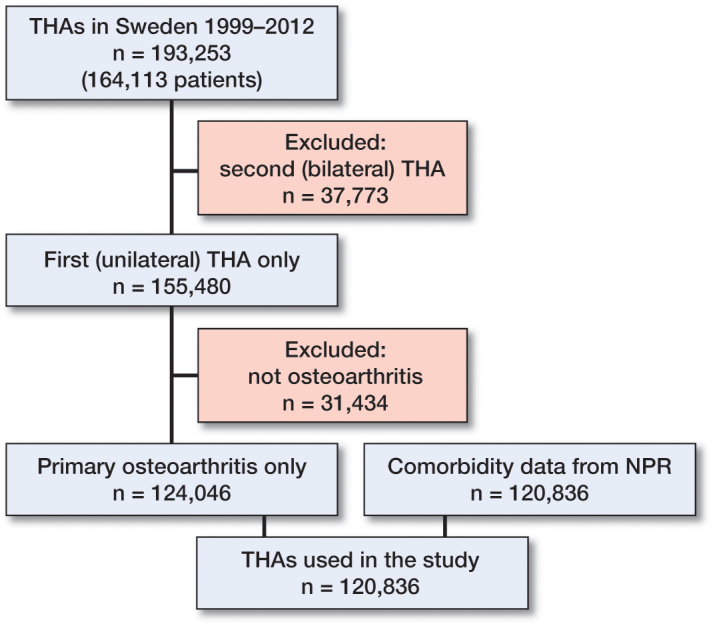
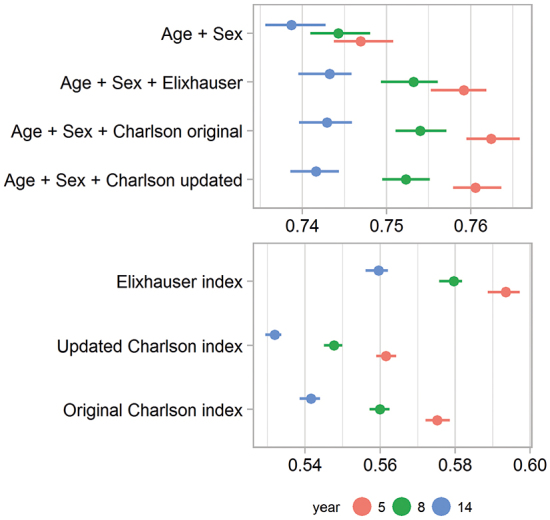
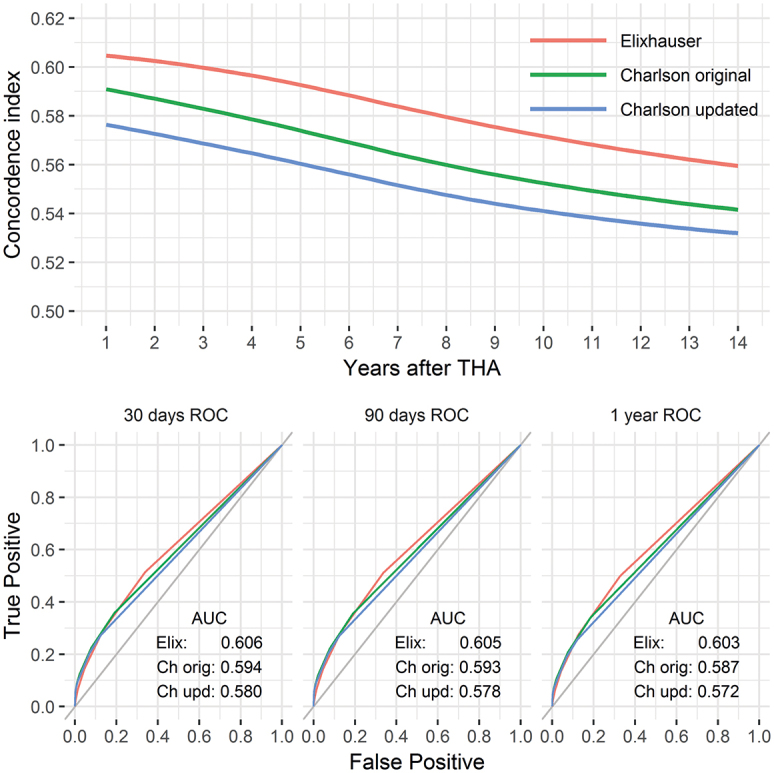
Background and purpose - In-hospital death following total hip arthroplasty (THA) is related to comorbidity. The long-term effect of comorbidity on all-cause mortality is, however, unknown for this group of patients and it was investigated in this study. Patients and methods - We used data from the Swedish Hip Arthroplasty Register, linked to the National Patient Register from the National Board of Health and Welfare, for patients operated on with THA in 1999-2012. We identified 120,836 THAs that could be included in the study. We evaluated the predictive power of the Charlson and Elixhauser comorbidity indices on mortality, using concordance indices calculated after 5, 8, and 14 years after THA. Results - All comorbidity indices performed poorly as predictors, in fact worse than a base model with age and sex only. Elixhauser was, however, the least bad choice and it predicted mortality with concordance indices 0.59, 0.58, and 0.56 for 5, 8, and 14 years after THA. Interpretation - Comorbidity indices are poor predictors of long-term mortality after THA.
背景与目的——全髋关节置换术(THA)后的院内死亡与合并症有关。然而,对于这组患者,合并症对全因死亡率的长期影响尚不清楚,本研究对此进行了调查。
患者与方法——我们使用了瑞典髋关节置换登记处的数据,并将其与瑞典卫生和福利委员会国家患者登记处的数据相链接,数据来自1999年至2012年接受THA手术的患者。我们确定了120836例可纳入研究的THA手术。我们使用THA术后5年、8年和14年计算的一致性指数,评估了Charlson和Elixhauser合并症指数对死亡率的预测能力。
结果——所有合并症指数作为预测指标的表现都很差,实际上比仅包含年龄和性别的基础模型还要差。然而,Elixhauser是最不差的选择,它预测THA术后5年、8年和14年死亡率的一致性指数分别为0.59、0.58和0.56。
解读——合并症指数对THA术后长期死亡率的预测能力较差。