
手臂运动检测(AMD)测试:一种用于快速检测手臂本体感觉敏锐度的机器人测试。
The Arm Movement Detection (AMD) test: a fast robotic test of proprioceptive acuity in the arm.
作者信息
Mrotek Leigh Ann, Bengtson Maria, Stoeckmann Tina, Botzer Lior, Ghez Claude P, McGuire John, Scheidt Robert A
机构信息
Marquette University, Biomedical Engineering 1515 W. Wisconsin Ave, Milwaukee, WI, 53233, USA.
University of Wisconsin Oshkosh, Department of Kinesiology, 800 Algoma Boulevard, Oshkosh, WI, 54901-8630, USA.
出版信息
J Neuroeng Rehabil. 2017 Jun 28;14(1):64. doi: 10.1186/s12984-017-0269-3.
BACKGROUND
We examined the validity and reliability of a short robotic test of upper limb proprioception, the Arm Movement Detection (AMD) test, which yields a ratio-scaled, objective outcome measure to be used for evaluating the impact of sensory deficits on impairments of motor control, motor adaptation and functional recovery in stroke survivors.
METHODS
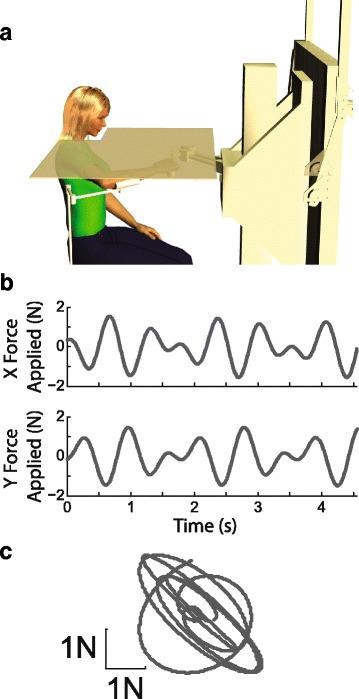
Subjects grasped the handle of a horizontal planar robot, with their arm and the robot hidden from view. The robot applied graded force perturbations, which produced small displacements of the handle. The AMD test required subjects to respond verbally to queries regarding whether or not they detected arm motions. Each participant completed ten, 60s trials; in five of the trials, force perturbations were increased in small increments until the participant detected motion while in the others, perturbations were decreased until the participant could no longer detect motion. The mean and standard deviation of the 10 movement detection thresholds were used to compute a Proprioceptive Acuity Score (PAS). Based on the sensitivity and consistency of the estimated thresholds, the PAS quantifies the likelihood that proprioception is intact. Lower PAS scores correspond to higher proprioceptive acuity. Thirty-nine participants completed the AMD test, consisting of 25 neurologically intact control participants (NIC), seven survivors of stroke with intact proprioception in the more affected limb (HSS+P), and seven survivors of stroke with impaired or absent proprioception in the more affected limb (HSS-P).
RESULTS
Significant group differences were found, with the NIC and HSS+P groups having lower (i.e., better) PAS scores than the HSS-P group. A subset of the participants completed the AMD test multiple times and the AMD test was found to be reliable across repetitions.
CONCLUSIONS
The AMD test required less than 15 min to complete and provided an objective, ratio-scaled measure of proprioceptive acuity in the upper limb. In the future, this test could be utilized to evaluate the contributions of sensory deficits to motor recovery following stroke.
背景
我们检验了上肢本体感觉的一种简短机器人测试——手臂运动检测(AMD)测试的有效性和可靠性,该测试产生一个比率量表式的客观结果指标,用于评估感觉缺陷对中风幸存者运动控制、运动适应和功能恢复障碍的影响。
方法
受试者握住水平平面机器人的手柄,其手臂和机器人均处于视线之外。机器人施加分级力扰动,使手柄产生微小位移。AMD测试要求受试者对关于他们是否检测到手臂运动的询问做出口头回应。每位参与者完成10次60秒的试验;在其中5次试验中,力扰动以小增量增加,直到参与者检测到运动,而在其他试验中,扰动减小,直到参与者不再能检测到运动。10个运动检测阈值的均值和标准差用于计算本体感觉敏锐度评分(PAS)。基于估计阈值的敏感性和一致性,PAS量化本体感觉完好的可能性。较低的PAS评分对应较高的本体感觉敏锐度。39名参与者完成了AMD测试,其中包括25名神经功能正常的对照参与者(NIC)、7名受影响较重肢体本体感觉完好的中风幸存者(HSS + P)以及7名受影响较重肢体本体感觉受损或缺失的中风幸存者(HSS - P)。
结果
发现组间存在显著差异,NIC组和HSS + P组的PAS评分低于HSS - P组(即更好)。一部分参与者多次完成AMD测试,结果发现AMD测试在重复测试中具有可靠性。
结论
AMD测试完成时间不到15分钟,并提供了一种客观的、比率量表式的上肢本体感觉敏锐度测量方法。未来,该测试可用于评估感觉缺陷对中风后运动恢复的影响。



 Zotero 插件