Lunenfeld-Tanenbaum Research Institute, Mount Sinai Hospital, 600 University Avenue, Toronto, Ontario, Canada M5G 1X5.
Department of Molecular Genetics, University of Toronto, Toronto, Ontario, Canada M5S 1A8.
Open Biol. 2017 Jun;7(6). doi: 10.1098/rsob.170114.
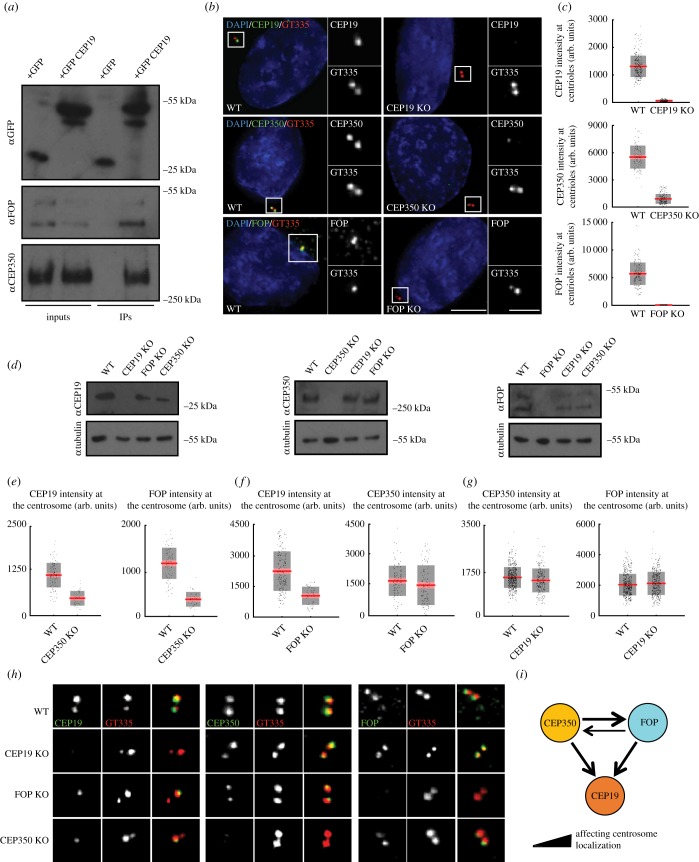
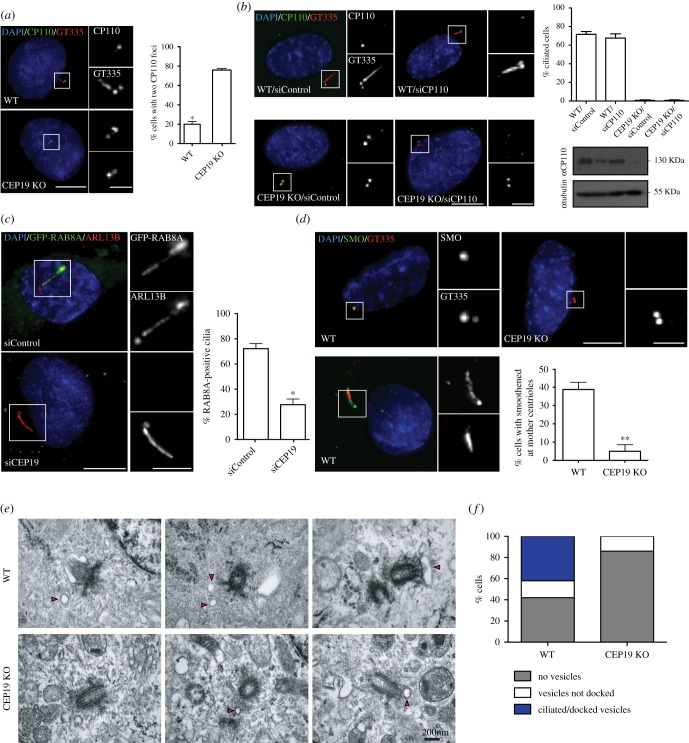
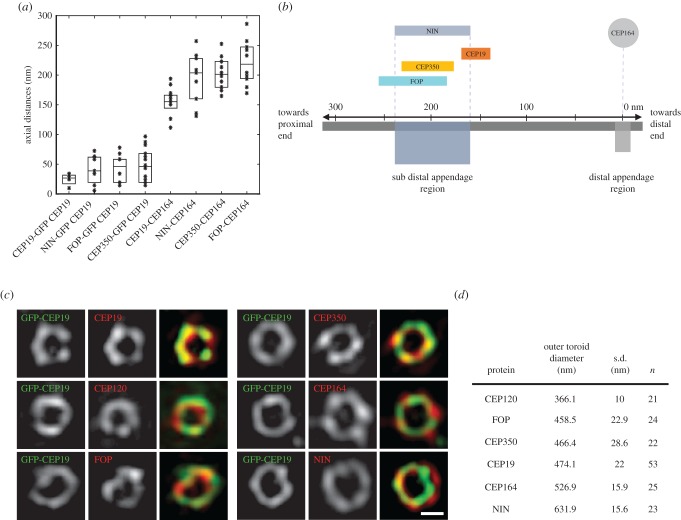
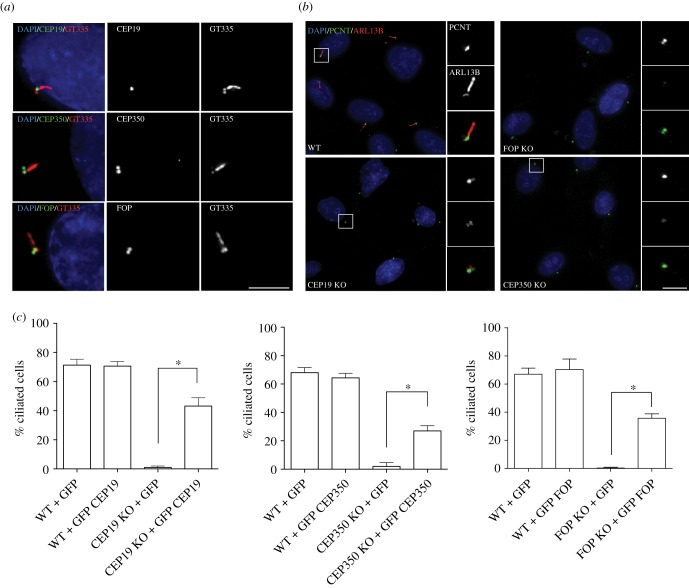
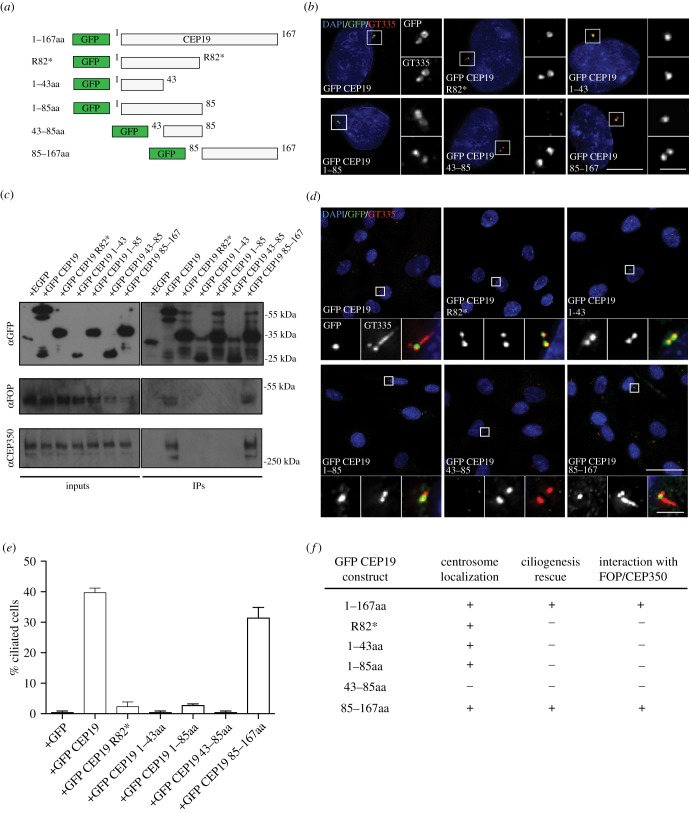
Primary cilia are microtubule-based sensory organelles necessary for efficient transduction of extracellular cues. To initiate cilia formation, ciliary vesicles (CVs) are transported to the vicinity of the centrosome where they dock to the distal end of the mother centriole and fuse to initiate cilium assembly. However, to this date, the early steps in cilia formation remain incompletely understood. Here, we demonstrate functional interplay between CEP19, FOP and CEP350 in ciliogenesis. Using three-dimensional structured-illumination microscopy (3D-SIM) imaging, we mapped the relative spatial distribution of these proteins at the distal end of the mother centriole and show that CEP350/FOP act upstream of CEP19 in their recruitment hierarchy. We demonstrate that CEP19 CRISPR KO cells are severely impaired in their ability to form cilia, analogous to the loss of function of CEP19 binding partners FOP and CEP350. Notably, in the absence of CEP19 microtubule anchoring at centromes is similar in manner to its interaction partners FOP and CEP350. Using GFP-tagged deletion constructs of CEP19, we show that the C-terminus of CEP19 is required for both its localization to centrioles and for its function in ciliogenesis. Critically, this region also mediates the interaction between CEP19 and FOP/CEP350. Interestingly, a morbid-obesity-associated R82* truncated mutant of CEP19 cannot ciliate nor interact with FOP and CEP350, indicative of a putative role for CEP19 in ciliopathies. Finally, analysis of CEP19 KO cells using thin-section electron microscopy revealed marked defects in the docking of CVs to the distal end of the mother centrioles. Together, these data demonstrate a role for the CEP19, FOP and CEP350 module in ciliogenesis and the possible effect of disrupting their functions in ciliopathies.
初级纤毛是基于微管的感觉细胞器,对于有效转导细胞外信号至关重要。为了启动纤毛形成,纤毛囊泡(CVs)被运输到中心体附近,在那里它们与母中心粒的远端末端对接并融合,从而启动纤毛组装。然而,到目前为止,纤毛形成的早期步骤仍不完全清楚。在这里,我们证明了 CEP19、FOP 和 CEP350 在纤毛发生中的功能相互作用。使用三维结构照明显微镜(3D-SIM)成像,我们绘制了这些蛋白质在母中心粒远端的相对空间分布,并表明 CEP350/FOP 在它们的募集层次结构中位于 CEP19 的上游。我们证明 CEP19 CRISPR KO 细胞在形成纤毛的能力上严重受损,类似于 CEP19 结合伙伴 FOP 和 CEP350 的功能丧失。值得注意的是,在没有 CEP19 的情况下,微管在中心体上的锚定方式与它的相互作用伙伴 FOP 和 CEP350 相似。使用 GFP 标记的 CEP19 缺失构建体,我们表明 CEP19 的 C 末端对于其在中心体上的定位和在纤毛发生中的功能都是必需的。至关重要的是,该区域还介导了 CEP19 与 FOP/CEP350 之间的相互作用。有趣的是,CEP19 的一种与肥胖相关的 R82*截断突变体不能纤毛化,也不能与 FOP 和 CEP350 相互作用,这表明 CEP19 在纤毛病中的可能作用。最后,使用薄切片电子显微镜对 CEP19 KO 细胞进行分析显示,CVs 与母中心粒远端的对接存在明显缺陷。总之,这些数据表明 CEP19、FOP 和 CEP350 模块在纤毛发生中起作用,并且破坏它们在纤毛病中的功能可能会产生影响。