Lafaille-Magnan Marie-Elyse, Poirier Judes, Etienne Pierre, Tremblay-Mercier Jennifer, Frenette Joanne, Rosa-Neto Pedro, Breitner John C S
From the Centre for Studies on Prevention of AD (M.-E.L.-M., J.P., P.E., J.T.-M., J.F., P.R.-N., J.C.S.B.) and McGill Centre for Studies in Aging (P.R.-N.), Douglas Mental Health University Institute, McGill University, Faculty of Medicine, Montreal, Quebec, Canada.
Neurology. 2017 Jul 25;89(4):327-335. doi: 10.1212/WNL.0000000000004159. Epub 2017 Jun 28.
To assess odor identification (OI) as an indicator of presymptomatic Alzheimer disease (AD) pathogenesis in cognitively normal aging individuals at increased risk of AD dementia.
In 274 members of the PREVENT-AD cohort of healthy aging persons with a parental or multiple-sibling history of AD dementia, we assessed the cross-sectional association of OI with potential indicators of presymptomatic AD. Some 101 participants donated CSF, thus enabling assessment of AD pathology with the biomarkers total tau (t-tau), phospho-tau (P-tau), and their ratios with β-amyloid (Aβ). Adjusted analyses considered age, cognition, ε4 status, education, and sex as covariates. We measured OI using the University of Pennsylvania Smell Identification Test and cognitive performance using the Repeatable Battery for Assessment of Neuropsychological Status. Standard kits provided assays of the AD biomarkers. Analyses used robust-fit linear regression models.
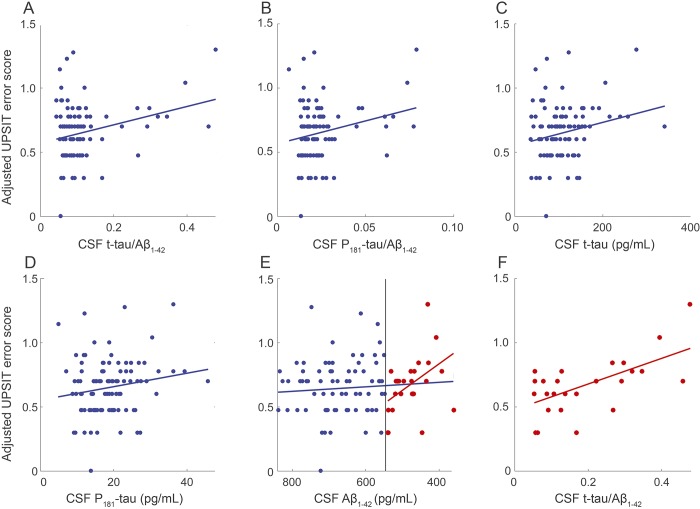
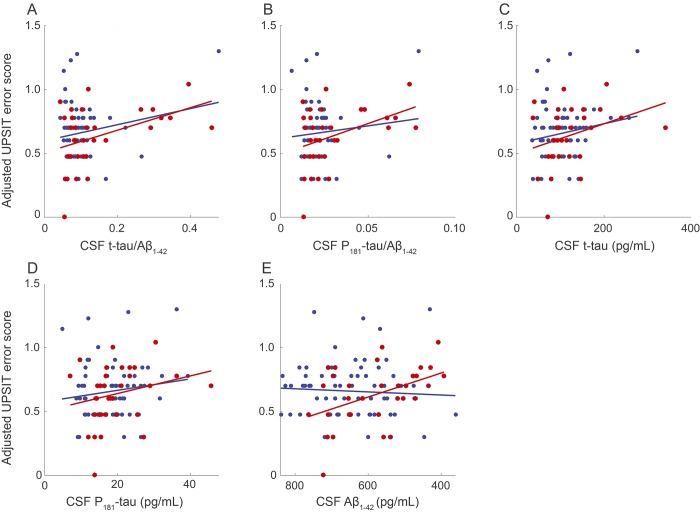
Reduced OI was associated with lower cognitive score and older age, as well as increased ratios of CSF t-tau and P-tau to Aβ (all < 0.02). However, the observed associations of OI with age and cognition were unapparent in adjusted models that restricted observations to CSF donors and included AD biomarkers. OI showed little association with CSF Aβ alone except in ε4 carriers having lowest-quartile Aβ levels.
These findings from healthy high-risk older individuals suggest that OI reflects degree of preclinical AD pathology, while its relationships with age and cognition result from the association of these latter variables with such pathology. Diminished OI may be a practical and affordable biomarker of AD pathology.
评估气味识别(OI)作为有患阿尔茨海默病(AD)痴呆症风险增加的认知正常老年人中症状前AD发病机制的指标。
在274名有AD痴呆症父母或多个兄弟姐妹病史的健康老年人的PREVENT-AD队列成员中,我们评估了OI与症状前AD潜在指标的横断面关联。约101名参与者捐献了脑脊液,从而能够使用生物标志物总tau(t-tau)、磷酸化tau(P-tau)及其与β-淀粉样蛋白(Aβ)的比率来评估AD病理。调整分析将年龄、认知、ε4状态、教育程度和性别作为协变量。我们使用宾夕法尼亚大学嗅觉识别测试测量OI,使用可重复神经心理状态评估量表测量认知表现。标准试剂盒提供AD生物标志物的检测。分析使用稳健拟合线性回归模型。
OI降低与较低的认知评分和较高的年龄相关,以及脑脊液t-tau和P-tau与Aβ的比率增加(均P<0.02)。然而,在将观察结果限制为脑脊液捐献者并纳入AD生物标志物的调整模型中,OI与年龄和认知的观察到的关联不明显。OI单独与脑脊液Aβ几乎没有关联,除了在Aβ水平处于最低四分位数的ε4携带者中。
这些来自健康高危老年人的发现表明,OI反映了临床前AD病理的程度,而其与年龄和认知的关系是由于这些后变量与这种病理的关联。OI降低可能是AD病理的一种实用且经济实惠的生物标志物。