Kasuya Goro, Kato Hirotoshi, Yasuda Shigeo, Tsuji Hiroshi, Yamada Shigeru, Haruyama Yasuo, Kobashi Gen, Ebner Daniel K, Okada Naomi Nagatake, Makishima Hirokazu, Miyazaki Masaru, Kamada Tadashi, Tsujii Hirohiko
Hospital of the National Institute of Radiological Sciences, National Institutes for Quantum and Radiological Science and Technology, Chiba, Japan.
Kato Medical Clinic, Tokyo, Japan.
Cancer. 2017 Oct 15;123(20):3955-3965. doi: 10.1002/cncr.30816. Epub 2017 Jun 29.
The objective of this study was to evaluate the safety and efficacy of carbon-ion radiotherapy (CIRT) in patients with hepatocellular carcinoma (HCC) with stepwise dose escalation and hypofractionation in 2 combined prospective trials.
Sequential phase 1/2 (protocol 9603) and phase 2 (protocol 0004) trials were conducted for patients with histologically proven HCC. The phase 1 component of protocol 9603 was a dose-escalation study; CIRT was delivered in 12, 8, or 4 fractions. After determination of the recommended dose, 2 phase 2 trials were performed in an expanded cohort, and the data were pooled to analyze toxicity, local control, and overall survival.
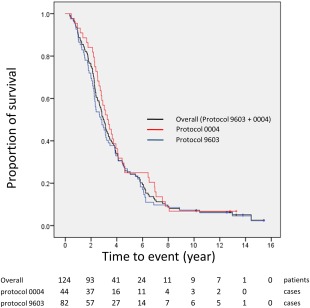
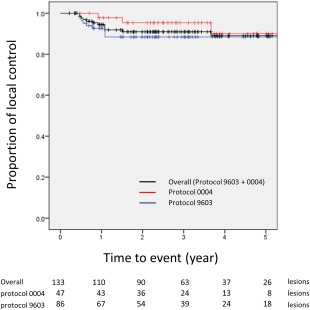
In the phase 1 component of protocol 9603, 69.6, 58.0, and 52.8 Gy (relative biological effectiveness [RBE]) in 12, 8, and 4 fractions, respectively, constituted the maximum tolerated doses, and 52.8 Gy (RBE) in 4 fractions was established as the recommended dose regimen for the 2 phase 2 studies. In 124 patients with a total of 133 lesions, few severe adverse effects occurred, and local-control and overall survival rates at 1, 3, and 5 years were 94.7% and 90.3%, 91.4% and 50.0%, and 90.0% and 25.0%, respectively; this included 1-, 3-, and 5-year local-control rates of 97.8%, 95.5%, and 91.6%, respectively, in the phase 2 study. In a multivariate analysis, Child-Pugh class B and the presence of a tumor thrombus were significant factors for mortality.
The safety and efficacy of CIRT in 12, 8, and 4 fractions were confirmed, with 52.8 Gy (RBE) in 4 fractions established as the recommended treatment course for eligible HCC patients. Cancer 2017;123:3955-65. © 2017 The Authors. Cancer published by Wiley Periodicals, Inc. on behalf of American Cancer Society.
本研究的目的是在两项联合前瞻性试验中,评估逐步增加剂量和采用大分割放疗的碳离子放疗(CIRT)对肝细胞癌(HCC)患者的安全性和疗效。
对组织学确诊的HCC患者进行了1/2期序贯试验(方案9603)和2期试验(方案0004)。方案9603的1期部分是一项剂量递增研究;CIRT采用12次、8次或4次分割照射。确定推荐剂量后,在扩大队列中进行了两项2期试验,并汇总数据以分析毒性、局部控制率和总生存率。
在方案9603的1期部分,12次、8次和4次分割照射时的最大耐受剂量分别为69.6 Gy(相对生物效应[RBE])、58.0 Gy(RBE)和52.8 Gy(RBE),4次分割照射时的52.8 Gy(RBE)被确定为两项2期研究的推荐剂量方案。在124例共有133个病灶的患者中,严重不良反应很少发生,1年、3年和5年的局部控制率和总生存率分别为94.7%和90.3%、91.4%和50.0%、90.0%和25.0%;在2期研究中,1年、3年和5年的局部控制率分别为97.8%、95.5%和91.6%。多因素分析显示,Child-Pugh B级和存在肿瘤血栓是死亡的重要因素。
证实了12次、8次和4次分割照射的CIRT的安全性和疗效,4次分割照射时的52.8 Gy(RBE)被确定为符合条件的HCC患者的推荐治疗方案。《癌症》2017年;123:3955 - 65。© 2017作者。《癌症》由威利期刊公司代表美国癌症协会出版。