Exposito-Rodriguez Marino, Laissue Pierre Philippe, Yvon-Durocher Gabriel, Smirnoff Nicholas, Mullineaux Philip M
School of Biological Sciences, University of Essex, Wivenhoe Park, Colchester, CO4 3SQ, UK.
Biosciences, College of Life and Environmental Sciences, University of Exeter, Geoffrey Pope Building, Stocker Road, Exeter, EX4 4QD, UK.
Nat Commun. 2017 Jun 29;8(1):49. doi: 10.1038/s41467-017-00074-w.
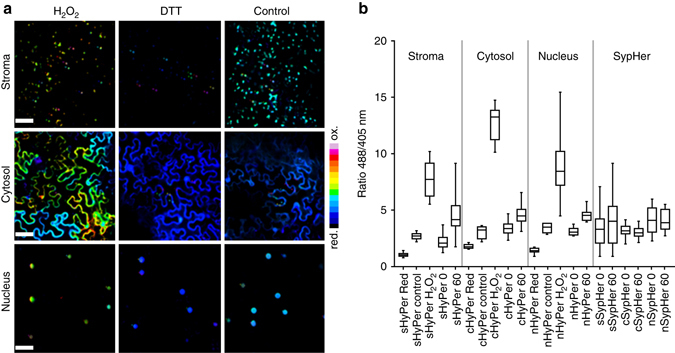
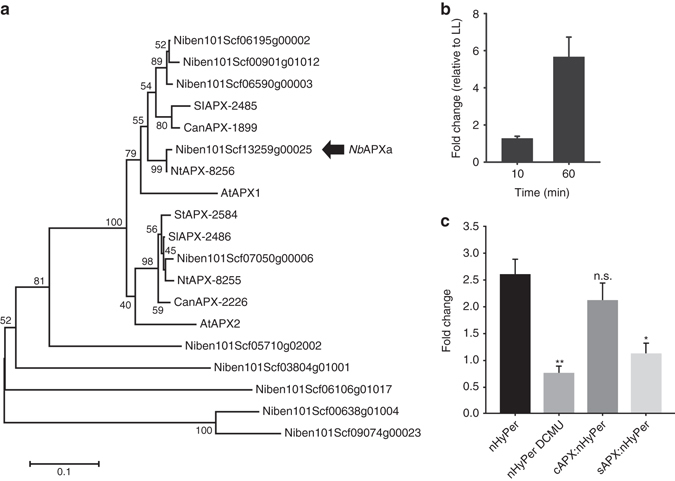
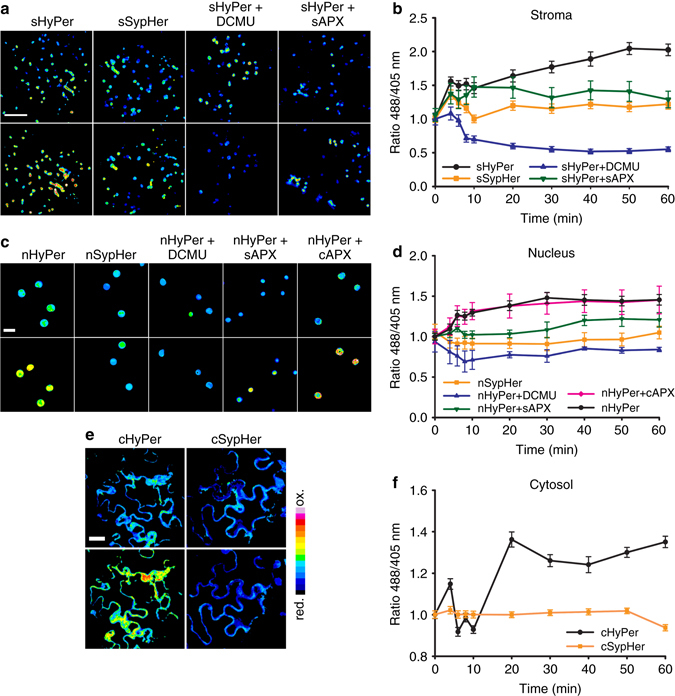
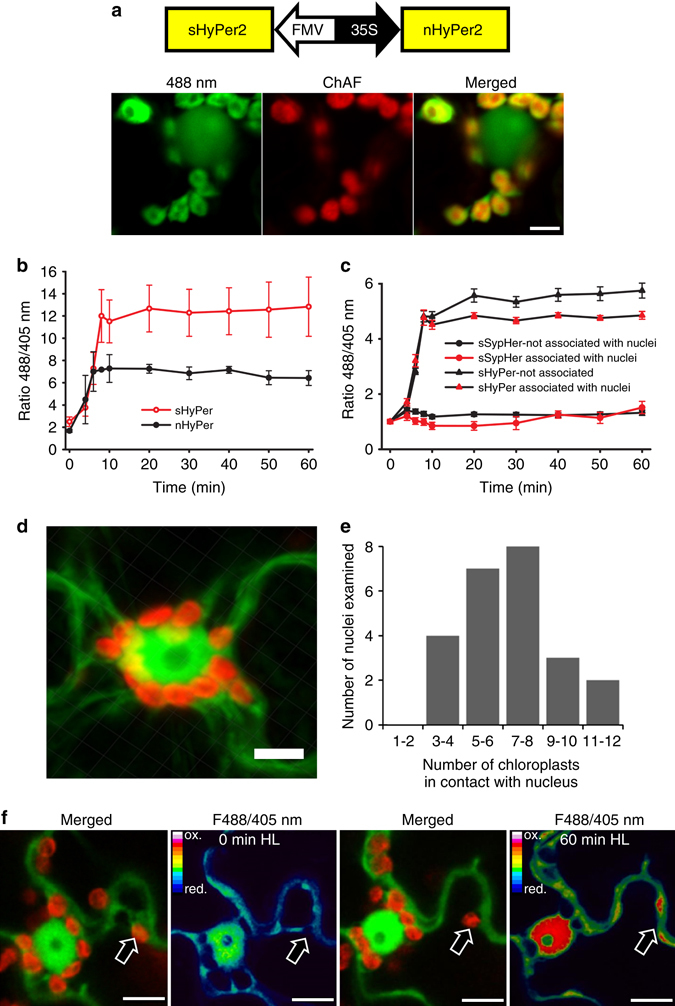
Chloroplasts communicate information by signalling to nuclei during acclimation to fluctuating light. Several potential operating signals originating from chloroplasts have been proposed, but none have been shown to move to nuclei to modulate gene expression. One proposed signal is hydrogen peroxide (HO) produced by chloroplasts in a light-dependent manner. Using HyPer2, a genetically encoded fluorescent HO sensor, we show that in photosynthetic Nicotiana benthamiana epidermal cells, exposure to high light increases HO production in chloroplast stroma, cytosol and nuclei. Critically, over-expression of stromal ascorbate peroxidase (HO scavenger) or treatment with DCMU (photosynthesis inhibitor) attenuates nuclear HO accumulation and high light-responsive gene expression. Cytosolic ascorbate peroxidase over-expression has little effect on nuclear HO accumulation and high light-responsive gene expression. This is because the HO derives from a sub-population of chloroplasts closely associated with nuclei. Therefore, direct HO transfer from chloroplasts to nuclei, avoiding the cytosol, enables photosynthetic control over gene expression.Multiple plastid-derived signals have been proposed but not shown to move to the nucleus to promote plant acclimation to fluctuating light. Here the authors use a fluorescent hydrogen peroxide sensor to provide evidence that HO is transferred directly from chloroplasts to nuclei to control nuclear gene expression.
在适应波动光照的过程中,叶绿体通过向细胞核发出信号来传递信息。已经提出了几种源自叶绿体的潜在操作信号,但尚未有信号被证明能移动到细胞核以调节基因表达。一种提出的信号是叶绿体以光依赖方式产生的过氧化氢(H₂O₂)。我们使用HyPer2(一种基因编码的荧光H₂O₂传感器),发现在光合烟草本生表皮细胞中,暴露于高光下会增加叶绿体基质、细胞质和细胞核中的H₂O₂产生。至关重要的是,基质抗坏血酸过氧化物酶(H₂O₂清除剂)的过表达或用DCMU(光合作用抑制剂)处理会减弱细胞核中的H₂O₂积累和高光响应基因表达。细胞质抗坏血酸过氧化物酶的过表达对细胞核中的H₂O₂积累和高光响应基因表达影响很小。这是因为H₂O₂源自与细胞核紧密相关的叶绿体亚群。因此,H₂O₂从叶绿体直接转移到细胞核,避开细胞质,实现了对基因表达的光合控制。已经提出了多种源自质体的信号,但尚未证明它们能移动到细胞核以促进植物适应波动光照。在这里,作者使用荧光过氧化氢传感器提供证据,证明H₂O₂直接从叶绿体转移到细胞核以控制核基因表达。