The Center for Advanced Medical Simulation and Training (CAMST), Karolinska University Hospital, Stockholm, Sweden.
Division of Surgery, Department of Clinical ScienceIntervention and Technology (CLINTEC), Karolinska Institutet, Stockholm, Sweden.
Surg Endosc. 2018 Jan;32(1):87-95. doi: 10.1007/s00464-017-5641-7. Epub 2017 Jun 29.
Basic skills training in laparoscopic high-fidelity simulators (LHFS) improves laparoscopic skills. However, since LHFS are expensive, their availability is limited. The aim of this study was to assess whether automated video analysis of low-cost BlackBox laparoscopic training could provide an alternative to LHFS in basic skills training.
Medical students volunteered to participate during their surgical semester at the Karolinska University Hospital. After written informed consent, they performed two laparoscopic tasks (PEG-transfer and precision-cutting) on a BlackBox trainer. All tasks were videotaped and sent to MPLSC for automated video analysis, generating two parameters (Pl and Prtcl_tot) that assess the total motion activity. The students then carried out final tests on the MIST-VR simulator. This study was a European collaboration among two simulation centers, located in Sweden and Greece, within the framework of ACS-AEI.
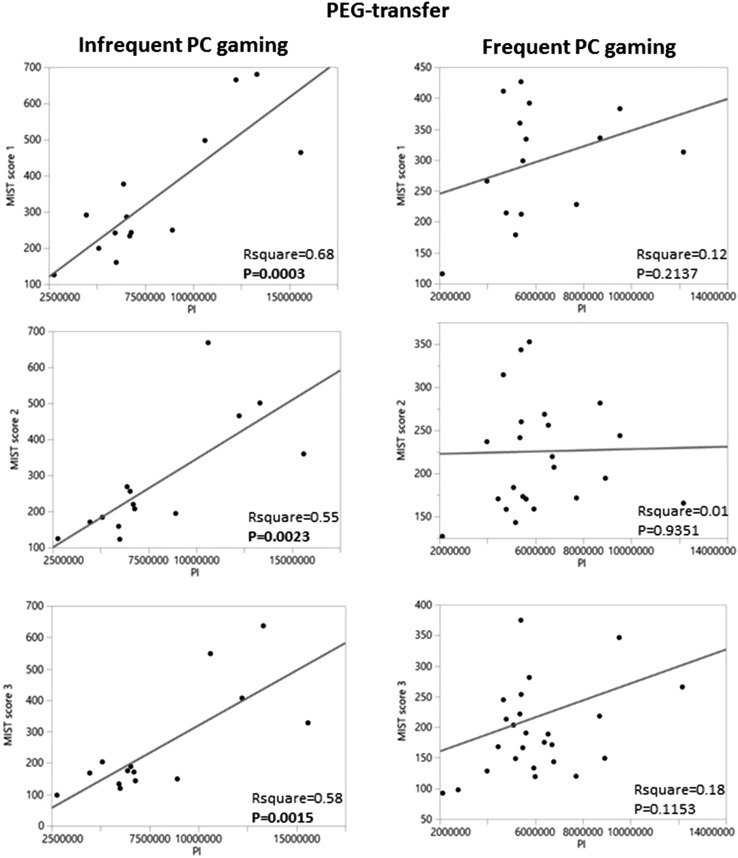
31 students (19 females and 12 males), mean age of 26.2 ± 0.8 years, participated in the study. However, since two of the students completed only one of the three MIST-VR tasks, they were excluded. The three MIST-VR scores showed significant positive correlations to both the Pl variable in the automated video analysis of the PEG-transfer (RSquare 0.48, P < 0.0001; 0.34, P = 0.0009; 0.45, P < 0.0001, respectively) as well as to the Prtcl_tot variable in that same exercise (RSquare 0.42, P = 0.0002; 0.29, P = 0.0024; 0.45, P < 0.0001). However, the correlations were exclusively shown in the group with less PC gaming experience as well as in the female group.
Automated video analysis provides accurate results in line with those of the validated MIST-VR. We believe that a more frequent use of automated video analysis could provide an extended value to cost-efficient laparoscopic BlackBox training. However, since there are gender-specific as well as PC gaming experience differences, this should be taken in account regarding the value of automated video analysis.
腹腔镜高保真模拟器(LHFS)的基础技能培训可以提高腹腔镜技能。然而,由于 LHFS 价格昂贵,其可用性有限。本研究旨在评估低成本 BlackBox 腹腔镜训练的自动化视频分析是否可以替代 LHFS 进行基本技能培训。
医学生在卡罗林斯卡大学医院的外科学期自愿参加。在书面知情同意后,他们在 BlackBox 训练器上进行了两项腹腔镜任务(PEG 转移和精密切割)。所有任务都被录像并发送到 MPLSC 进行自动化视频分析,生成两个参数(Pl 和 Prtcl_tot),评估总运动活动。然后,学生在 MIST-VR 模拟器上进行最终测试。这项研究是由位于瑞典和希腊的两个模拟中心在 ACS-AEI 框架内进行的欧洲合作。
31 名学生(19 名女性和 12 名男性),平均年龄 26.2 ± 0.8 岁,参加了这项研究。然而,由于两名学生仅完成了 MIST-VR 的三项任务中的一项,因此被排除在外。三项 MIST-VR 评分与 PEG 转移的自动化视频分析中的 Pl 变量呈显著正相关(RSquare 0.48,P < 0.0001;0.34,P = 0.0009;0.45,P < 0.0001,分别),与同一运动中的 Prtcl_tot 变量也呈显著正相关(RSquare 0.42,P = 0.0002;0.29,P = 0.0024;0.45,P < 0.0001)。然而,这种相关性仅在 PC 游戏经验较少的组和女性组中表现出来。
自动化视频分析提供的结果与经过验证的 MIST-VR 一致。我们相信,更频繁地使用自动化视频分析可以为具有成本效益的腹腔镜 BlackBox 训练提供更多的价值。然而,由于存在性别特异性和 PC 游戏经验差异,在考虑自动化视频分析的价值时应考虑到这一点。