Sereni Maria Isabella, Baldelli Elisa, Gambara Guido, Ravaggi Antonella, Hodge K Alex, Alberts David S, Guillen-Rodriguez Jose M, Dong Ting, Memo Maurizio, Odicino Franco, Angioli Roberto, Liotta Lance A, Pecorelli Sergio L, Petricoin Emanuel F, Pierobon Mariaelena
Center for Applied Proteomics and Molecular Medicine, George Mason University, 10920 George Mason Circle, Manassas, VA 20110, USA.
Department of Molecular and Translational Medicine, University of Brescia, Viale Europa 11, 25123 Brescia, Italy.
Br J Cancer. 2017 Aug 8;117(4):494-502. doi: 10.1038/bjc.2017.195. Epub 2017 Jun 29.
The biological mechanisms underlying early- and advanced-stage epithelial ovarian cancers (EOCs) are still poorly understood. This study explored kinase-driven metabolic signalling in early and advanced EOCs, and its role in tumour progression and response to carboplatin-paclitaxel treatment.
Tumour epithelia were isolated from two independent sets of primary EOC (n=72 and 30 for the discovery and the validation sets, respectively) via laser capture microdissection. Reverse phase protein microarrays were used to broadly profile the kinase-driven metabolic signalling of EOC with particular emphasis on the LBK1-AMPK and AKT-mTOR axes. Signalling activation was compared between early and advanced lesions, and carboplatin-paclitaxel-sensitive and -resistant tumours.
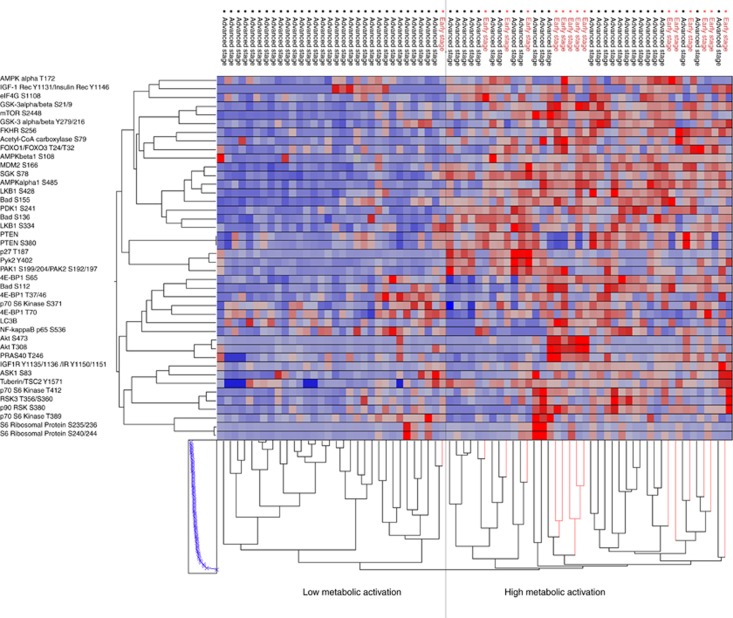
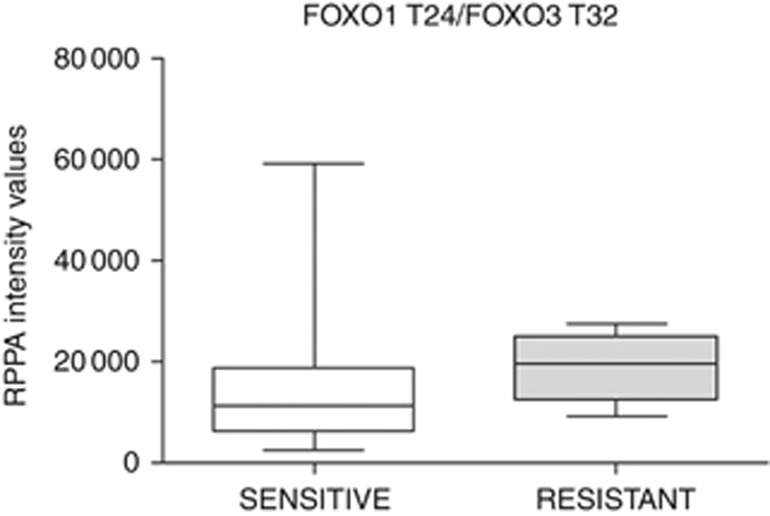
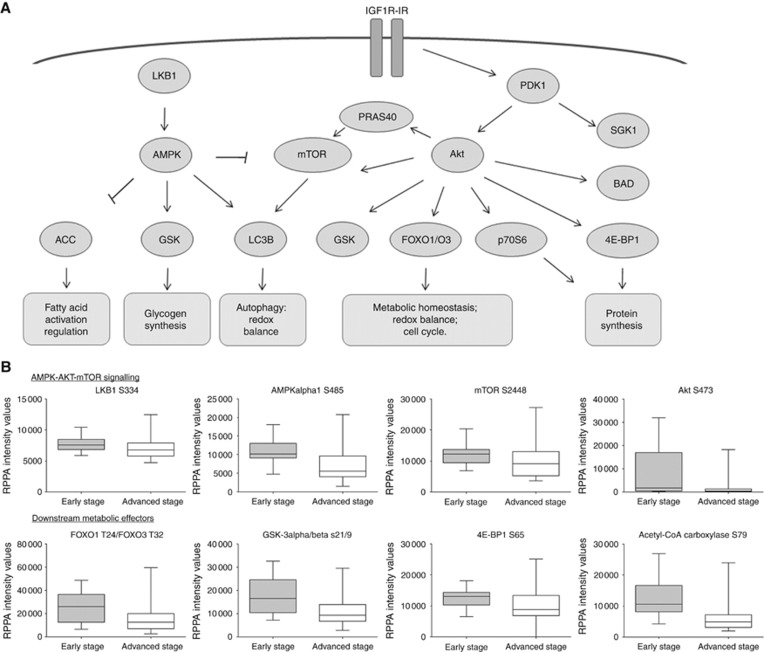
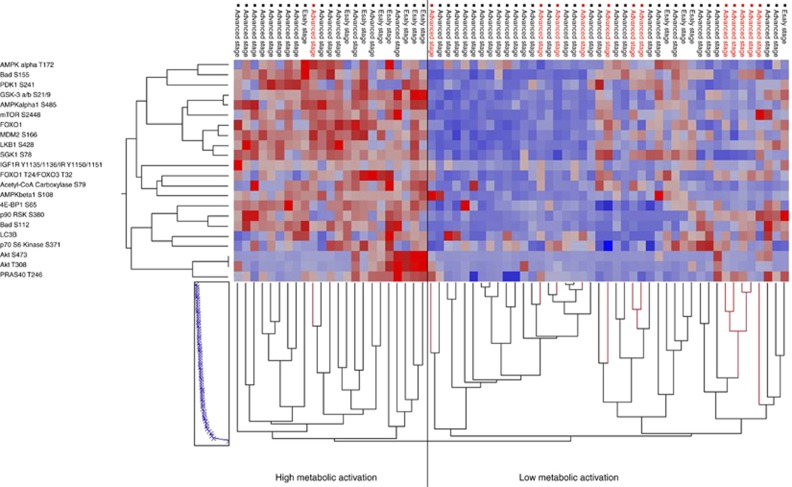
Advanced EOCs were characterised by a heterogeneous kinase-driven metabolic signature and decreased phosphorylation of the AMPK-AKT-mTOR axis compared to early EOC (P<0.05 for AMPKα T172, AMPKα1 S485, AMPKβ1 S108, AKT S473 and T308, mTOR S2448, p70S6 S371, 4EBP1 S65, GSK-3 α/β S21/9, FOXO1 T24/FOXO3 T32, and FOXO1 S256). Advanced tumours with low relative activation of the metabolic signature and increased FOXO1 T24/FOXO3 T32 phosphorylation (P=0.041) were associated with carboplatin-paclitaxel resistance.
If validated in a larger cohort of patients, the decreased AMPK-AKT-mTOR activation and phosphorylation of FOXO1 T24/FOXO3 T32 may help identify carboplatin-paclitaxel-resistant EOC patients.
早期和晚期上皮性卵巢癌(EOC)的生物学机制仍知之甚少。本研究探讨了早期和晚期EOC中激酶驱动的代谢信号传导及其在肿瘤进展和对卡铂-紫杉醇治疗反应中的作用。
通过激光捕获显微切割从两组独立的原发性EOC(发现组和验证组分别为n = 72和30)中分离肿瘤上皮。使用反相蛋白质微阵列广泛分析EOC的激酶驱动的代谢信号传导,特别关注LBK1-AMPK和AKT-mTOR轴。比较早期和晚期病变以及卡铂-紫杉醇敏感和耐药肿瘤之间的信号激活情况。
与早期EOC相比,晚期EOC的特征是激酶驱动的代谢特征异质性以及AMPK-AKT-mTOR轴的磷酸化降低(AMPKα T172、AMPKα1 S485、AMPKβ1 S108、AKT S473和T308、mTOR S2448、p70S6 S371、4EBP1 S65、GSK-3 α/β S21/9、FOXO1 T24/FOXO3 T32和FOXO1 S256,P<0.05)。代谢特征相对激活较低且FOXO1 T24/FOXO3 T32磷酸化增加(P = 0.041)的晚期肿瘤与卡铂-紫杉醇耐药相关。
如果在更大的患者队列中得到验证,AMPK-AKT-mTOR激活降低以及FOXO1 T24/FOXO3 T32磷酸化可能有助于识别卡铂-紫杉醇耐药的EOC患者。