Center for Applied Proteomics and Molecular Medicine, George Mason University, Manassas, Virginia, USA.
Department of Experimental Medicine, Section of Anatomic Pathology and Histology, University of Perugia, Perugia, Italy.
J Immunother Cancer. 2021 Oct;9(10). doi: 10.1136/jitc-2020-002179.
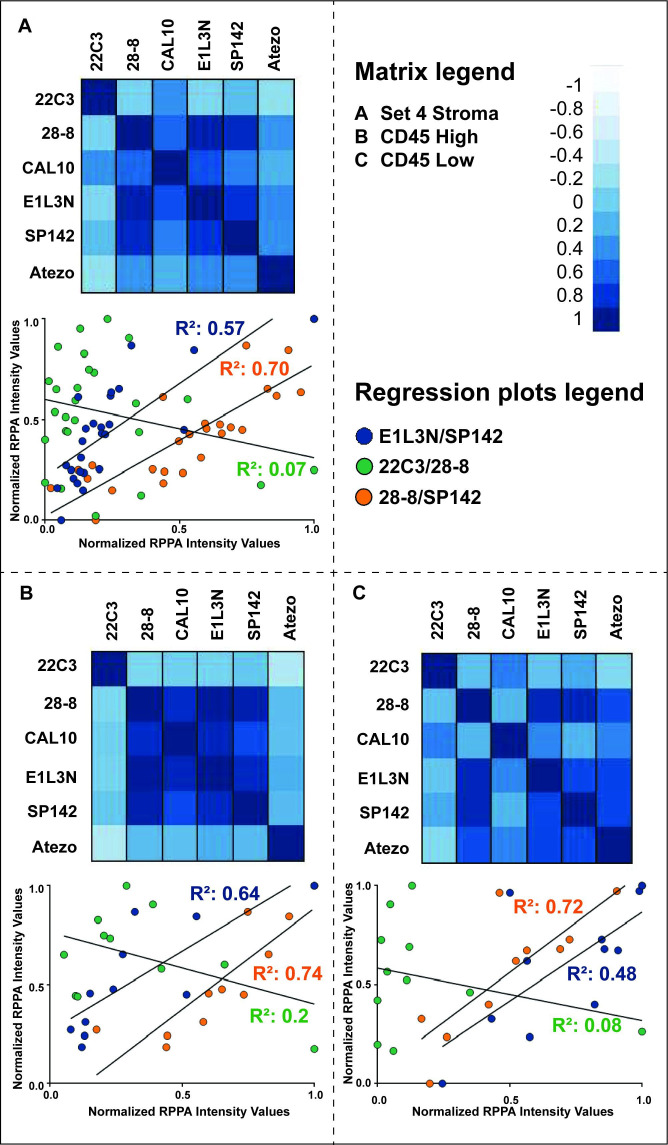
Anti-programmed cell death protein 1 and programmed cell death ligand 1 (PD-L1) agents are broadly used in first-line and second-line treatment across different tumor types. While immunohistochemistry-based assays are routinely used to assess PD-L1 expression, their clinical utility remains controversial due to the partial predictive value and lack of standardized cut-offs across antibody clones. Using a high throughput immunoassay, the reverse phase protein microarray (RPPA), coupled with a fluorescence-based detection system, this study compared the performance of six anti-PD-L1 antibody clones on 666 tumor samples.
PD-L1 expression was measured using five antibody clones (22C3, 28-8, CAL10, E1L3N and SP142) and the therapeutic antibody atezolizumab on 222 lung, 71 ovarian, 52 prostate and 267 breast cancers, and 54 metastatic lesions. To capture clinically relevant variables, our cohort included frozen and formalin-fixed paraffin-embedded samples, surgical specimens and core needle biopsies. Pure tumor epithelia were isolated using laser capture microdissection from 602 samples. Correlation coefficients were calculated to assess concordance between antibody clones. For two independent cohorts of patients with lung cancer treated with nivolumab, RPPA-based PD-L1 measurements were examined along with response to treatment.
Median-center PD-L1 dynamic ranged from 0.01 to 39.37 across antibody clones. Correlation coefficients between the six antibody clones were heterogeneous (range: -0.48 to 0.95) and below 0.50 in 61% of the comparisons. In nivolumab-treated patients, RPPA-based measurement identified a subgroup of tumors, where low PD-L1 expression equated to lack of response.
Continuous RPPA-based measurements capture a broad dynamic range of PD-L1 expression in human specimens and heterogeneous concordance levels between antibody clones. This high throughput immunoassay can potentially identify subgroups of tumors in which low expression of PD-L1 equates to lack of response to treatment.
抗程序性细胞死亡蛋白 1 和程序性死亡配体 1(PD-L1)药物广泛用于不同肿瘤类型的一线和二线治疗。虽然基于免疫组织化学的检测方法通常用于评估 PD-L1 表达,但由于抗体克隆之间的部分预测价值和缺乏标准化截止值,其临床实用性仍存在争议。本研究使用高通量免疫测定法——反向蛋白微阵列(RPPA),结合荧光检测系统,比较了六种抗 PD-L1 抗体克隆在 666 个肿瘤样本上的表现。
使用五种抗体克隆(22C3、28-8、CAL10、E1L3N 和 SP142)和治疗性抗体 atezolizumab 测量了 222 例肺癌、71 例卵巢癌、52 例前列腺癌和 267 例乳腺癌以及 54 例转移性病变的 PD-L1 表达。为了捕获临床相关变量,我们的队列包括冷冻和福尔马林固定石蜡包埋样本、手术标本和核心针活检。使用激光捕获微切割从 602 个样本中分离出纯肿瘤上皮。计算相关系数以评估抗体克隆之间的一致性。对于接受 nivolumab 治疗的两个独立的肺癌患者队列,研究了基于 RPPA 的 PD-L1 测量结果以及对治疗的反应。
六种抗体克隆的中位数中心 PD-L1 动态范围为 0.01 至 39.37。六种抗体克隆之间的相关系数不一致(范围为-0.48 至 0.95),61%的比较低于 0.50。在接受 nivolumab 治疗的患者中,基于 RPPA 的测量确定了肿瘤的亚组,其中低 PD-L1 表达等同于缺乏反应。
连续的基于 RPPA 的测量方法可捕获人标本中 PD-L1 表达的广泛动态范围,以及抗体克隆之间的一致性水平差异。这种高通量免疫测定法有可能确定肿瘤的亚组,其中低表达的 PD-L1 等同于对治疗缺乏反应。