Dos Santos Patricia Carolina, Panero Julieta, Stanganelli Carmen, Palau Nagore Virginia, Stella Flavia, Bezares Raimundo, Slavutsky Irma
Laboratorio de Genética de Neoplasias Linfoides, Instituto de Medicina Experimental, CONICET-Academia Nacional de Medicina, Buenos Aires, Argentina.
División Patología Molecular, Instituto de Investigaciones Hematológicas-Academia Nacional de Medicina, Buenos Aires, Argentina.
PLoS One. 2017 Jun 30;12(6):e0179883. doi: 10.1371/journal.pone.0179883. eCollection 2017.
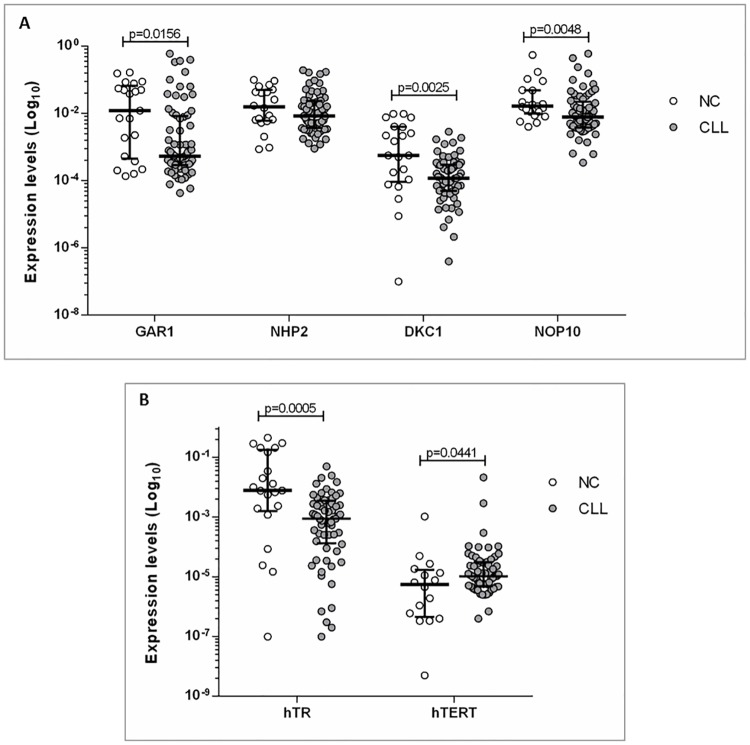
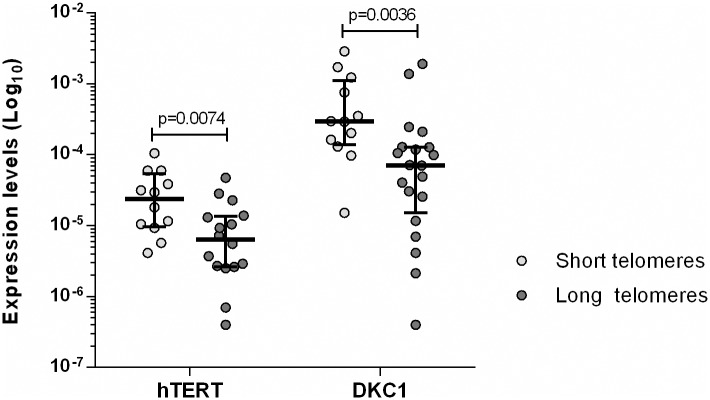
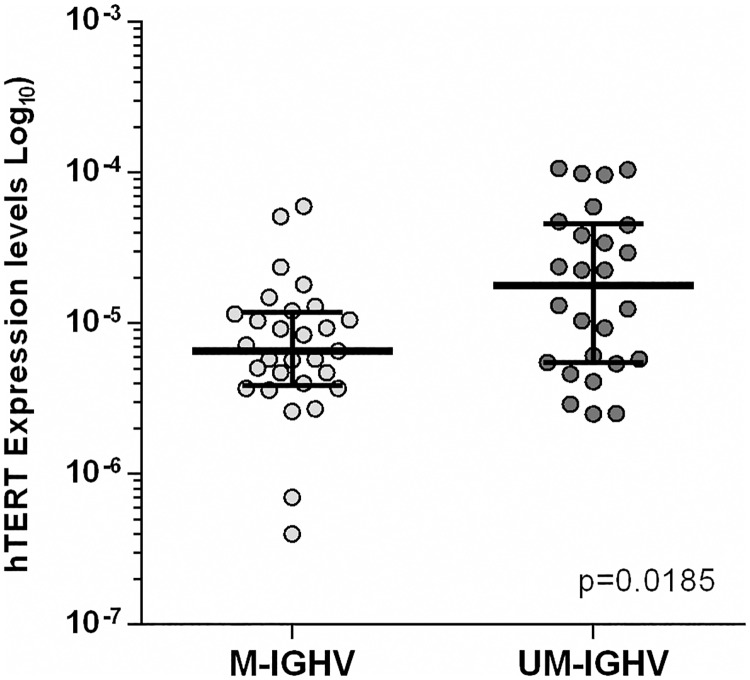
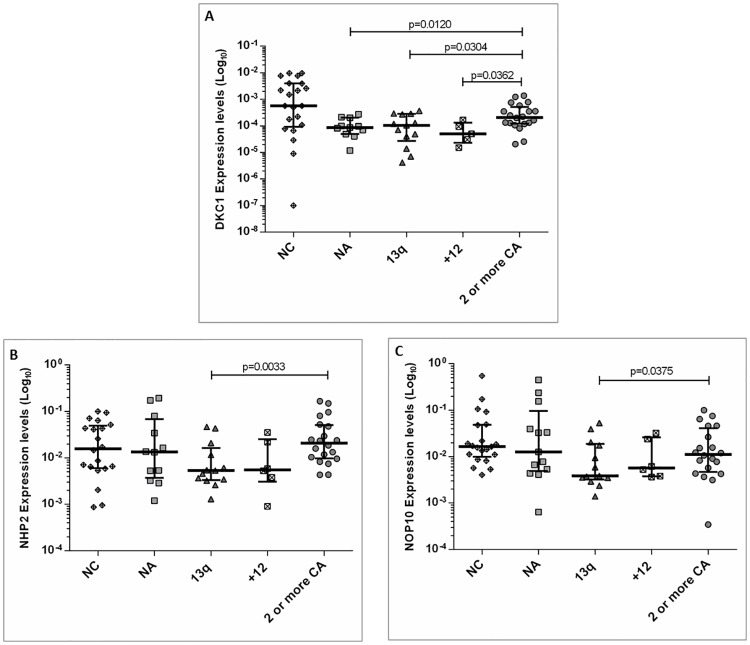
Telomeres are protective repeats of TTAGGG sequences located at the end of human chromosomes. They are essential to maintain chromosomal integrity and genome stability. Telomerase is a ribonucleoprotein complex containing an internal RNA template (hTR) and a catalytic subunit (hTERT). The human hTR gene consists of three major domains; among them the H/ACA domain is essential for telomere biogenesis. H/ACA ribonucleoprotein (RNP) complex is composed of four evolutionary conserved proteins, including dyskerin (encoded by DKC1 gene), NOP10, NHP2 and GAR1. In this study, we have evaluated the expression profile of the H/ACA RNP complex genes: DKC1, NOP10, NHP2 and GAR1, as well as hTERT and hTR mRNA levels, in patients with chronic lymphocytic leukemia (CLL). Results were correlated with the number and type of genetic alteration detected by conventional cytogenetics and FISH (fluorescence in situ hybridization), IGHV (immunoglobulin heavy chain variable region) mutational status, telomere length (TL) and clinico-pathological characteristics of patients. Our results showed significant decreased expression of GAR1, NOP10, DKC1 and hTR, as well as increased mRNA levels of hTERT in patients compared to controls (p≤0.04). A positive correlation between the expression of GAR1-NHP2, GAR1-NOP10, and NOP10-NHP2 (p<0.0001), were observed. The analysis taking into account prognostic factors showed a significant increased expression of hTERT gene in unmutated-IGHV cases compared to mutated-CLL patients (p = 0.0185). The comparisons among FISH groups exhibited increased expression of DKC1 in cases with two or more alterations with respect to no abnormalities, trisomy 12 and del13q14, and of NHP2 and NOP10 compared to those with del13q14 (p = 0.03). The analysis according to TL showed a significant increased expression of hTERT (p = 0.0074) and DKC1 (p = 0.0036) in patients with short telomeres compared to those with long TL. No association between gene expression and clinical parameters was found. Our results suggest a role for these telomere associated genes in genomic instability and telomere dysfunction in CLL.
端粒是位于人类染色体末端的TTAGGG序列的保护性重复序列。它们对于维持染色体完整性和基因组稳定性至关重要。端粒酶是一种核糖核蛋白复合体,包含一个内部RNA模板(hTR)和一个催化亚基(hTERT)。人类hTR基因由三个主要结构域组成;其中H/ACA结构域对于端粒生物合成至关重要。H/ACA核糖核蛋白(RNP)复合体由四种进化保守蛋白组成,包括戴氏蛋白(由DKC1基因编码)、NOP10、NHP2和GAR1。在本研究中,我们评估了慢性淋巴细胞白血病(CLL)患者中H/ACA RNP复合体基因(DKC1、NOP10、NHP2和GAR1)的表达谱,以及hTERT和hTR mRNA水平。结果与通过传统细胞遗传学和荧光原位杂交(FISH)检测到的基因改变的数量和类型、免疫球蛋白重链可变区(IGHV)突变状态、端粒长度(TL)以及患者的临床病理特征相关。我们的结果显示,与对照组相比,患者中GAR1、NOP10、DKC1和hTR的表达显著降低,而hTERT的mRNA水平升高(p≤0.04)。观察到GAR1与NHP2、GAR1与NOP10以及NOP10与NHP2的表达之间呈正相关(p<0.0001)。考虑预后因素的分析显示,与突变型CLL患者相比,未突变IGHV病例中hTERT基因的表达显著增加(p = 0.0185)。FISH组之间的比较显示,与无异常、三体12和del13q14相比,有两种或更多改变的病例中DKC1的表达增加,与del13q14相比,NHP2和NOP10的表达增加(p = 0.03)。根据TL进行的分析显示,与长TL患者相比,短端粒患者中hTERT(p = 0.0074)和DKC1(p = 0.0036)的表达显著增加。未发现基因表达与临床参数之间的关联。我们的结果表明这些端粒相关基因在CLL的基因组不稳定性和端粒功能障碍中发挥作用。